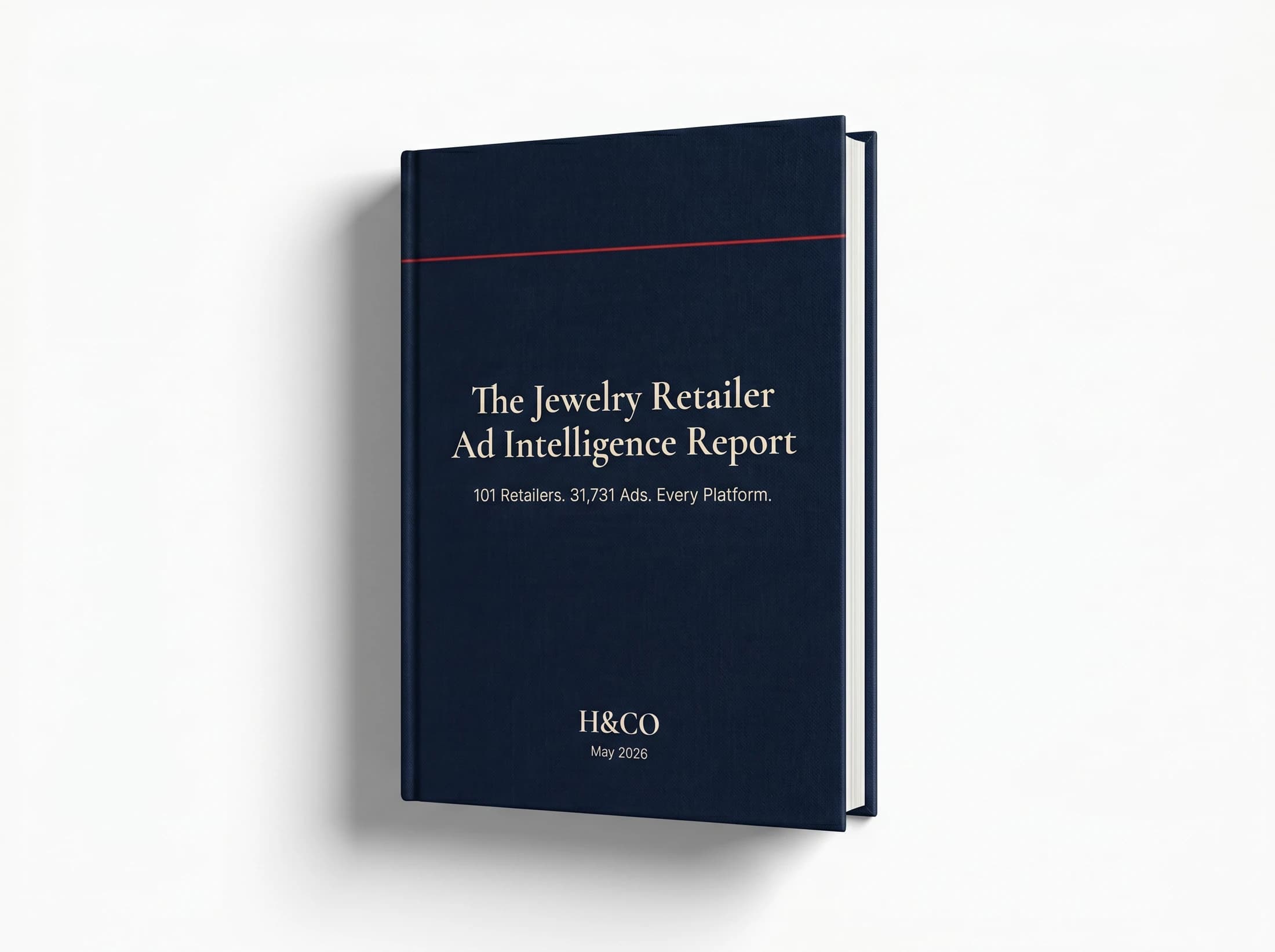

We recently analyzed 20,946 ads across 99 luxury watch and jewelry retailers. Half of them only advertise on one platform. And the retailers with the longest-running ads are doing something most of the industry ignores.
This piece is the strategy behind those numbers. Whether you're an authorized dealer trying to drive foot traffic, a jewelry brand building awareness, or a retailer with your own house line trying to compete with the Brilliant Earths of the world, the advertising playbook for luxury in 2026 looks different from what is actually running in most accounts.
Three Readers, One Problem
Before the strategy, a distinction. There are three types of businesses reading this, and the paid ads approach differs for each:
The retailer carries other brands. Rolex, Omega, David Yurman, Roberto Coin, whatever the mix is. Your job is to get people into the store to see the pieces in person. You're capturing demand that the brands themselves are creating through their own marketing. Your ads need to answer one question: why buy from you instead of the dealer down the road (or worse, the grey market)?
The brand is building its own name. You sell direct, through your website, or through retail partners. Your job is to create demand where none exists yet. Nobody is Googling your name. You have to interrupt them on Meta, YouTube, or Pinterest and make them care. Your ads need to tell a story that makes someone stop scrolling.
The hybrid is a retailer with a house brand. You carry Rolex and Breitling, and you also design your own jewelry line. You need to capture demand for the brands you carry while simultaneously creating demand for the brand you're building. That is two different strategies running in parallel, and they usually get treated as one.
The mistake we see across all three: treating every platform the same way, or worse, only showing up on one.
The Single-Platform Trap
In our analysis, 33% of luxury retailers advertise on Google only. The math makes sense on the surface. Someone searches "Rolex dealer near me" or "custom engagement ring Dallas," that's high intent. You bid on the keyword, they click, they call or visit. You can see it in the data. Cost per click, cost per lead, cost per call. Clean attribution.
Meta is harder to measure. Someone sees your ad while scrolling Instagram at 10pm. They don't click. Three weeks later they walk into your store. Meta influenced that visit, but nothing in your analytics connects the two events. So the retailer looks at the dashboard, sees Google producing measurable leads and Meta producing "engagement," and shifts the budget to Google.
This is rational behavior based on incomplete information. And it's why half the industry is invisible on the platform where luxury products look their best.
Why Meta matters for luxury retail
The luxury purchase journey is long. An engagement ring buyer typically shops for one to three months. A watch enthusiast may research for six months or longer. During that time, they're not searching Google every day. They're scrolling Instagram, watching YouTube, browsing Pinterest, reading forums.
Meta's role is to keep your store in front of them during that research window. Not to generate a click today, but to be the name they remember when they're ready to walk in. Brand recall. Top of mind. The thing that makes them drive to your store instead of the competitor who also carries Omega.
The creative barrier is real, but solvable
The other reason retailers avoid Meta: creative is harder. Google Search is text. Meta requires visuals, images, video, carousels, and for luxury, those visuals need to feel premium. A content production pipeline is the piece that is usually missing. So they either run static product images or they don't run Meta ads at all.
Advantage+ Catalog Ads (what Meta used to call Dynamic Product Ads) and Dynamic Creative Optimization accounted for 68% of the longest-running Meta ads in our dataset. Whether that reflects performance or neglect varies by retailer, but the format is low-effort to launch and worth testing. Catalog ads pull directly from your product feed, the images you already have, and show them to people who browsed your site. DCO is different: it takes your existing creative elements and tests combinations of headlines, images, and descriptions automatically. Both require minimal creative production.
Short-form video doesn't require a studio. A 15-second clip of a watch being unboxed, a ring being tried on, a finished custom piece being revealed, shot on an iPhone by the store owner, outperforms a polished brand video in most Meta placements.
The retailers avoiding Meta because "the creative is too hard" are solving the wrong problem. The creative can be simple. It just needs to exist.
What Your Ads Should Actually Say
58.8% of ads in our dataset are visual-only, with no extractable text copy. Another 38.7% are brand co-op ads with the brand's message, not the retailer's. That means fewer than 3% of luxury retailer ads communicate something specific about the store itself. This is the biggest missed opportunity in the space.
A brand co-op ad for Rolex in Dallas looks identical to a Rolex co-op ad in Chicago. If your only ads are co-op, you're driving traffic for Rolex, not for your store. The customer who clicks has no reason to choose you over the next authorized dealer.
For retailers: sell the experience, not the product
The brands market themselves. Rolex doesn't need your help telling people what a Submariner is. What Rolex can't do is tell someone why they should buy it from your store. That's your job. What your ads should communicate: why buying from an authorized dealer matters, what makes your store different, what the buying experience looks like, and social proof from your market.
For brands: tell a story worth stopping for
If you're building a brand, your ads need to create demand from scratch. Nobody is searching for you yet. Brilliant Earth built a business on one insight: engagement ring buyers want to feel good about their purchase. Their ads don't lead with the diamond. They lead with the story. The lesson: lead with why this piece exists, not what it's made of.
For hybrids: separate the strategies
If you carry Rolex and you also design your own engagement rings, don't run both under the same campaign structure. Brand-carry campaigns capture existing demand. House-brand campaigns create new demand. Running these as separate campaigns with separate budgets, separate creative, and separate KPIs prevents the common problem where all the budget flows to the brand-carry campaigns and the house brand gets starved.
Co-Op Dollars: The Money Most Dealers Leave Unused
Authorized dealers have access to advertising budgets that independent retailers don't. Brands like Rolex, Breitling, and Richemont (Cartier, IWC, Jaeger-LeCoultre) fund ads that drive traffic to their dealers' websites. In our data, Rolex alone accounted for over 7,700 co-op ads across its various entities.
Yet 9.9% of authorized dealers in our dataset run no detectable advertising under their own accounts on either platform. Some may have brand-funded co-op ads running under the brand's account, but the dealer itself is not actively advertising, even with co-op programs available to them.
Here's the part of co-op that gets missed: brands typically want demand creation, not demand capture. They don't want you running Search ads to capture people already looking for a Rolex. The brand already owns that search traffic through its own website. What brands want is for you to introduce new audiences to the brand, which is exactly what Meta and display ads do. If you've been avoiding Meta because "the ROI is hard to measure," consider that your brand partners may actually be willing to pay for that exact type of advertising. Talk to your brand reps about digital co-op. Many dealers don't realize what's available until they ask.
The DTC Threat and What It Teaches You
Brilliant Earth did nearly $450M in revenue in 2023. They didn't do it by running Google Search ads for "engagement ring." They did it by building a brand story, ethically sourced, transparency-first, direct-to-consumer, and telling that story consistently across every channel. They run Meta ads that look like editorial content. They run YouTube ads that tell customer stories. Every contact reinforces the same narrative.
An independent luxury retailer usually has a better product, a better in-store experience, and deeper expertise than any DTC brand. What they don't have is a cohesive story told consistently across channels.
The lesson isn't to copy the DTC playbook. It's to recognize that the retailers losing ground are the ones who never developed their own narrative. "We carry these brands and we're located here" is not a story. "We're a third-generation family of gemologists who hand-select every stone in our cases" is.
Your advertising can only be as good as the story behind it. If you don't have something to say, DPA and co-op ads will keep the lights on. But they won't build a brand that survives when a DTC competitor enters your market with a better narrative and a bigger ad budget.
Where to Start
If you're currently Google-only, here's the 90-day plan:
Month 1: Audit your Google campaigns. Fix negative keywords, fix landing page alignment, restructure campaigns by intent (brand defense, product category, service). This alone will improve your Google performance before you spend a dollar more.
Month 2: Launch Meta with Advantage+ Catalog Ads. Connect your product catalog. Set up retargeting for website visitors. Start building a custom audience from your email/CRM list. Total creative needed: zero. The platform builds ads from your existing product images.
Month 3: Add one piece of original creative per week to Meta. A short video, a carousel, a customer story. Test what your audience responds to. By the end of the month, you'll have data on what works and what doesn't for your specific market.
If you're not advertising at all, and 15.2% of the industry isn't, start with Google Search. Product category campaigns in your city. One month of data will tell you which keywords drive calls and visits. Then follow the plan above.
If you're a brand or a hybrid with a house line, start with Meta. Search volume for your brand doesn't exist yet. You need to create the demand first, then capture it with Google once people start searching.
The Opportunity Nobody Sees
Only 0.3% of ads in our dataset promote events or service appointments. Only 0.1% promote certified pre-owned. The default is a generic CTA like "Shop now" rather than service-driven calls to action like "Book an appointment" or "Schedule a consultation."
These aren't small gaps. These are entire categories of advertising that the industry has left on the table. The retailer who runs trunk show ads with a "Book now" CTA, service reminder ads with a "Schedule your appointment" CTA, and certified pre-owned campaigns targeting watch enthusiasts is operating in a lane with almost zero competition.
The data is clear: luxury retailers are competing in the same narrow band, brand co-op display ads and visual-only product images on Google. Step outside that band and you're the only one there.
This analysis draws from H&CO's March 2026 Ad Strategy Intelligence Report, which reviews advertising activity across 99 luxury watch and jewelry retailers on Google Ads and Meta.
Want to see how your advertising compares? Book a strategy call and we'll walk through where you stand relative to the rest of the industry.

About the author
Hagop Imasdounian
Hagop Imasdounian is the founder of H&CO. Raised around his family’s jewelry businesses, he brings more than 15 years of digital marketing experience to helping jewelry and watch brands improve their websites, reach buyers and connect marketing with sales.