

There's a word the luxury industry has used for decades that gets said far more often than it gets run: clienteling.
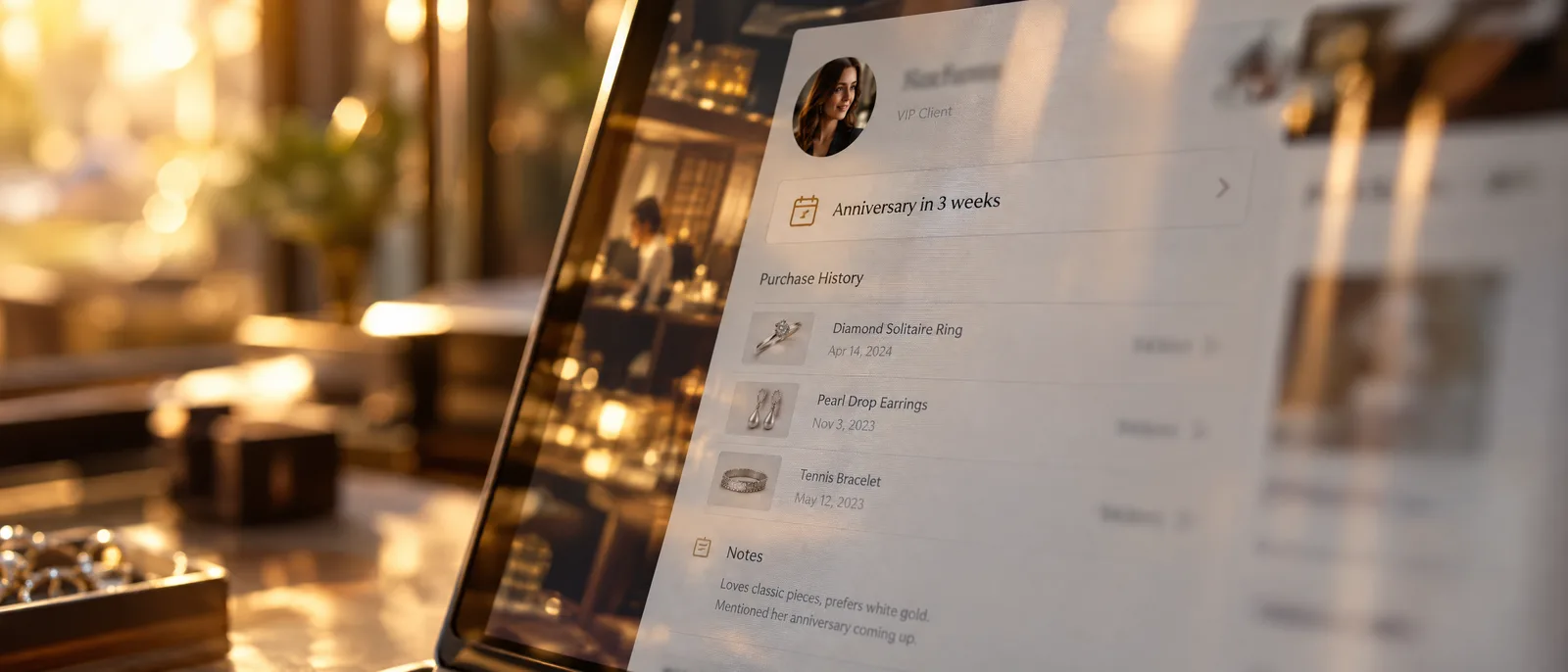
It is what your best salesperson already does naturally. Remembering that Mrs. Torres prefers pear-shaped stones. That Mr. Kim's anniversary is in March. That the couple who bought the engagement ring will need wedding bands in six months.
The difference between a store that systemizes this and a store that doesn't is staggering. Clienteled customers are worth 4-5x more over their lifetime (BSPK/Proximity Insight, 2025). But if you are running this on memory, Post-it notes, or a leather-bound book that walks out the door when a salesperson quits.
This guide is the playbook for building a clienteling system from scratch, without expensive enterprise software, that turns one-time buyers into lifetime clients. We'll cover the economics, the process, the tech stack at every budget level, and the part nobody else talks about: connecting your clienteling data to your marketing spend so you actually know which ads produce clients who stick.
Here's the number that should keep you up at night. Only 9.9% of first-time luxury jewelry customers make a second purchase within a year (Chakril, 2025). That means 90% of your acquisition spend is buying single transactions. Clienteling changes the math entirely.
Part of H&CO's 2026 luxury retail marketing series.
The Math That Makes Clienteling Non-Negotiable
Every clienteling article on page one of Google right now leads with a definition. "Clienteling is the practice of..." You don't need that. You know what good service looks like. What you might not know is what it's worth in dollars.
What a Single Customer Is Actually Worth
The average in-store fine jewelry transaction runs about $1,500 (industry data, 2025). If that customer never comes back, and 75% don't (Chakril, 2025), their lifetime value is exactly $1,500. One transaction. Done.
Now run a different scenario. That same customer becomes a repeat buyer. Two purchases a year over a five-year relationship. Their lifetime value jumps to $15,000. If they refer even one other buyer, you're past $15,000 and climbing.
The real example is the engagement ring buyer. They come back for wedding bands. Then anniversary gifts. Then birthday gifts for their spouse. Then milestone jewelry for their kids. Over 20 years, that single customer can be worth $30,000 or more (Jewel360/JCK, ongoing).
The average CLV for luxury jewelry sits around $2,430 (Upcounting, 2025). That's the blended number, clienteled and non-clienteled combined. Move a customer from that baseline to a clienteled repeat buyer at 4-5x (per BSPK data), and you're looking at $9,700 to $12,150 in lifetime value. Per customer. From a system that costs you nothing to start.
Repeat customers spend 33% more per transaction and are 70% more likely to purchase than first-timers. Customers engaged through personalized approaches spend 2x as much as non-engaged shoppers (Tulip, 2025). The numbers all point the same direction.
The Acquisition Cost Problem
Here's where the math gets uncomfortable.
Jewelry e-commerce customer acquisition cost averages about $1,143 (Mobiloud, 2025). Luxury goods LTV:CAC ratios routinely exceed 5:1. That ratio looks great on paper.
But it only works if customers come back.
At a 9.9% second-purchase rate, you are paying $1,143 to acquire $1,500 in revenue. Once. That's a 1.3x return. After cost of goods, you're barely breaking even on the first sale (Stylograph, 2026).
Clienteling is how you turn that $1,143 investment into $12,000+ in revenue over the life of the relationship. A 5% increase in customer retention produces a 25-95% increase in profits (Bain/HBR). Not because individual transactions get bigger, though they do, but because the acquisition cost gets amortized across years of repeat purchases.
You're already spending the money to get them in the door. Clienteling is how you stop wasting it.
Why the Paper Book Is Still in Use (And Why That's a Problem)
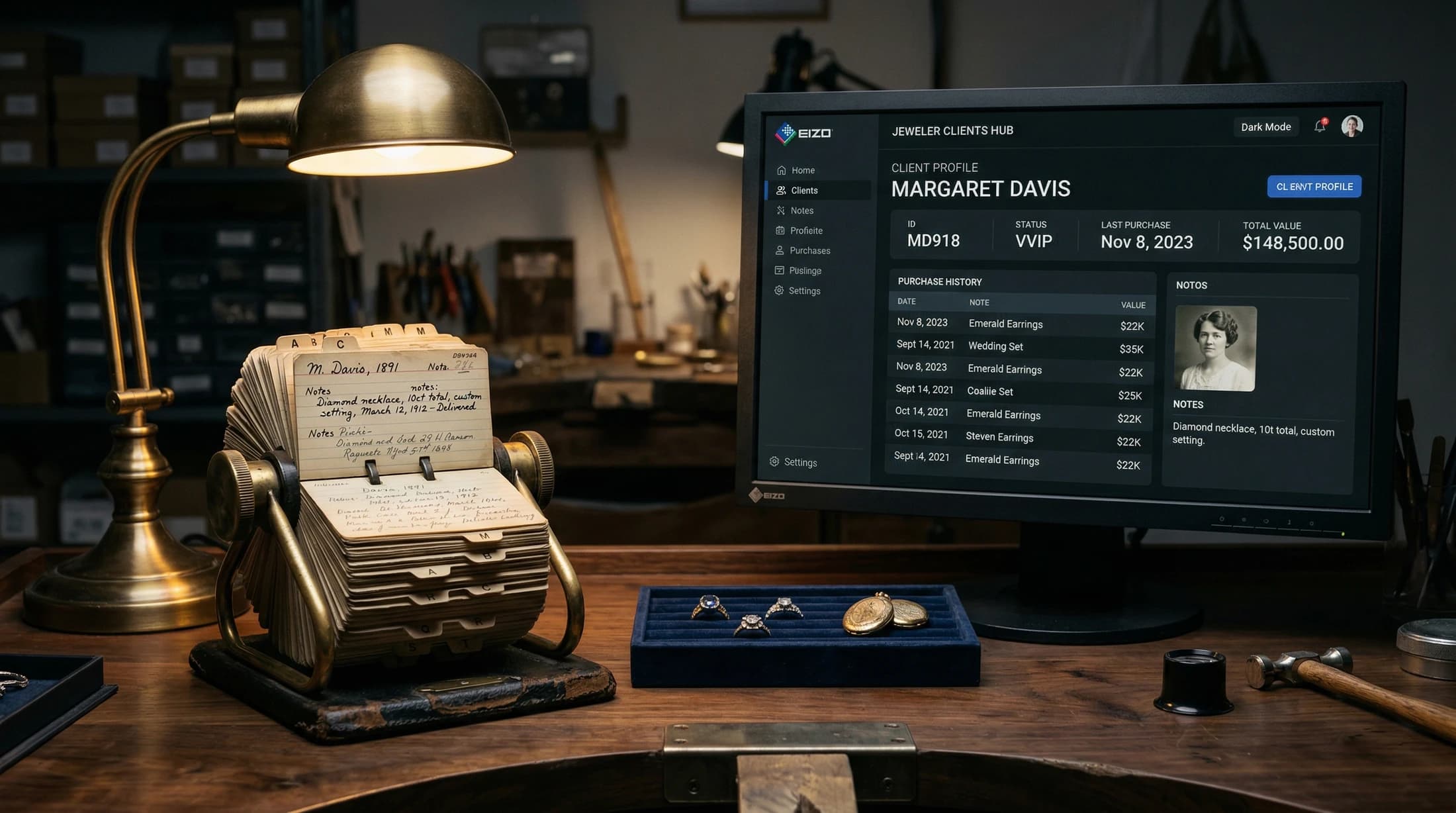
Walk into enough independent jewelry stores and you'll see it: a leather-bound notebook behind the counter, filled with client names, purchase dates, ring sizes, and personal notes. Sometimes it's a Rolodex. Sometimes it's a collection of sticky notes on a monitor. The system is older than the store.
And it works. Sort of.
What the Paper Book Gets Right
Give it credit where it's earned. The paper book is personal. The associate owns the relationship and knows the client. There's no software learning curve, no monthly subscription, no IT department needed. It works in the moment, a quick flip to remember that Mrs. Chen wears a size 6 and her husband likes to surprise her in December.
For a single associate managing 50 to 80 close relationships, the notebook does its job.
What the Paper Book Costs You
The problems start when you look past the individual relationship and think about the business.
The book isn't portable. When your best salesperson leaves, the book leaves too. Or it stays, but it's written in shorthand only they understand. Either way, you just lost years of client intelligence in a single resignation.
It doesn't scale. One associate can manage maybe 100 to 200 clients in a notebook before follow-ups start slipping. A system can manage thousands with better consistency than any human memory.
It doesn't connect to anything. You can't segment clients by spend tier. You can't automate anniversary reminders. You can't measure which clients came from Google Ads versus a referral versus a walk-in. Without that connection, your marketing is flying blind.
It creates single points of failure. If your top salesperson is sick, on vacation, or quits, those client relationships go dark. No one else on the floor knows that Mr. Hoffman's 25th anniversary is next week.
Here's something worth noting: the number-one challenge with clienteling solutions is sales team adoption (BSPK, 2025). The reason isn't resistance to the concept. It's bad software. The fix isn't forcing your team off the notebook. It's giving them something that's almost as easy to use and ten times more useful.
The Clienteling System, From Zero to Operational
This is where most guides fall apart. They tell you to "invest in a clienteling platform" and leave it there. That's useless if you're a three-person jewelry store wondering whether to spend $500 a month on software you've never tested.
Here's the system at three tiers. Pick the one that matches where you are right now.
Tier 1: The $0 System (Google Sheets + Your Phone)
What you need: Google Sheets, a phone with texting capability, 15 minutes per day.
The spreadsheet columns:
[TABLE: Field | What to Track]
The process: After every sale, the associate adds the client to the sheet. Every morning, the associate checks the "next milestone" column and sends one personal text or makes one call to whoever's date is approaching.
Who this is for: Solo operators, one- to two-person sales floors, anyone starting from zero.
Why it works: Consistency beats sophistication. Every time. The jeweler who sends five personal texts a day will outsell the one with a $30,000 CRM they never open. When you reach back out to existing clients, you're 70-90% more likely to close them, and they spend 33% more per transaction (Clientbook, 2024).
Five texts a day, five days a week, is 1,300 personalized touchpoints a year. That is more outreach than an independent store usually does in a decade. And each one costs you nothing but time and attention.
Tier 2: The $50-200/mo System (CRM + Email/SMS Platform)
What you need: A retail CRM (Clientbook, Jewel360, or similar) plus Klaviyo or a comparable email/SMS platform for automated flows.
What it adds over Tier 1:
- Purchase history synced directly from your POS, no manual entry
- Automated anniversary and birthday triggers that fire without anyone remembering
- Segmentation by spend tier, so your $10,000 client gets different treatment than your $500 client
- Centralized client data that stays with the store, not the associate
The connection that matters: This tier links your clienteling to your email marketing flows. Clienteling data feeds segmentation. Segmentation feeds automation. Automation means the right message reaches the right client at the right time, even when your team is busy on the floor.
Businesses that excel at personalization generate 40% more revenue than slower competitors (McKinsey, 2023). At this tier, personalization stops being a manual effort and becomes a system.
Who this is for: Two- to five-person sales teams, retailers doing $500K to $2M annual revenue.
Tier 3: The Full Stack ($200-500/mo)
What you need: CRM + email/SMS + attribution tracking + analytics.
What it adds over Tier 2:
- Revenue attribution: which marketing channel produced this client?
- CLV tracking by acquisition source, so you know whether Google Ads clients or Instagram clients are worth more over five years
- Automated segmentation that adjusts as clients move between tiers
- Reporting that connects marketing spend to lifetime revenue, not just first-purchase revenue
The connection that matters: This tier links clienteling to revenue attribution. Now you don't just know that Mrs. Torres is a $15,000 lifetime client. You know she found you through a Google Ad for "custom engagement rings near me," and you can calculate the actual ROI of that campaign over its full timeline.
Who this is for: Retailers doing $2M+ annual revenue, multi-location operators, anyone who wants to stop guessing which marketing works.
[TABLE: Feature | Tier 1 ($0) | Tier 2 ($50-200/mo) | Tier 3 ($200-500/mo)]
The Five Touchpoints That Turn Buyers Into Lifetime Clients
Having the system is one half. Knowing what to say, and when, is the other. These are the five touchpoints that produce the highest return on effort, ranked by impact.
1. The 48-Hour Follow-Up
Text or call within 48 hours of purchase. Not a survey. Not a review request. A genuine check-in.
*"Hi Sarah, it's James from [Store]. Just wanted to make sure you're loving the new pendant. If you have any questions about care or need anything adjusted, I'm here."*
This single follow-up separates you from 95% of retailers who let the client walk out the door and never reach out again. SMS clienteling converts roughly 10x better than email for personalized outreach (Endear, 2025). Your best clients don't want a newsletter. They want a text from the person who helped them.
2. The Milestone Message
Anniversary of purchase. Birthday. Wedding anniversary. Graduation. Retirement.
This is where the CRM earns its money. No human can remember 500 client anniversaries. A system can, and it can remind the right associate to send the right message at the right time.
*"Hi David, your anniversary is coming up on the 15th. Last year you went with the sapphire earrings and she loved them. Want me to pull a few options before you come in?"*
That message takes 30 seconds to send. It can produce a $2,000 sale. The math is absurd.
3. The New Arrival Alert
This one has to be personalized, not a mass blast. The difference between a generic "New collection just dropped!" email and a targeted text is the difference between being ignored and making a sale.
*"We just got a Colombian emerald ring that reminded me of the pendant you picked out in September. Thought you'd want to see it before it hits the floor."*
76% of consumers say tailored messages prompted them to consider purchasing (McKinsey, 2023). The word "tailored" is doing the work there. Generic doesn't move anyone.
4. The Service Reminder
Cleaning, resizing, inspection, battery replacement for watches. These are practical, non-salesy reasons to get a client back in the store.
And once they're in the store for a service appointment, they see new inventory. They chat with their associate. They remember why they liked shopping with you. 64% of shoppers are more likely to visit a physical store if the associates are knowledgeable about their needs (PwC, 2024). 75% spend more after receiving high-quality in-store service.
The service reminder is the trojan horse of clienteling. It looks like customer care and it drives sales. And the client never feels sold to, because you genuinely are providing a service. The sale happens naturally because they're back in your space, interacting with your team, and reminded of why they bought from you in the first place.
5. The Life Event Trigger
Engagement ring buyer? Wedding bands are next. Baby announcement on social media? Push gift. Kids turning 16, 18, 21? Milestone jewelry.
This is the $30,000 relationship in action. One sale doesn't have to be one sale. It becomes ten purchases over a lifetime, each one flowing naturally from the last, each one requiring almost zero acquisition cost because the relationship already exists.
80% of businesses report increased consumer spending when experiences are personalized (Epsilon/Tulip, 2024). Life event triggers are personalization at its most powerful, because you're reaching the client at the exact moment the need exists.
> Your CRM is sitting on revenue you can't see. You have hundreds of past clients in a system somewhere, POS, email list, even a paper book, but no process to reactivate them. We wrote the playbook. Read The Jeweler's CRM Playbook: Turn Your Client List Into Revenue for the step-by-step system to turn dormant contacts into repeat buyers.
Clienteling Without Attribution Is Flying Blind
Here's the gap that none of the clienteling software vendors will talk about, because it's outside their product.
The Problem With Measuring Clienteling in a Vacuum
Most clienteling guides tell you to measure response rate, conversion rate, and CLV. Those numbers matter. But they miss the upstream question entirely: what brought this client to you in the first place?
If your best lifetime clients, the ones generating $10,000+ in repeat revenue, all came from local Google Ads, you should be spending more there. If they came from referrals, you should be building a referral program. If they came from Instagram, your social spend is justified.
Without attribution, you can't make that call. You're optimizing the relationship downstream without optimizing the pipeline that feeds it upstream. You're doing half the work and wondering why you can't scale.
This is the blind spot that costs independent retailers the most money, because they're often making budget decisions based on first-purchase data alone. A campaign that looks like it barely broke even on the first sale might be your best-performing channel when you look at three-year CLV.
89% of business leaders now recognize personalization as critical to their success over the next three years (Salesforce, 2024). But personalization without measurement is just guessing with better intentions. You need to know what's working and why, not just that clients seem happy.
Read more about this in The 14-Day Blind Spot, which covers why most attribution models miss luxury purchases entirely.
What a Connected System Looks Like
The loop works like this:
- Ad spend brings a customer through the door (or onto the site).
- Your CRM captures the purchase, the client details, and the acquisition source.
- Clienteling keeps that customer buying over months and years.
- Attribution connects the lifetime value back to the original ad, campaign, or channel.
Without this loop, your Google Ads report says you spent $1,143 to get a $1,500 sale. That's a 1.3x return. Mediocre. Possibly not worth continuing.
With the loop, the same report says you spent $1,143 to get a $12,000 lifetime client. That's a 10.5x return. Now it's your most profitable channel, and you'd never have known without connecting the pieces.
That reframe changes every budget decision you make. It changes which campaigns you scale, which you cut, and how you allocate between channels. If you are making these decisions on 30-day ROAS, you are optimizing for the wrong window. They're optimizing for transactions when they should be optimizing for relationships. Clienteling data, connected to attribution, is what makes that shift possible.
69% of retailers report annual revenue increases after adopting AI tools (NVIDIA, 2025). The retailers who connect clienteling to attribution aren't just serving clients better. They're making smarter bets with their marketing dollars.
Read the full framework in Revenue Attribution for Jewelry & Watch Retailers.
Clienteling as a Competitive Moat
Zoom out from the tactics for a moment. There's a strategic reason clienteling matters more for independent retailers than for anyone else.
The Threat Independent Retailers Actually Face
Blue Nile, James Allen, Brilliant Earth, and every DTC jewelry brand can compete on price. They can compete on selection, running tens of thousands of SKUs that no independent can match. They can compete on convenience, with next-day shipping and easy returns.
You cannot win those fights. Trying to is a losing strategy. And yet the energy goes there anyway, matching prices, expanding inventory, building e-commerce sites that will never out-convert a platform with a $200 million marketing budget.
What they cannot replicate is the relationship. A real human who remembers your name, knows your taste, texts you when the right piece comes in, and greets you by name when you walk through the door. That is the independent retailer's structural advantage.
But that advantage only works if it's systematic. One great salesperson isn't a strategy. It's a liability, because the day they leave, the advantage walks out with them.
Turning the Relationship Into a System
Clienteling takes what your best associate does naturally and makes it a property of the business, not the individual.
It makes the relationship transferable. Client data stays with the store, not the person. When an associate leaves, the next person can pick up where they left off.
It makes the relationship scalable. From 100 clients in a notebook to 2,000 in a CRM, with better follow-up consistency than any single human can maintain.
It makes the relationship measurable. CLV by client, repeat rate by associate, referral rate by segment. You can see what's working and fix what isn't. You can identify which associates are best at retaining clients and replicate what they do across your team.
Omnichannel shoppers, those engaged across clienteling, email, in-store, and digital channels, spend significantly more and buy 2.5x more often than single-channel shoppers (Harvard Business Review). The independent retailer who builds a clienteling system isn't just improving customer service. They're building a moat that online-only competitors physically cannot cross.
Keep the content engine running alongside your clienteling program with a Content Calendar for Jewelry and Watch Stores.
How to Start This Week
No more theory. Here's the seven-day launch plan. Every step is something you can do between customers on a normal sales day.
Day 1-2: Audit What You Have
Pull every client name from your POS system. Export it to a spreadsheet. If you have a paper book, start typing the names into a Google Sheet. You don't need to transfer everything on day one, just names, phone numbers, and last purchase dates.
Sort by total spend. Your top 20% of clients generated roughly 80% of your revenue. Those are your first clienteling targets. For an independent that is somewhere between 40 and 200 names. Manageable.
Day 3-4: Build the System
Choose your tier from the breakdown above. Tier 1 costs nothing and takes an hour to set up. Start there if you need to.
Set up the spreadsheet or CRM with the fields that matter: name, phone, last purchase, next milestone, preferred contact method, notes. Assign every top client to a specific associate. Ownership matters, because if everyone is responsible for a client, nobody is.
Day 5-7: Make the First Outreach
Each associate texts or calls five clients per day. Personal, not scripted. Something like:
*"Hey Michael, it's been a while since you picked up those cufflinks. How are they holding up? We just got some new pieces in that match that same style. Thought you'd want a look before they're in the case."*
Track response rates and any purchases that follow. You'll see results within the first week, because these are warm contacts who already know and trust you.
Then repeat. Every day. That's the system. Five texts a day, five days a week, 50 weeks a year. 1,250 personal touchpoints annually, each one costing you nothing but two minutes and a genuine interest in the client.
Within 30 days, you'll have data. You'll know which clients responded, which ones came back in, which ones bought. That data tells you whether to stay at Tier 1 or graduate to Tier 2. It also gives you something the paper book never could: a measurable, repeatable acquisition-to-retention pipeline that you can optimize month over month.
Clienteling isn't a technology purchase. It's a discipline. The technology helps, and at a certain scale it becomes necessary, but the discipline is what produces the 4-5x lifetime value. A $0 spreadsheet run with discipline will outperform a $500/month platform that nobody touches (Proximity Insight, 2025).
Most of the articles ranking for "clienteling" right now want to sell you a platform. Some of those platforms are genuinely good. But none of them matter if your team doesn't send the text. The tool is irrelevant without the habit.
Start with the spreadsheet. Graduate to the CRM when you've proven the process works. Connect it to attribution when you're ready to know which marketing actually feeds the pipeline.
The store that knows its clients and follows up systematically will outlast the one that doesn't. Every time. And every week you wait to start is another week of clients walking out the door and never hearing from you again.
Ready to connect your clienteling data to your marketing spend? H&CO builds the full attribution loop for independent jewelry and watch retailers: from the ad that brought them in, to the CRM that keeps them buying, to the dashboard that shows you what's actually working. Talk to us about your store.

About the author
Hagop Imasdounian
Hagop Imasdounian is the founder of H&CO. Raised around his family’s jewelry businesses, he brings more than 15 years of digital marketing experience to helping jewelry and watch brands improve their websites, reach buyers and connect marketing with sales.