
We tracked the fastest growing jewelry brands across 190+ names using Google search data, then sorted them into three price tiers so you can see what's actually happening at every level of the market.
Search volume is one of the cleanest signals of brand momentum. When someone types a brand name into Google, they already want something. They want to buy, compare, or learn more. That's demand. Not sentiment.
Some of the results confirmed what everyone already suspects. Others didn't.
The Full Picture: 190 Brands, One Year of Data
Across all 190+ brands we tracked, total monthly search volume was roughly 5.5 million searches in the United States. A few patterns jumped out:
- Holiday concentration is extreme. Most brands saw November-December spikes of 50-150% above their baseline, then sharp drops in January-February.
- Most brands are flat or declining. Only about 30% posted positive year-over-year growth.
- Growth doesn't care about price point. Some of the fastest growers are $40 fashion pieces. Others are six-figure high jewelry.
- Branded is eating unbranded. Branded fine jewelry is growing at an 8-12% compound annual rate, roughly three times faster than the overall jewelry market (McKinsey/BoF State of Fashion). About 75% of global jewelry sales are still unbranded, but that share shrinks every year. The brands in this analysis that are growing are growing because consumers search for them by name. That's branded demand, and it's the structural shift underneath everything else in this article.
Cohort 1: High End ($1,000+)
Fine jewelry, heritage houses, established designers. The brands that anchor the luxury case.
[TABLE: High End brands — see draft markdown for full data]
What's happening at the top
The two biggest names, Cartier (823,000/mo) and Tiffany & Co (673,000/mo), are both flat year over year. At their scale, flat is fine. But flat while smaller competitors grow means attention is redistributing.
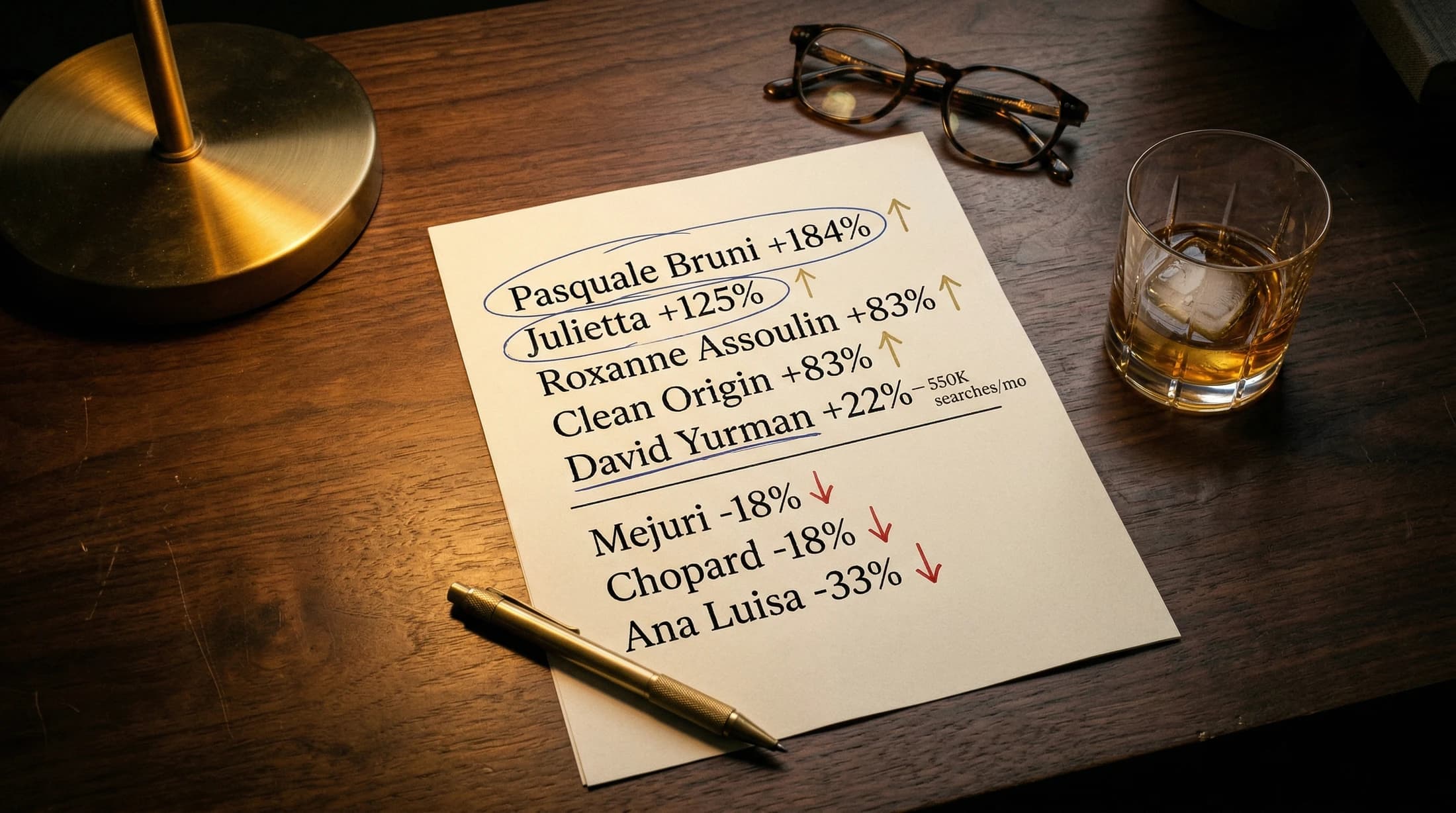
David Yurman (+22%, 550,000/mo) is the most impressive number in the entire dataset. That's roughly 100,000 more people searching for the brand each month compared to last year. Think about that for a second.
Here's what their team actually did. CMO Carolyn Dawkins built a tiered creator strategy: Michael B. Jordan and Eiza Gonzalez at the luxury-campaign tier for Chevron and Sculpted Cable, NBA players like Kyle Kuzma and D'Angelo Russell at the sports-culture level with a three-part docuseries, and platform-native creators producing content for TikTok and Instagram independently. They invested heavily in personalized e-commerce, using behavioral and transactional data to customize everything from email sequences to homepage layouts. That isn't luck. It's infrastructure.
Heritage is splitting
Graff, Buccellati, Messika, and Pomellato are all up 22-23%. Chopard, Piaget, Van Cleef & Arpels, and Chaumet are all down 18%. Faberge is down 33%.
The difference isn't product quality. It's how these brands show up in culture and in digital.
Buccellati's growth goes beyond distribution. The brand's rigato engraving, a technique using a grooved burin to carve parallel lines that produce a textile-like sheen on gold, is genuinely impossible to replicate at scale. Same with their tulle openwork, where artisans hand-pierce each polygonal hole to create a lace effect in solid metal, a process that takes nearly a month per piece. Renaissance-era goldsmith techniques. Richemont's investment since the 2019 acquisition gave Buccellati the retail footprint to put that craftsmanship in front of more people. The search growth follows.
Messika's numbers make more sense when you look at what happened in 2025. High jewelry now accounts for 15% of revenue, up from 5-6% just four years ago. Beyonce wore the So Move three-row necklace and Move Link 20th-anniversary earrings while attending Kelly Rowland's appearance on Brandy & Monica's tour in November 2025. A Madison Avenue flagship opened to anchor the U.S. market. And the Move collection, diamonds set in a track so they slide freely, gave Messika something no other house had: a mechanical signature you can feel on your wrist.
Pasquale Bruni jumped 184% year over year. Highest growth rate in our dataset. The cause is obvious: Casa Pasquale Bruni opened on Madison Avenue in mid-March 2026, a 6,800-square-foot, five-floor townhouse and the brand's first North American flagship. The Italian fine jeweler reported 24% revenue growth in 2025 and is projecting another 19% for 2026. Corporate boutiques are planned for Miami and Los Angeles, with partner locations in Aspen, Las Vegas, and Palm Beach. The search trajectory tracks almost perfectly with their retail expansion timeline.
The designer growth cluster
Below the heritage tier, a group of designers with unmistakable aesthetics are all posting 20%+ growth:
- Foundrae's symbolic medallions in 18K gold (+22%)
- Sophie Buhai's sculptural silver (+22%)
- Jacquie Aiche's body chains and gemstone layering (+24%)
- Brent Neale's playful, colorful fine jewelry (+23%)
- AGMES' architectural, handmade-in-NYC pieces (+23%)
- Martin Katz's high jewelry (+50%, with accelerating momentum)
The common thread: you could identify any of these brands from across a room. They've built a visual language that's distinctly theirs, and consumers search for them by name because nothing else substitutes.
Cohort 2: Mid-Range ($100-$1,000)
DTC brands, contemporary designers, and the names that defined the last decade of jewelry e-commerce. This is where the biggest structural shifts are happening.
[TABLE: Mid-Range brands — see draft markdown for full data]
The first-wave correction
The first generation of DTC jewelry brands is cooling. Mejuri (-18%), Missoma (-18%), Maison Miru (-33%), and Stone and Strand (-33%) are all losing search interest. These are still massive brands by volume, Mejuri alone pulls 450,000 monthly searches, but the growth engine has stalled.
Mejuri is adapting. The brand is actively pursuing wholesale concessions and shop-in-shops, including a 300-square-foot presence at Nordstrom's 57th Street flagship. That tells you something: even the biggest DTC jewelry brand decided it can't grow on its own website alone.
Second-wave brands are surging
The brands gaining ground here have one thing in common. Sharper positioning.
Dorsey (+50%, 22,200/mo) makes lab-grown gemstone jewelry, sapphires, emeralds, and diamonds, starting around $200. The pitch is different from lab-grown diamond brands: colored gemstones compete on access ("stones you couldn't afford in natural, now you can") rather than price against natural. Searches jumped from 18,100 to 33,100 during the holidays, then held at 22,200-27,100 into 2026. That's a brand converting holiday curiosity into sustained demand. Celebrity placements from Hailey Bieber and Taylor Swift didn't hurt.
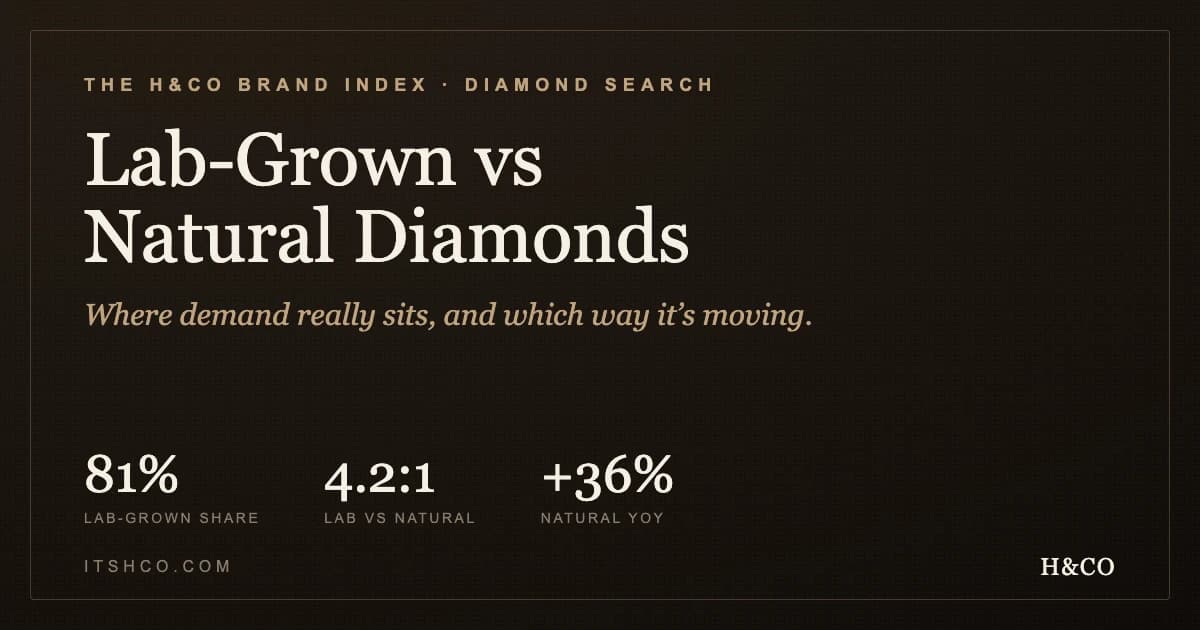
Clean Origin (+83%, 5,400/mo) is a lab-grown diamond retailer that saw steady growth all year, peaking at 8,100 in December. Lab-grown diamonds now account for 61% of engagement ring center stones in the U.S. (The Knot Real Weddings Study), and two-thirds of Gen Z buyers choose lab-grown. Clean Origin is riding that wave while the larger lab-grown names (Brilliant Earth, VRAI) are flat.
Roxanne Assoulin (+83%, 12,100/mo) built an entire aesthetic around colorful enamel and beaded stackable bracelets. The rainbow layering look became a social media uniform for a specific subset of fashion-forward consumers, the kind who buy five at a time. Searches went from 8,100 to a peak of 18,100 around the holidays, settling at 14,800 into early 2026.
Trouver (+50%, 5,400/mo) and Mondo Mondo (+26%) are both growing with distinct design identities. Alighieri (+26%), the London-based brand where every piece draws from Dante's Divine Comedy, and Laura Lombardi (+21%), known for chunky recycled-brass chains, round out a cohort of designers whose growth comes from having a visual language you can't confuse with anyone else.
Cohort 3: Accessible (Under $150)
Higher volume, lower price points, driven by trend cycles and gifting seasons. These brands live or die by cultural relevance.
[TABLE: Accessible brands — see draft markdown for full data]
Seasonality distorts everything here
This cohort has the most extreme holiday swings. BaubleBar jumped to 450,000 searches in December, then dropped to 165,000 by February. Kendra Scott hit 2.24 million in November before falling back to 823,000. If you only look at the 3-month trend, everything looks like it's collapsing. The YoY number tells the real story.
The growth stories are about standing out
BaubleBar (+22%, 201,000/mo) keeps growing at scale by staying relentlessly on-trend. At 201,000 monthly searches, it's the clear volume leader among accessible brands that are actually gaining ground.
Atolea Jewelry (+49%, 40,500/mo) is the biggest mover in this cohort. The ocean-inspired brand uses PVD-coated stainless steel to make waterproof pieces that sit between fast fashion and fine jewelry, averaging around $45 per piece. Their sustainability angle (ocean preservation partnerships) gives them a narrative that works on social, and the search data shows it's converting. Volume climbed from 27,100 to 40,500 over the year.
Hey Harper (+23%, 27,100/mo) carved a niche with affordable, waterproof, tarnish-free jewelry starting under $50, using PVD coating and a lifetime color guarantee. The brand made "jewelry you can wear in the shower" into a search-worthy proposition. Searches peaked at 49,500 in November (gifting season), and while they pulled back, the floor is higher than a year ago. That's the pattern of a brand building a loyal repeat base, not riding one viral moment.
Julietta (+125%, 3,600/mo) posted the highest growth rate in the accessible cohort and one of the fastest among all 190+ brands. The Brooklyn-based brand, founded by Brazilian-born designer Juliana Liden, went maximalist with chunky earrings, seashells, and mixed-media statement pieces when most of the market was still doing delicate gold. What's notable is the consistency: searches held flat at 3,600 through the year without a single dip. The growth isn't seasonal. It's organic discovery.
Electric Picks (+22%, 18,100/mo) is growing steadily with dainty, layering-focused jewelry and a California aesthetic that photographs well on social. Their holiday spike was significant, 33,100 in December, but the brand held at 18,100 through Q1. That suggests the audience isn't buying gifts. They're buying for themselves.
The brands losing ground share a pattern
Adina Eden (-33%), Shashi (-17%), and several flat brands in this cohort have something in common: their product could come from anyone. When your jewelry doesn't have a recognizable identity, there's nothing specific for a consumer to search. The brands growing in this tier all have something you could describe in one sentence. The ones declining don't.
Which Jewelry Brands Are Growing Fastest, and Why
1. Bold jewelry is eating minimalism's lunch
Julietta (+125%), Roxanne Assoulin (+83%), Mondo Mondo (+26%). The fastest growing jewelry brands in the fashion and mid-range tiers are the loud ones. The delicate-chain, barely-there aesthetic that dominated the last five years? Losing search interest. Mejuri (-18%), Missoma (-18%), and Ana Luisa (-33%) all built their brands on understated simplicity. Consumers are moving on.
This isn't surface-level. It shows up across price tiers. In high-end, the growing designers (Foundrae, Jacquie Aiche, Brent Neale) all make pieces with strong visual signatures. In accessible, Julietta and Roxanne Assoulin are growing while generic delicate-chain brands are flat. The market is rewarding identity over subtlety.
2. Heritage houses are on two different tracks
Messika, Buccellati, Graff, and Pomellato are growing. Chopard, Piaget, Van Cleef, and Chaumet are declining. The difference is digital presence and cultural relevance. Period. The growers show up in editorial, social, and celebrity placements. The decliners have the product but aren't generating the search interest to match.
This split matters if you carry heritage brands. If you're building marketing campaigns around a brand that's losing 18% search interest per year, you're swimming upstream. The brands investing in their own demand generation (Messika's celebrity strategy, Buccellati's retail expansion) make your job easier. The ones coasting on their name make it harder.
3. The DTC correction is real, but the model isn't dead
First-wave DTC brands are cooling across the board. Second-wave brands with sharper positioning (Dorsey, Clean Origin, Hey Harper, Atolea) are growing fast. "Online jewelry brand" isn't a differentiator anymore. You need a specific reason for someone to type your name into Google.
Look at the pattern. Dorsey owns lab-grown colored gemstones. Clean Origin owns lab-grown diamond engagement rings. Hey Harper owns waterproof everyday jewelry. Atolea owns ocean-inspired accessories. Each brand is one sentence. The first-wave brands that are declining can't be described that simply anymore. Their positioning drifted toward "everything for everyone," and the search data punished it.
4. David Yurman is the blueprint
A 22% increase at 550,000 monthly searches doesn't happen by accident. In a year when most brands at scale were flat or declining, David Yurman added the equivalent of a mid-size brand's entire search volume to its own.
The playbook is documented: a tiered creator strategy that covers luxury editorial, sports culture, and platform-native content. Platform-specific creative that treats TikTok and Instagram as different audiences, not the same post cross-published. And personalized e-commerce that uses behavioral data to customize the shopping experience down to the homepage layout.
None of that is proprietary technology. It's strategy and execution. The question for every other brand in this dataset: are you willing to invest in the infrastructure to do it? The ones who do will show up in next year's growth column. The ones who don't won't.
What This Means If You Run a Jewelry Store
There's a structural reason this data matters beyond individual brand names. Branded fine jewelry is growing three times faster than the overall market. About 75% of jewelry sales globally are still unbranded, but that number shrinks every year. The era of filling cases with generic inventory and competing on price is ending. Building your store around brands with search velocity is how you stay relevant.
Demand data should inform your buying. If Dorsey is up 50% and your competitor carries them and you don't, those searches become their foot traffic.
Don't mistake heritage for momentum. Some of the biggest names in jewelry are losing search interest. The brands growing are the ones investing in digital presence that makes consumers search their name.
Give bold jewelry a real presence. The data says maximalist, colorful, statement-making jewelry is gaining momentum across every price tier. If your display cases are all quiet minimalism, you're aligned with a trend that's fading.
Understand the economics of what you stock. Not all growth is equal. Industry-wide, 2025 was a "price up, units down" year: unit sales declined 5.6% while average retail sale rose 10.9% (Edge Retail Academy/National Jeweler). In lab-grown specifically, wholesale prices for 1-3 carat stones dropped 42% year over year through mid-2025, with further modest declines projected for 2026. Gross margins on lab-grown look healthy on paper, around 74%, but in dollar terms you need to move roughly four lab-grown stones to match the profit from one comparable natural sale (Rapaport). Carry lab-grown because your customers are searching for it. Go in with your eyes open on inventory economics.
H&CO helps jewelry retailers turn market data into marketing strategy. If you want to understand what your customers are searching for and how to show up when they do, get in touch.
Methodology
We analyzed Google Keyword Planner data for 190+ jewelry brand names across the United States for the period March 2025 through February 2026. For brands with generic names (e.g., "Studs," "Rowan," "Soko," "Faris"), we used the "[brand] jewelry" variant to isolate jewelry-specific search intent.
A note on scope: This analysis covers brands typically found in independent fine jewelry retailers or searched by their customer base. We excluded chain-retail brands (Kay, Zales, Jared) because their search dynamics are driven by national TV spend and franchise economics that don't map to independent retail. Pandora was excluded because its search volume (2M+ monthly) would compress the scale for every other brand on the list.
"Average monthly searches" represents the mean monthly search volume over the 12-month period. Year-over-year change compares the current period to the prior year. Three-month change compares the most recent quarter to the previous quarter. Search volume is rounded by Google to standard thresholds. Brands with fewer than 500 average monthly searches were excluded from the cohort tables.
We excluded terms where non-jewelry intent clearly dominates volume (e.g., "vertigo," "yam," "shay," "common era," "dyne").