

Your showroom is immaculate. Your cases are lit perfectly. Your staff can talk a customer through the four Cs without blinking. And your Google Business Profile has three photos from 2019, no posts, and a description that says "Fine jewelry and watches."
That's the gap. The store is built for the person who walks in. But the person who walks in found you on Google first, and right now, Google is sending them to your competitor.
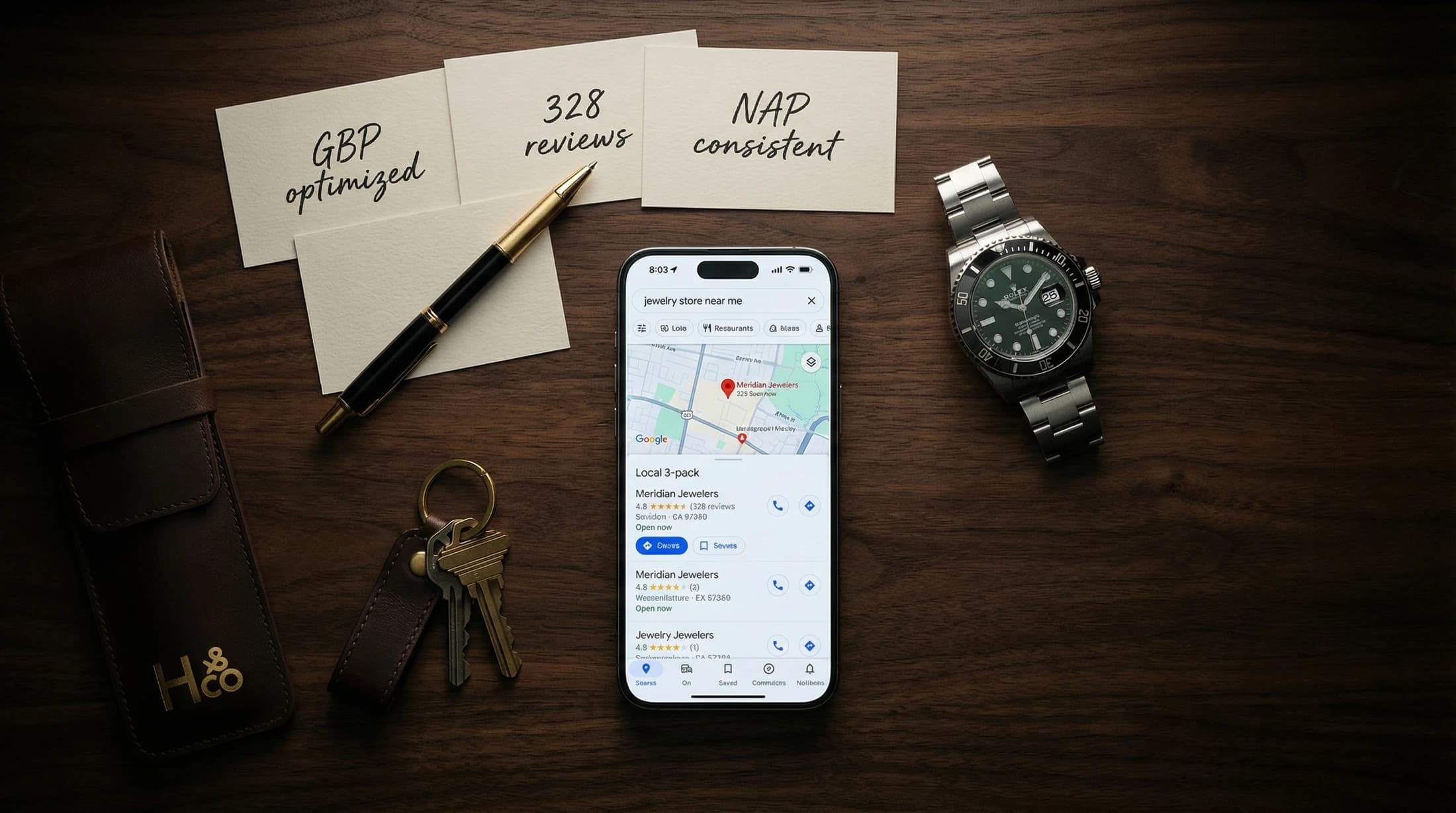
42% of all clicks on local-intent searches go to the Map 3-Pack. Businesses in that 3-Pack get 93% more actions, calls, direction requests, website visits, than everyone below them. And 58% of businesses still don't optimize for local search at all (SOCi, 2024).
For jewelry and watch retailers selling $5,000-$50,000 items from physical stores, this is the widest open opportunity in digital marketing. Not because local SEO is complicated. Because nobody in your market is doing it.
This guide covers the full local SEO stack for jewelry and watch retailers: GBP optimization, the anatomy of the Map 3-Pack, citation building, on-page local signals, review strategy, and the dealer-specific wrinkles that most generic SEO advice ignores.
What Actually Moves the Needle Strip it back and local search comes down to three things. You need an address in the place you want to rank. You need content on your site that genuinely references that city, that township, that area. And you need reviews from clients who are actually in that city, from accounts whose own review history is local to it. A review from someone who has reviewed a dozen other businesses in Toronto carries different weight than one from an account with no history anywhere. How Local Search Actually Works
Google runs two parallel algorithms for local queries. One ranks organic results. The other ranks local pack results, the map with three business listings that appears at the top of local searches. They share some inputs but are weighted differently, which is why a business can rank #1 in organic and not appear in the 3-Pack.
The local pack algorithm weighs three factors: relevance (does your business match what the searcher is looking for), distance (how far is your business from the searcher or the location they specified), and prominence (how well-known and trusted is your business online).
Google names three factors and refuses to weight them: relevance, distance and prominence. It also says outright that it keeps the algorithm details confidential. Anyone publishing a precise percentage split is reading a survey of other SEOs, not Google. That number should put everything else in perspective. You cannot move your store. Distance you mostly cannot change. Relevance and prominence you can.
Google Business Profile: The Most Underused Asset in Luxury Retail
Your GBP is your most important local SEO asset. Not your website. Not your backlinks. Your GBP. Fully optimized profiles are nearly twice as likely to be considered reputable by customers and get significantly more direction requests and website clicks than incomplete ones.
Category Selection
Your primary category is the single biggest GBP signal after proximity. "Jewelry store" is the obvious primary, but secondary categories matter too. If you sell watches, add "Watch store." If you do repairs, add "Jewelry repair service." If you do custom design, add "Jewelry designer." Google allows up to 10 categories and uses them to match your profile to relevant searches.
Authorized dealers face a specific issue here. Certain watch brands have brand-specific categories ("Rolex dealer," "Patek Philippe dealer") that are only available if Google grants them. These categories carry significant weight for brand searches. Contact your brand's marketing team to find out if they can flag your GBP for these categories through their Google relationship.
Business Description
You get 750 characters. Count what you are using. It is probably about 50. Write a description that leads with your primary service and location, mentions the brands you carry if they are significant, and includes the types of customers you serve. This is where information that matches search intent goes.
Example: "[Store name] is a fine jewelry and watch retailer in [neighborhood], [city]. We carry engagement rings, wedding bands, and estate jewelry, along with authorized dealer collections from [Brand A] and [Brand B]. We offer custom design, resize and repair services, and estate buying."
Photos and Video
Here is where I disagree with every other guide on this. They will tell you to upload high-quality professional photography. For a jeweler that advice is half wrong. A photo shot in a studio, lit properly, retouched, communicates a specific thing: this is a catalog image. Fine for an ad. But when every photo on your profile looks like that, the whole profile starts to read as fake, or worse, as stock. Nobody believes you actually have the piece. What you want your profile photos to say is we made this and we have this, right now, in the case. That usually means the photo needs to be a little worse. Slightly grainy, shot on a phone, real light, no retouching. A ring on a bench with the tools still around it. Somebody's hand in frame. It looks like evidence rather than advertising, and evidence is what a local searcher is actually looking for.
Upload interior and exterior photos, team photos, work in progress, and photos that show the in-store experience. Name your photos descriptively before uploading ("diamond-engagement-ring-los-angeles.jpg" beats "IMG_4892.jpg"). Add new photos every month. Stale profiles lose ground to active ones.
GBP Posts
How often you post depends entirely on your niche, and for luxury jewelry it is less often than the guides claim. There is no weekly quota. Post when there is something real to post. Reviews do far more work than posting cadence ever will. GBP posts appear in your knowledge panel and signal recency to Google. Post once a week minimum. What to post: new arrivals, brand events, local events you are participating in, staff spotlights, and content tied to seasonal purchase occasions (Valentine's Day, Mother's Day, graduation season, holiday). Keep posts short. Link to a relevant page on your site.
Q&A Section
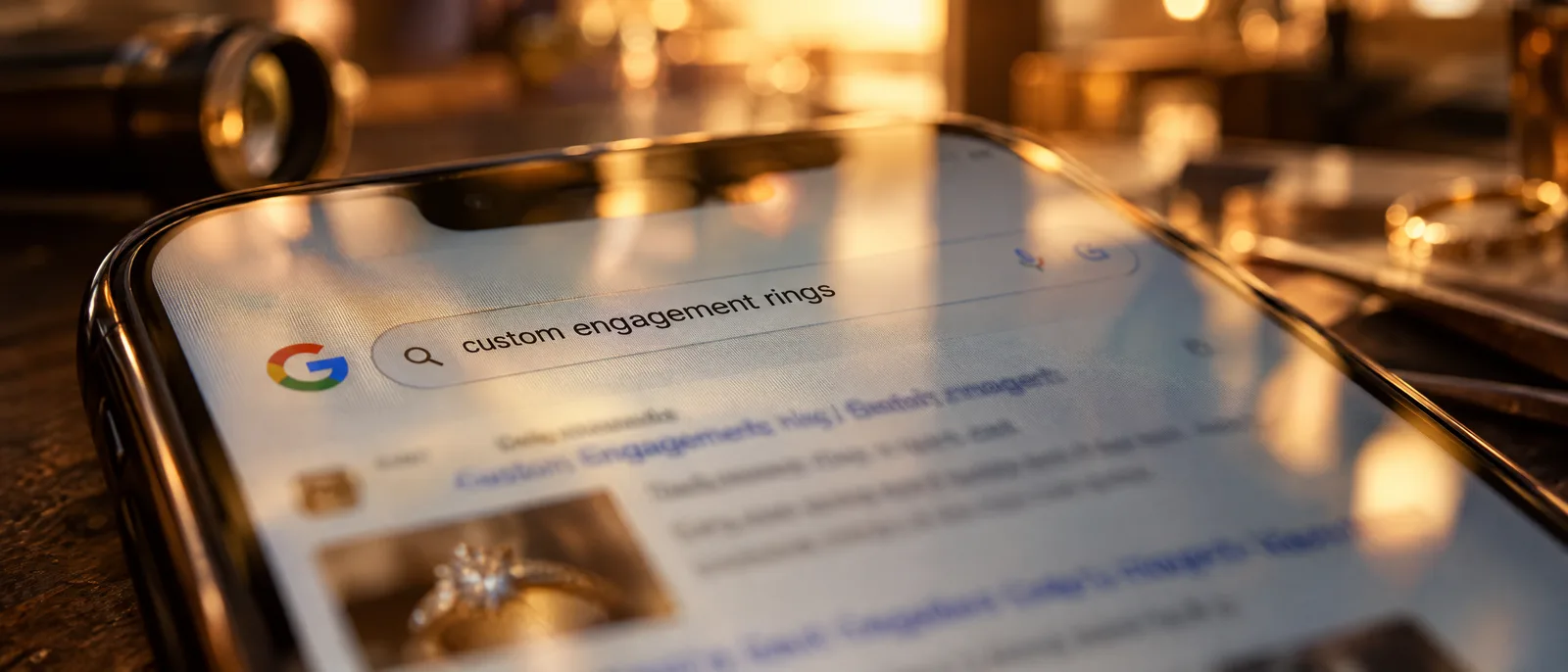
The Q&A section on your profile is probably empty. Seed it yourself. Ask and answer the questions your customers actually ask: Do you do custom engagement rings? Do you carry pre-owned Rolex? Do you offer jewelry repair while you wait? Do you buy estate jewelry? These become indexed content that shows up in search results.
Services and Products
Fill out the Services section completely. Create entries for each major service category: Custom Design, Jewelry Repair, Watch Servicing, Estate Buying, Appraisals. For the Products section, add your major brand names and product categories. This data feeds Google's understanding of your inventory and helps you appear in searches for specific products or services.
The Map 3-Pack: How to Get In and Stay In
The Map 3-Pack gets 42% of all clicks on local-intent searches. The organic results below it split the remaining clicks with everyone who did not make the pack. This is where the math gets uncomfortable if you are not in it.
GBP Optimization Signals
Your profile is the part of relevance you control directly. Category relevance, completeness, posting activity, and review response rate all feed into this.
Review Signals
Google says prominence is based partly on how many reviews you have and how good they are. That is as specific as it gets on the record. This includes review count, review velocity (how often new reviews are coming in), average rating, review diversity across platforms, and whether the business responds to reviews. Google is looking for a consistent stream of real reviews, not a burst of them 3 years ago.
Respond to every review. Positive or negative. Thank reviewers by name where possible. When responding to negatives, stay professional and take the conversation offline. These responses are public content, indexed by Google, and read by prospective customers.
On-Page Local Signals
Your website needs to confirm your location and services to Google. This means your NAP (name, address, phone number) should appear in crawlable text on every page, not just in an image or embedded in a map. Your homepage title tag should include your city. Your location page should have the full address, embedded map, hours, and parking information.
LocalBusiness schema markup on your location page tells Google your hours, address, phone, and service area in structured data it can parse directly. This is table stakes now. If your site does not have LocalBusiness schema, add it.
Citation Signals
Citations are any online mention of your business name, address, and phone number. They are a trust signal: if your NAP appears consistently across the web, Google has more confidence that you are a real, established business at that location.
Citation inconsistency, different phone numbers on different directories, old addresses from a previous location, abbreviated street names in some places and full names in others, confuses Google and suppresses rankings. Run a citation audit using BrightLocal or Whitespark before building new citations. Fix the inconsistencies first.
Priority citation sources for jewelry and watch retailers:
- Google Business Profile (primary)
- Apple Maps
- Bing Places
- Yelp
- Better Business Bureau
- Facebook Business
- Industry directories (Jewelers of America, American Gem Society, brand-specific dealer finders)
Brand dealer finders are an often-missed citation source. If you are an authorized dealer for Rolex, Cartier, TAG Heuer, or similar brands, you should appear in their official dealer locators. These carry high domain authority and drive direct traffic from customers researching where to buy specific brands. Contact your brand rep if you are missing from these.
On-Page Local SEO: Your Website's Job
On-page signals tell Google what you do and where you do it. They feed prominence, which Google says is partly about how many sites reference your business.
The basics:
- Title tags: Include city + primary keyword on homepage and key service pages. "Fine Jewelry and Watches | [City] | [Store Name]" beats "[Store Name] | Fine Jewelry."
- Header tags: H1 on each page should name the service and location. "Custom Engagement Rings in Beverly Hills" is a real H1. "Our Collection" is not.
- NAP in footer: Your name, address, and phone number in crawlable text on every page. Do not put this only in an image.
- Location page: A dedicated page with your full address, embedded Google Map, hours, parking info, and photos of your exterior. This is where Google sends customers who find you in the pack.
- LocalBusiness schema: Structured data markup that tells Google your hours, address, phone, and geo-coordinates in machine-readable format.
- Content with local references: Blog posts, brand pages, and service pages that naturally reference your city and neighborhood. A post about "Where to Buy an Engagement Ring in [City]" drives local search traffic and signals relevance.
If you have multiple locations, each needs its own page, its own GBP, and its own local keyword targeting. Do not try to cover two cities from one page.
Local Keyword Strategy
Local search keywords follow predictable patterns:
- [Product/service] + [city] -- "engagement rings Los Angeles," "watch repair Beverly Hills"
- [Brand] + "dealer" + [city] -- "Rolex dealer Chicago," "Cartier authorized dealer Miami"
- Near-me queries -- "jewelry store near me," "watch repair near me" (you rank for these based on GBP and proximity, not keyword stuffing)
- Neighborhood targeting -- "jewelry store [neighborhood]" for stores in cities where neighborhood identity is strong (NYC, Chicago, LA, SF)
Build your keyword list by city, service, and brand. Map each keyword to a page on your site. If the page does not exist, build it. If it exists but does not mention the city, fix it.
Review Strategy That Actually Works
Review generation is usually either ignored or handled inconsistently. Neither works. You need a system.
The ask timing matters more than the ask method. The best time to ask for a review is immediately after a positive moment: when a customer picks up their repaired piece and loves it, when you complete a custom design and they see it for the first time, when someone buys an engagement ring and you just had a great appointment. That emotional peak is when people say yes.
The ask itself should be direct. "Would you mind leaving us a Google review? It helps other customers find us." Then hand them a card with a QR code that links directly to your GBP review form. No friction. One scan, one tap, done.
Follow up via email for online purchasers. 24-48 hours after delivery confirmation, send a short email asking for a review. Keep it brief. Include the direct link.
What you cannot do: offer incentives for reviews (violates Google's terms), post fake reviews, ask only happy customers while ignoring unhappy ones, or batch-ask customers en masse after years of not asking. Any of these can result in review removal or GBP suspension.
Handling Negative Reviews
Negative reviews are not the end of the world. How you respond to them is what prospective customers actually judge. A bad review with a thoughtful, professional response reads better than a business with no reviews at all.
The formula: acknowledge the issue without admitting liability, thank them for bringing it to your attention, offer to resolve it offline ("Please call us directly at [number] or email [address] so we can make this right"). Do not argue. Do not explain at length. Take it private.
If a review appears to be fake or from a non-customer, flag it for removal through Google's review management tools. Have documentation ready that the person was never a customer. Google does remove fake reviews, but it takes time and you need evidence.
- Respond within 24 hours
- Keep the response professional and brief
- Offer a direct path to resolution
- Never argue publicly
A business with 4.7 stars and 200 reviews consistently outperforms one with 5.0 stars and 8 reviews. Volume and recency matter more than perfection.
Dealer-Specific Challenges and Advantages
Authorized dealers operate under brand restrictions that independent retailers do not face. These restrictions affect what you can say on your website, what photos you can use, and sometimes how you can name your GBP categories. But they also come with advantages.
The Restrictions Worth being accurate about this: brands do not really have local SEO policies. They are not auditing your Google Business Profile. What they restrict is what you are allowed to say as an authorized retailer, and that spills into local because your profile and your pages are places where you say things.
Luxury watch brands generally prohibit using their trademark in your domain name, require approval for any paid ads that use their brand name, restrict which product images you can use on your site, and sometimes require specific language or disclaimers. A few brands ban certain marketing tactics outright.
For local SEO, the practical impact is on keyword targeting and content creation. You generally cannot create pages that are purely about the brand ("Buy Rolex in Chicago") without risking compliance issues. What you can do is create pages about your dealership that mention the brand in context ("Authorized Rolex Dealer in Chicago: [Store Name]"). The distinction matters.
The Advantages
Brand dealer locators are high-authority backlinks and citation sources. If you are in the Rolex AD locator, that is a link from rolex.com. That matters for both local and organic rankings.
Brand association also creates local brand search volume. People searching "Rolex dealer near me" or "where to buy Omega in [city]" are in-market buyers. If you show up for those searches, you are capturing people who have already made the purchase decision and are now looking for a place to buy.
Tracking Local SEO Performance
Google Search Console shows you what queries are driving clicks to your site, which pages rank, and what your average position is for different searches. It does not show you local pack rankings. For that you need a local rank tracker.
GBP Insights shows you how many people saw your profile, how many clicked to your website, how many requested directions, and how many called you. These numbers should be trending up month over month if your optimization is working.
Metrics to track monthly:
- GBP profile views (search and maps separately)
- Direction requests
- Phone calls from GBP
- Website clicks from GBP
Local Pack Rank Tracking
- BrightLocal: Local-focused rank tracker with grid tracking (shows rankings across a geographic grid, not just one location)
- Whitespark: Strong citation finder and local rank tracker, good for citation audits
- Local Falcon: Grid-based GBP rank tracker that shows where you rank from different locations within your city
- Semrush Local: Built into the broader Semrush suite, useful if you already use Semrush for keyword research
- Ahrefs: Better for organic tracking but has improving local features
- Google Search Console: Free, shows organic queries and clicks but not local pack rankings directly
- GBP Insights: Free from Google, shows profile views, direction requests, calls, and website clicks from your profile
What Most Local SEO Guides Miss for Luxury Retail
Generic local SEO advice is written for the general market: pizza shops, dentists, plumbers. Luxury retail is different in ways that matter.
The purchase timeline is longer. Someone buying a $15,000 engagement ring or a $30,000 watch is not going to walk in the same day they search. They are researching. Local SEO for luxury retail is about being present throughout that research phase, not just at the moment of decision. This means GBP posts that talk about your expertise, website content that answers the questions buyers ask during research (how to evaluate diamond quality, how to tell a genuine Rolex from a gray-market one, what questions to ask an authorized dealer), and reviews that speak to the in-store experience and staff knowledge.
The customer travels further. The standard local SEO assumption is that customers will not travel more than a few miles. Luxury buyers travel across cities and sometimes across states for the right retailer. This changes your geographic targeting strategy. You are not just trying to rank in your immediate neighborhood. You are trying to rank for your city and surrounding affluent neighborhoods, and to appear for searches from customers who may be driving 30-45 minutes to reach you.
Brand association creates search volume that other retail categories do not have. A furniture store does not benefit from being a "Herman Miller authorized dealer" in local search the way a jewelry store benefits from being an authorized Rolex or Cartier dealer. Those brand searches have high commercial intent and relatively low local competition.
The in-store experience is the product. For jewelry and watch retailers, photos and reviews that convey the in-store experience are not just nice to have. They are the primary decision factor for first-time customers. Someone choosing between two authorized dealers in their city is often making the decision based on which store looks like the kind of place they want to be. Your GBP photos, your review content, and your website imagery need to convey that experience.
Seasonal search volume spikes are predictable and significant. Jewelry search volume spikes around Valentine's Day, Mother's Day, graduation season, and the holiday window (November-December). Watch search volume spikes at similar times with an additional peak around Father's Day. Local SEO strategy should account for these: ramp up GBP posting, publish seasonal content, and refresh seasonal pages 6-8 weeks before each spike.
Who Are You Actually Best Equipped to Serve? This is the part almost nobody gets right, and it decides everything above it. Oro Sergio is a custom jeweler in Toronto. They are best equipped to serve someone in the greater Toronto area, because custom work means fittings, conversations, changes, and a person coming back three times. That is the honest boundary of who they can serve well. The instinct is to be everything to everyone: chase rankings in cities you cannot really service, then wonder why the leads are bad. Work out who you are genuinely best equipped to serve in your area, then point everything at that. The rankings follow the honesty. The Priority Stack
If you are starting from zero or from a neglected local SEO foundation, the order of operations matters.
Start with GBP. Claim and fully optimize your profile first. This is the move that pays most in local SEO, and it can show results within weeks. Get your categories right, fill the description, add photos, start posting.
Then fix citations. Run an audit. Find the inconsistencies. Fix them before building new ones. Inconsistent NAP data actively suppresses rankings.
Then build reviews. Stand up a review request process that your staff actually uses. The goal is consistency, not volume spikes. Google wants to see regular new reviews, not 50 reviews in a week followed by silence.
Then address on-page. Add location to title tags and H1s. Build or improve your location page. Add LocalBusiness schema. This work is lower urgency than the first three but compounds over time.
Then build local content. Brand pages, service pages, neighborhood guides, seasonal content. This is the work that widens the gap between you and a competitor who just does the basics.
Local SEO is the lowest-competition, highest-intent marketing channel available to a jewelry and watch retailer right now. Not because it is a secret. Because the work does not get done. this space have not done the work. That gap is your advantage, but only until someone else fills it.
Ready to Own Your City?
Local SEO for luxury retail is not complicated, but it requires consistent execution across GBP, citations, reviews, and on-page signals. If you want someone to audit where you stand and build a plan to get you into the 3-Pack in your market, that is exactly what we do.
Contact H&CO to start with a local SEO audit.
About the author
Hagop Imasdounian
Hagop Imasdounian is the founder of H&CO. Raised around his family’s jewelry businesses, he brings more than 15 years of digital marketing experience to helping jewelry and watch brands improve their websites, reach buyers and connect marketing with sales.