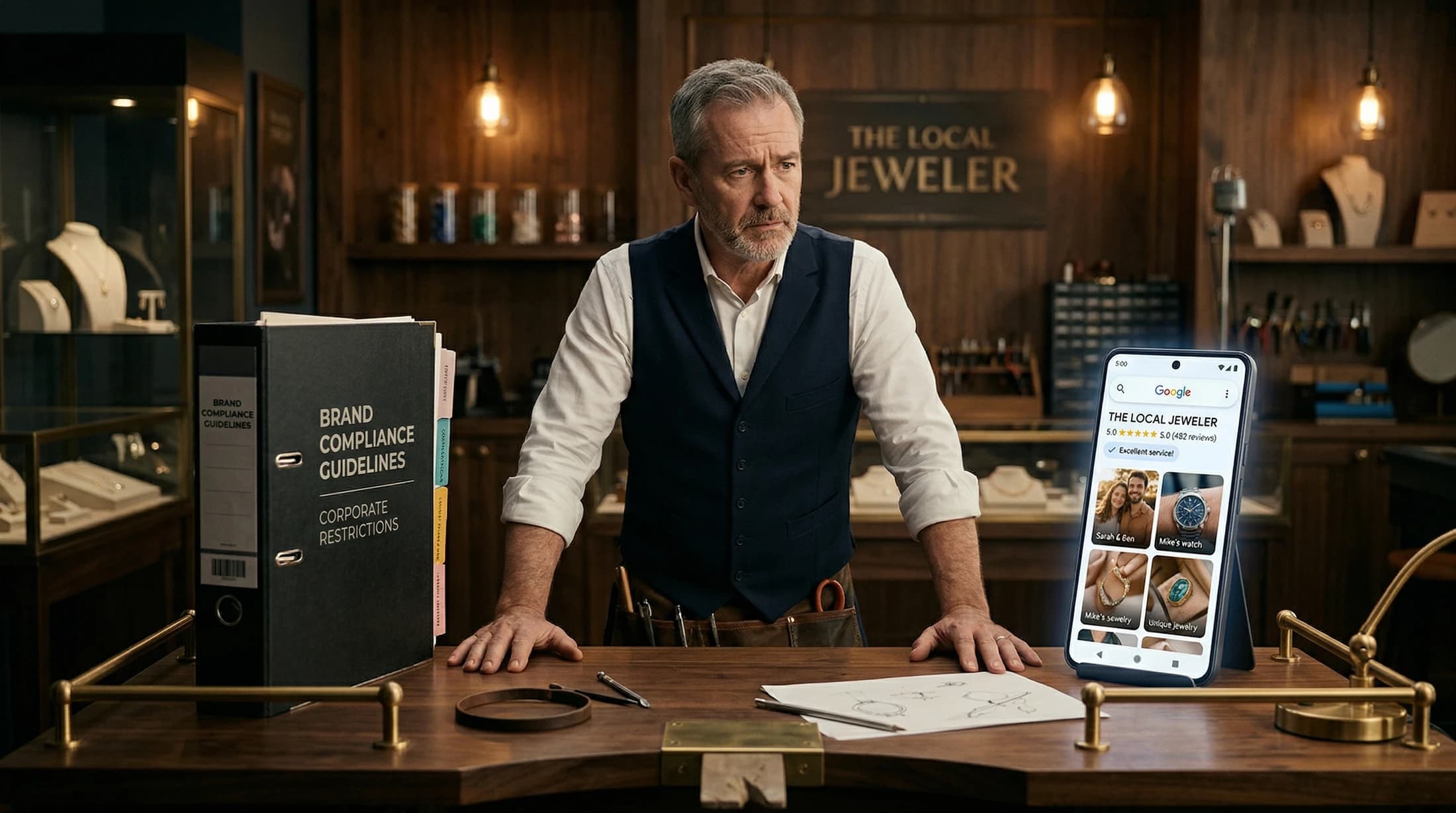


Walk into any independent jewelry store or watch boutique in America and you'll see the same thing. Custom display cases. Perfect lighting. A showroom that cost six figures to build out. Every detail considered.
Then pull up their website on your phone.
A template. Stock photography. Copy that reads like someone fed a list of SEO keywords into a blender. Load time pushing five, six, sometimes eight seconds. No personality. No warmth. Nothing that reflects what it actually feels like to walk into that store.
This is the reality for about 8 out of 10 jewelry and watch retailers we talk to. And the gap between their physical presence and their digital one is costing them far more than they realize.
You Spent $200K on Your Showroom. Your Website Looks Like a Demo.
Here's what we see over and over. A retailer invests $150K, $200K, sometimes more into their physical space. Renovations, custom millwork, lighting design, the works. Then they go with a $2,000 template for their website because their last agency said it would be "just as good."
It's not.
Template websites are built to serve everyone, which means they serve no one particularly well. They ship with bloated code, unnecessary plugins, extra CSS and JavaScript files you'll never use. The result is a site that looks like every other jewelry and watch retailer's site and loads like it's carrying dead weight, because it is.
Here's the number that should bother you: 75% of consumers judge a business's credibility based on its website design, according to research from Stanford University. Not your reviews. Not your reputation. Your website.
And the judgment happens fast. Researchers have measured it. Users form an opinion about your site in 0.05 seconds. Fifty milliseconds. That's faster than a blink. In that sliver of time, a potential customer has already decided whether your store looks legitimate or forgettable.
When your website is a template with stock photos of rings that aren't even in your cases, that snap judgment doesn't go your way.
The problem goes deeper than aesthetics. Template copy is written for search engines, not humans. You've seen it. "Discover our extensive collection of fine jewelry" followed by a wall of text nobody reads. Your customer can smell it. They came to your site expecting the same feeling they'd get walking through your door, and instead they got a brochure that could belong to any store in any city.
The 3-Second Window You're Losing
Google published a study called "The Need for Mobile Speed" that produced one of the most cited stats in digital marketing: 53% of mobile visitors abandon a site that takes longer than 3 seconds to load (Google, 2016).
Three seconds. That's your window.
Now consider what happens with most luxury retail websites. Template sites loaded with unoptimized images, third-party scripts, and plugin bloat regularly hit 8 to 10 seconds on mobile. Some are worse. Every additional second of load time drops your conversion rate by 4.42%. By the time your homepage finishes loading, you've already lost more than half the people who clicked (Portent, 2019).
Luxury websites carry a benchmark bounce rate of 45.8%. That's nearly half your visitors leaving after seeing a single page. And that's the benchmark. If your site is slower than average, heavier than average, or less mobile-friendly than average, your number is worse (My Codeless Website, 2026).
The math gets ugly fast. If your site does $5M annually and loads in 3.5 seconds instead of under 2, you're leaving hundreds of thousands in revenue on the table based on Portent's conversion decay data.
For luxury brands specifically, the Deloitte/Google study found a 0.1-second improvement in load time produced an 8.6% increase in page views and a 40.1% increase in product-to-cart progression. A tenth of a second. That's how sensitive your customers are to performance.
And here's what makes it worse for jewelry and watch retailers in particular: your customers skew affluent. Affluent consumers have higher expectations for digital experiences because they encounter better ones everywhere else. They bank with apps that load instantly. They shop on sites built by teams of fifty engineers. Then they land on your site, and it stutters, and they leave.
Your Website Is Burning Your Ad Budget (Twice)
This is the part that really hurts. A bad website doesn't just lose organic visitors. It actively destroys the ROI on every dollar you spend driving traffic to it.
Think about what happens when you run Google Ads or Meta campaigns. You bid for clicks. You pay for those clicks. Each one sends a person to your website. If that person lands on a slow, generic, poorly structured page and bounces within seconds, you just paid for nothing.
That's the first burn.
The second burn is what happens to your ad platform metrics. Google Ads uses Quality Score to determine how much you pay per click and where your ads appear. One of the factors in Quality Score is landing page experience. A slow, high-bounce-rate landing page tanks your Quality Score, which means Google charges you more per click and shows your ads in worse positions.
So now you're paying more per click and getting less from each one. The site is leaking money from both directions.
This is what we mean when we talk about the double-burn. Your website isn't converting, and your entire paid media budget is being dragged down by the site it points to. You're spending $10K, $20K, $50K a month on ads, and a meaningful chunk of that spend is wasted because the destination doesn't hold up its end.
The landing page benchmark for paid traffic is under 2 seconds. Most luxury retail sites aren't even close. And every second over that threshold is burning budget you could be using to actually grow.
101 Errors and No One Told You
Beyond speed and design, there's usually a graveyard of technical problems nobody has flagged. We've audited hundreds of luxury retail websites, and the pattern is consistent.
Broken links pointing to pages that no longer exist. Missing alt text on every product image, which means Google can't index them and screen readers can't describe them. Redirect chains three or four hops deep, where a single URL passes through multiple redirects before landing somewhere, each hop adding latency. No SSL certificate, or an expired one throwing browser warnings that make your store look like a scam.
Duplicate title tags across thirty pages. Meta descriptions that are either missing or copied from the template's placeholder text. Canonical tags pointing to the wrong URLs. 404 pages that dump visitors on a dead end with no navigation back to your products. We've seen sites with over a hundred indexable errors that the owner had no idea existed, because no one was checking.
The most common technical failure? Mobile responsiveness. 64% of web professionals cite non-responsive design as the single biggest website mistake. For jewelry and watch retailers, this is a death sentence. Your customers are browsing on their phones during lunch, in the car, on the couch at night. If your site doesn't work properly on a phone, you've lost them (GoodFirms, 2021).
Then there's structured data. Most luxury retail sites have none. No product schema, no local business markup, no organization data. This means Google can't properly understand what you sell, where you're located, or how to display your products in search results. You're invisible to the features that drive clicks, like rich snippets and product carousels.
Core Web Vitals, the performance metrics Google uses for ranking, are often in the red. Largest Contentful Paint over 4 seconds. Cumulative Layout Shift causing the page to jump around while it loads. Interaction to Next Paint lagging because the site is choking on its own scripts. Google doesn't just use these as suggestions. They're ranking factors. A site with poor Core Web Vitals gets pushed down in search results, which means less organic traffic, which means more dependence on paid ads to fill the gap.
None of this is visible to you when you check your site on your office computer with a fast internet connection. That's the "it works on my computer" trap. Your customers aren't on your office Wi-Fi. They're on cellular connections, on older phones, in areas with spotty coverage. The experience they get is nothing like the one you see.
And here's the part that frustrates store owners the most: they're often paying someone to manage the site. An agency, a freelancer, someone who set it up and walked away. These technical issues accumulate silently. No one monitors them. No one runs regular audits. By the time someone finally checks, the site has been bleeding performance and search visibility for months or years.
You Can't Fix What You Can't Track
Here's a problem that's even more expensive than a slow website, because it makes everything else harder to diagnose.
Most luxury retail websites have broken or inadequate tracking. We're talking about sites running basic Google Analytics with a client-side pixel and nothing else. No server-side tracking. No third-party attribution software. No way to actually understand which marketing efforts are driving revenue.
Client-side tracking, the standard setup where a JavaScript snippet fires in the visitor's browser, loses 30 to 40% of your conversion data. That's not a guess. That's measured. Ad blockers, which 30 to 40% of internet users have installed, prevent tracking scripts from loading entirely. Apple's App Tracking Transparency framework has gutted cross-site tracking on iOS devices (Backlinko, 2025).
This matters more for jewelry and watch retailers than almost any other segment. Your customers skew toward higher income, which means higher iPhone ownership, which means a larger share of your traffic is essentially invisible to client-side tracking. You're making marketing decisions based on 60 to 70% of the picture (Releva, 2025).
Without server-side tracking, your conversion data has gaps. Without third-party attribution software, you can't connect ad spend to actual revenue, whether that's online sales or foot traffic. You're spending money on marketing and then guessing whether it worked.
This compounds the double-burn problem. You can't optimize a campaign when you can't see which campaigns are actually producing results. So you keep spending on channels that might not be working, and you underinvest in channels that might be your best performers, because the data is incomplete.
We wrote a full breakdown of how attribution works for jewelry and watch retailers and why stores are leaving revenue on the table without it. If your current setup is "we have Google Analytics," that post is worth your time.
Your Mobile Site Is an Afterthought. Your Customers Aren't.
Between 65 and 75% of your website traffic comes from mobile devices. But across ecommerce, mobile converts at roughly half the rate of desktop, and in luxury, where the overall rate is already under 1.2%, that gap is where the money leaks.
That gap isn't because people don't want to buy on their phones. It's because most luxury retail sites make it painful to do so.
The typical luxury store website was designed on a desktop, for a desktop. The mobile version is an afterthought, a cramped version of the desktop layout that technically "works" but delivers a miserable experience. Tiny tap targets. Images that take forever to load. A checkout flow that requires twelve form fields and no digital wallet options.
The data on this is brutal. 88% of online consumers say they're less likely to return to a site after a bad mobile experience. 57% say they won't recommend a business with a poorly designed mobile site. One bad mobile visit, and you've lost that customer's future business and their referrals.
Luxury and jewelry ecommerce converts at just 0.87%, the lowest of any ecommerce segment. Part of that is the nature of high-value purchases. People research online and buy in store. But a significant part of it is fixable. Better mobile performance, streamlined checkout, faster load times, and proper product presentation can move that number meaningfully (Branvas, 2026).
The retailers who treat their mobile site as their primary storefront, not a secondary one, are the ones closing the gap. That means designing for the phone first and scaling up to desktop, not the other way around.
Consider the journey your customer actually takes. They see your Instagram ad on their phone. They tap through. They land on your mobile site. If that site loads slowly, looks cramped, and makes it hard to browse your collection, you've broken the chain. The ad did its job. The site didn't. And you paid for that click anyway.
What Fixing This Actually Looks Like
Here's the part where we talk about solutions. And we want to be clear: not every site needs a full rebuild. Some do, and we'll be honest about that when we see it. But many of the problems above have targeted fixes that can move the needle without starting from zero.
The goal is to close the gap between your physical experience and your digital one. When someone lands on your site, they should feel the same thing they'd feel walking into your store. Quality. Confidence. Something worth their time.
Speed First
This is the highest-impact fix and often the cheapest. Image optimization alone can cut load times dramatically. Compress images, serve them in modern formats like WebP or AVIF, and implement lazy loading so images below the fold don't slow down the initial page render.
Strip out unnecessary plugins and scripts. Every third-party tool you added "just in case" is adding weight to your page. Audit what's actually being used and remove everything else.
Use a content delivery network (CDN) to serve your site from servers closer to your visitors. Set up proper browser caching. Minimize CSS and JavaScript files.
Your target: under 2 seconds on mobile. Not 4 seconds. Not 3 seconds. Under 2. Run your site through Google's PageSpeed Insights right now. If your mobile score is below 50, speed optimization should be your first project, before you touch anything else.
Real Photography, Not Stock
Your products are the reason people come to you. They should be the reason people stay on your site.
Stop using stock photography. Stop using manufacturer-supplied images that appear on fifty other retailers' sites. Shoot your own products, in your own store, with your own lighting.
You don't need a $10,000 photography budget to make this happen. A DSLR with a macro lens and a basic lightbox will produce better results than a professional photographer who doesn't know your inventory. Your staff handles these pieces every day. They know how to present them. Give them the tools and let them shoot.
We put together a complete guide to product photography for jewelry retailers that walks through equipment, lighting, and technique. It's written for store owners, not photographers.
Tracking That Actually Works
Move to server-side tracking. This sends data from your server to analytics and ad platforms, bypassing ad blockers and browser restrictions. You'll recover that 30 to 40% of conversion data that client-side tracking misses (Releva, 2025).
Add third-party attribution software that can connect online marketing activity to actual revenue, including in-store purchases. This is the missing piece. You need to know which Google Ads campaign drove someone into your store, not just which one got a click.
The difference between guessing and knowing is the difference between wasting ad budget and scaling what works. Our full breakdown on revenue attribution for jewelry and watch retailers covers the full setup.
Mobile-First, Not Mobile-Also
Design for the phone first. Start with the smallest screen and the slowest connection, then scale up. This forces you to prioritize what matters and strip out what doesn't.
Integrate digital wallets. Apple Pay, Google Pay, Shop Pay. Reduce checkout friction to the absolute minimum. Every form field you add is a chance for someone to drop off.
Test your site on actual phones. Not just the latest iPhone. Pull out a three-year-old Android and load your homepage. That's closer to what a large chunk of your visitors are experiencing.
Copy That Sounds Like You
Template copy is the written equivalent of stock photography. It's generic, forgettable, and your customer knows it didn't come from you.
Write copy that reflects your store's personality. The way you talk to customers on the floor, the stories behind the brands you carry, the reason you got into this business. That voice should be on your website.
This doesn't mean abandoning SEO. It means writing for humans first and structuring for search second. The best-performing pages we've built do both, and they outperform keyword-stuffed template copy every time.
Your About page shouldn't read like a corporate mission statement. Your product descriptions shouldn't be manufacturer boilerplate. Your homepage shouldn't greet visitors with "Welcome to [Store Name], your premier destination for fine jewelry." That sentence could belong to any store anywhere. It tells the visitor nothing about who you are or why they should care.
The Math That Should Keep You Up at Night
Let's put this together with a scenario that's not far from what we see regularly.
A luxury jewelry retailer does $3 million a year in revenue. Their website loads in 5 seconds on mobile. They're spending $15,000 a month on Google and Meta ads. They have client-side tracking only, losing roughly 35% of their conversion data.
The speed problem: at 5 seconds, they're experiencing conversion rate drops of about 17.5% compared to a 1-second load time (4.42% per second over four extra seconds). On $3 million in revenue, that's roughly $525,000 in lost annual revenue from speed alone.
The tracking problem: they're making optimization decisions with 65% of their data. Campaigns that look like they're underperforming might be their best ones, and they'd never know. Ad platforms can't optimize properly because they're missing a third of the conversion signals. Conservative estimate: 15 to 20% of their $180,000 annual ad spend is misallocated, so $27,000 to $36,000 wasted.
The mobile problem: with 70% of traffic on mobile and a conversion rate gap of 1.5% between their mobile and desktop experience, they're leaving another $200,000 to $300,000 on the table from a fixable UX gap.
The compounding problem: these issues don't just add up. They multiply. Bad tracking makes it impossible to diagnose the speed problem because you can't see which pages are leaking conversions. Bad mobile UX makes the tracking problem worse because mobile sessions are shorter, more likely to be blocked by iOS privacy features, and harder to attribute. Bad speed makes the ad problem worse because every bounced click is wasted budget that could have driven a sale on a faster site.
And here's what makes this especially painful for independent jewelry and watch retailers: your competitors with bigger budgets can absorb this waste. You can't. A national chain spending $500K a month on ads can tolerate a 20% waste rate because volume covers the gap. A family-owned boutique spending $15K a month feels every lost dollar. The inefficiency hits harder when your margins are tighter and your budget is smaller.
The Deloitte/Google study showed a 0.1-second improvement in load time produced an 8.6% increase in page views and a 40.1% increase in product-to-cart progression for luxury brands. Server-side tracking recovers 30 to 40% of lost conversion data. A mobile-first redesign can close a meaningful chunk of the desktop-mobile conversion gap. None of these are theoretical. They're documented.
If you want a broader view of what a complete marketing strategy looks like for jewelry and watch retailers, including how web, paid, and organic work together, our 2026 luxury retail marketing playbook covers the full picture.
Your Website Is Either Working for You or Against You
There's no neutral ground here. Every day your site loads in 5 seconds instead of 2, you're losing customers. Every month your tracking setup misses a third of your conversions, you're making decisions with bad data. Every quarter your ad budget points to a slow, generic landing page, you're burning money that could be building your business.
The gap between your showroom and your website doesn't have to exist. The fixes range from a few hours of speed optimization to a full redesign, depending on where you're starting. But the first step is the same for everyone: understand what's actually broken.
We audit luxury retail websites and tell you exactly what's costing you money, what to fix first, and what the expected impact looks like. No guessing. No generic recommendations. Just a clear picture of where you are and what it takes to close the gap.
Talk to us about your website.

About the author
Hagop Imasdounian
Hagop Imasdounian is the founder of H&CO. Raised around his family’s jewelry businesses, he brings more than 15 years of digital marketing experience to helping jewelry and watch brands improve their websites, reach buyers and connect marketing with sales.