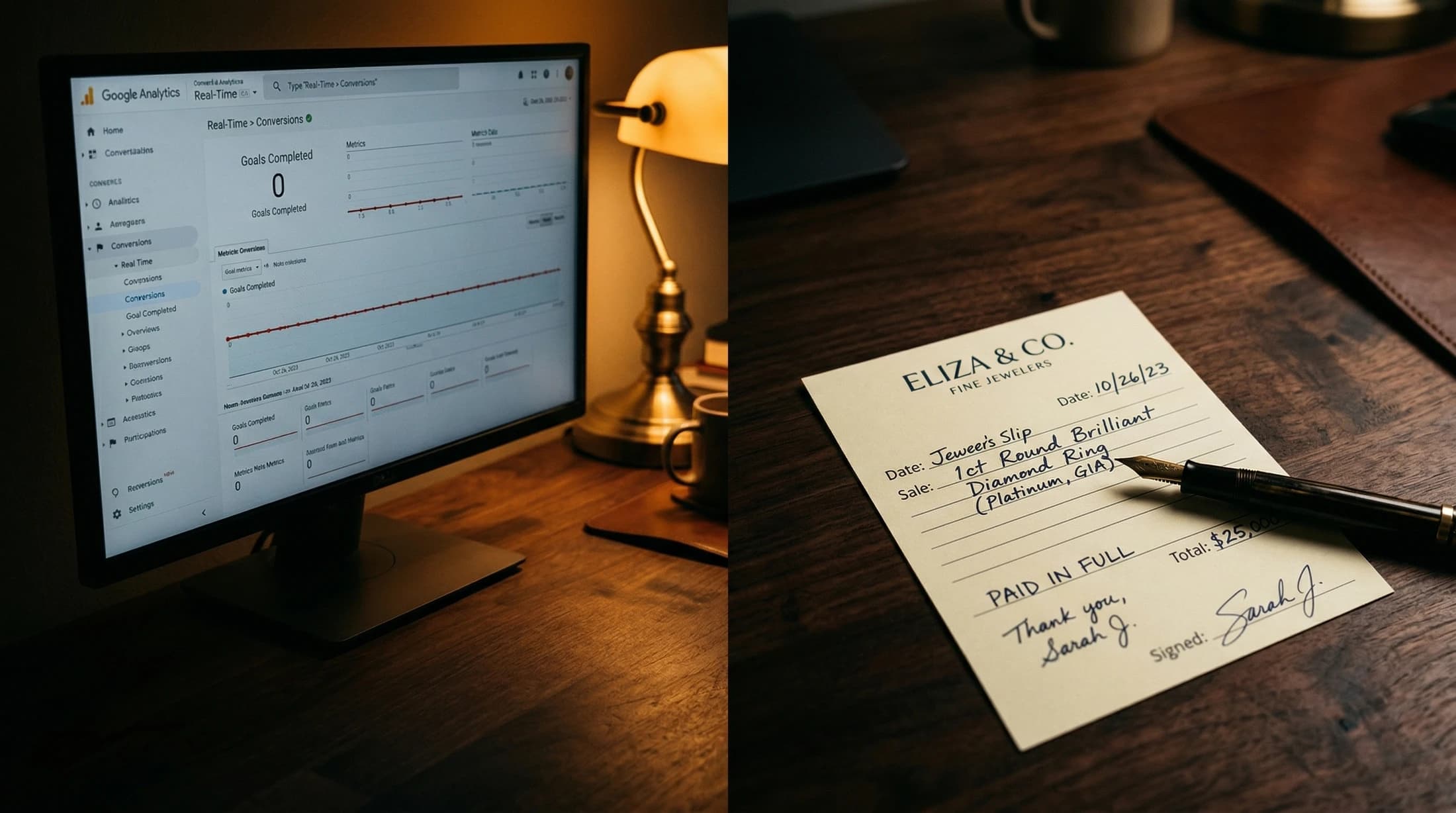



Open Google Analytics for any luxury jewelry or watch retailer. You'll see a 0.9% conversion rate. An 80% cart abandonment rate. A cost-per-click that would make a DTC skincare brand faint. Every metric on that dashboard screams that marketing isn't working (Branvas, 2026).
Except it probably is.
The problem isn't your marketing. The problem is that every reporting tool you use was built for businesses selling $50 products to impulse buyers. When your average transaction is $7,000 to $10,000, the entire measurement framework breaks. Conversion rates, ROAS, cost per click, even lead count, none of these metrics mean what they mean for a standard e-commerce store.
We've spent years building measurement systems for jewelry and watch retailers, and the single biggest gain isn't a better ad campaign or a new channel. It's seeing the numbers that actually matter instead of the ones your dashboard defaults to.
This post is about the metrics framework: what to measure, why the standard numbers mislead you, and how to build a reporting system that reflects how high-ticket retail actually works.
The Math Is Different When a Single Sale Pays for the Quarter
When your AOV is $50, you need volume. Thousands of transactions per month. Small changes in conversion rate move the needle because you're playing a percentages game across massive numbers.
When your AOV is $7,000, the math changes completely. You're not optimizing for volume. You're optimizing for precision.
This is B2B math applied to a retail business. You're not managing a funnel. You're managing a pipeline.
Why Standard Dashboards Lie to Jewelry & Watch Retailers
The Conversion Rate Trap
Luxury jewelry converts online at 0.8 to 1.2%. Revenue per visitor is the number that matters. Conversion rate without AOV context is meaningless (Branvas, 2026).
The ROAS Illusion
Between 80 and 83% of luxury retail revenue happens in-store. Your ad platforms can't see those transactions. Retailers who make budget decisions based on platform-reported ROAS alone are routinely killing their most profitable campaigns.
The Channel Attribution Problem
Your standard dashboard can't show you which channels actually drive revenue. It shows channel-level performance based on online conversions only, which is maybe 20% of what's actually happening.
What to Measure Instead: The High-Ticket Retail Framework
Revenue Per Qualified Lead
Not all leads are equal. At $7,000+ AOV, a qualified lead is someone who booked an appointment, called the store, or walked in after engaging with your marketing.
Blended Customer Acquisition Cost
Total marketing spend divided by total new customers, online and in-store combined.
Customer Lifetime Value and the LTV:CAC Ratio
The average luxury retail customer stays for five to seven years. Repeat purchase rates in jewelry run 25 to 40% within the first year alone. The retailers we talk to have almost never calculated their LTV (Jewel360, 2025).
Pipeline Value and Velocity
Treating your retail business like a pipeline means tracking stages: open inquiries, appointments set, store visits, proposals sent, closed sales. This is CRM thinking applied to retail.
Blended ROAS (Online + Offline)
Take whatever your ad platform reports as revenue. Add the revenue from in-store transactions you can attribute to marketing. Divide by total ad spend. That's your blended ROAS.
Building the Dashboard That Actually Works
Eleven metrics across three cadences. Every number answers a specific question that drives a decision.
The Three Mistakes That Cost Jewelry & Watch Retailers the Most
Killing campaigns based on online ROAS alone. Chasing traffic volume instead of lead quality. Refusing to pay for acquisition because the CAC looks scary.
Making This Work for Your Business
Track fewer, better numbers. Include offline revenue. Calculate lifetime value. Measure acquisition cost against that lifetime value, not against this month's platform report.
If your current marketing dashboard doesn't show offline revenue, customer lifetime value, or pipeline data, you're making decisions based on 20% of reality. H&CO builds measurement frameworks for jewelry and watch retailers that connect the full picture. Get in touch and we'll show you what your marketing is actually producing.

About the author
Hagop Imasdounian
Hagop Imasdounian is the founder of H&CO. Raised around his family’s jewelry businesses, he brings more than 15 years of digital marketing experience to helping jewelry and watch brands improve their websites, reach buyers and connect marketing with sales.