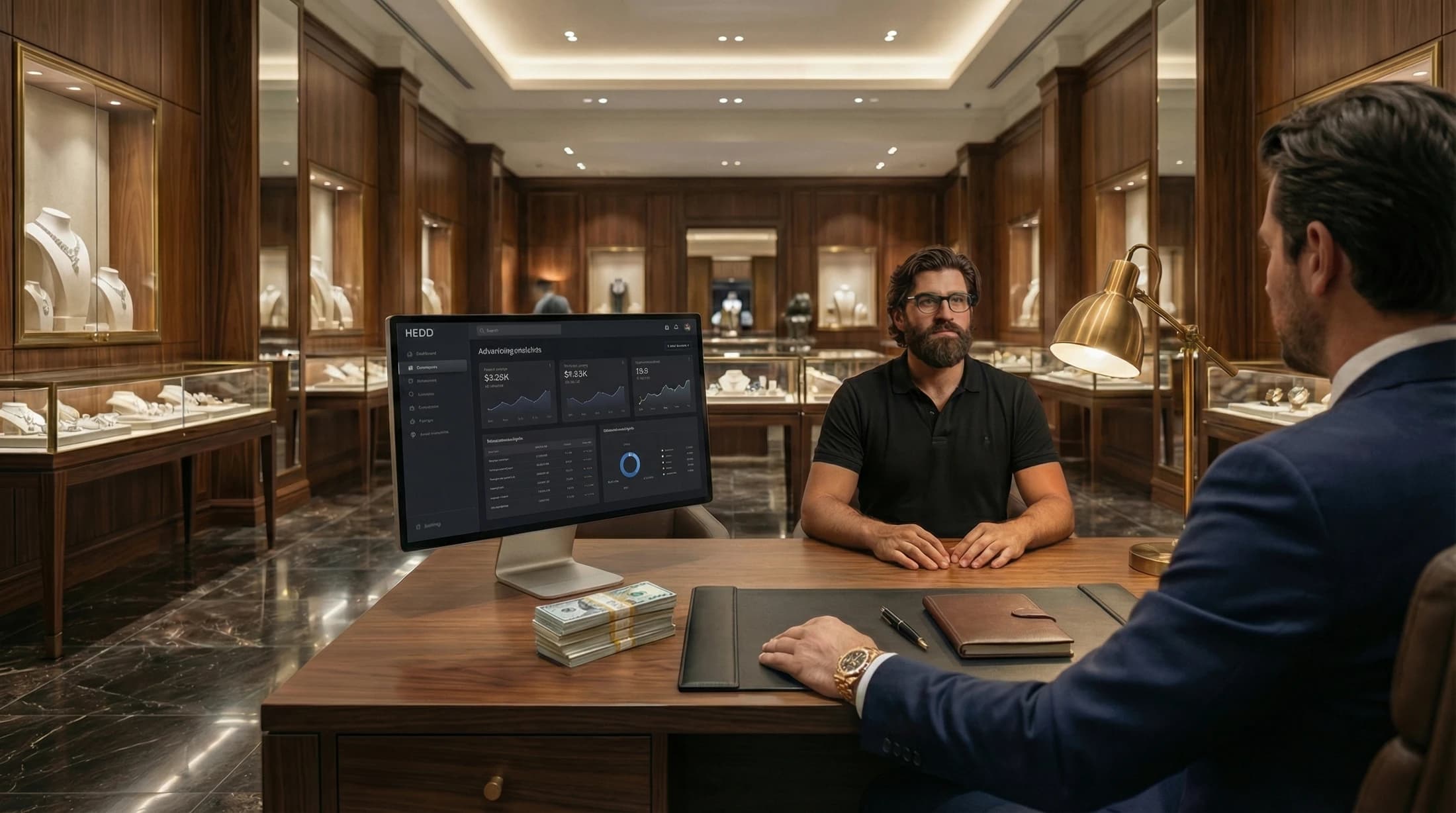



Most luxury jewelry and watch retailers burn between $5,000 and $15,000 per month on marketing. And most of them have no idea if it's actually working. Their agency sends a monthly report filled with "impressions," "clicks," and "CTR." Maybe there's a "cost per lead" number if they're lucky. But when the retailer looks at their register at the end of the month, they can't point to which sales came from which ads.
This is the "Black Box" of jewelry marketing. It's why the marketing budget feels like a leak you can't plug. The problem isn't that digital marketing doesn't work. The problem is that standard tracking wasn't built for a business where 81.4% of sales happen offline. According to Fortune Business Insights, the luxury watch market is still a high-touch, physical game. If your tracking stops at your website, you are only measuring 20% of the picture. You're flying blind.
The Silent Gap in Your Attribution
A large share of first-time purchase revenue is not captured by standard marketing dashboards. The luxury buying cycle is long: in H&CO client data, 20 days on average for an authorized Rolex or Patek Philippe dealer and 22 days for a custom engagement ring.
Across both categories, 70% of buyers take longer than 14 days to move from initial research to an in-store swipe. These are your most profitable customers, people who did the work, did the research, and came in ready to spend five figures. Yet your agency is likely telling you to turn off the very ads that brought them in because the "last-click" data looks poor (H&CO client data).
Why Standard Attribution Fails Luxury Jewelers
If you sell $50 t-shirts on Shopify, attribution is easy. A customer clicks an ad, buys the shirt, and the pixel records the win. But if you sell a $15,000 Audemars Piguet Royal Oak or an $8,000 Cartier Love Bracelet, the journey is a jagged line.
The technical reason is brutal. Safari accounts for over half of all mobile traffic in the US, and its Intelligent Tracking Prevention (ITP) has blocked all third-party cookies entirely since 2020. On top of that, ITP caps first-party script-writable storage (LocalStorage, document.cookie set via JavaScript, IndexedDB) to 7 days when there's been no user interaction with your site. If a tracking script writes a cookie and the user doesn't come back within a week, that identifier is gone.
Here's what that looks like in practice:
- Day 1: A customer clicks your Instagram ad and browses $15,000 engagement rings.
- Day 8: The customer returns to your site to show their partner. Safari has already purged the script-written identifier.
- Day 20: The customer walks into your store and buys the ring.
To Meta and Google, that customer is a "New, Direct Visitor." The original ad click that started the entire journey is nowhere to be found. Because 70% of your customers take longer than 14 days to buy, standard tracking is systematically deleting the "proof" that your marketing works (H&CO client data).
Without server-side attribution and CRM integration, you are optimizing your budget based on the 30% of people who buy quickly (often lower-value fashion jewelry) rather than the 70% who take their time on high-value bridal and watches. You're training the algorithms to find you more quick, small buyers instead of the slow, big spenders who actually move your bottom line.
The Four Layers of Real Attribution
To see the truth, you need a multi-layered tracking strategy that goes beyond the browser pixel.
| Layer | What It Tracks | Tool | Why It Matters |
|---|---|---|---|
| Call Tracking | Phone calls to ad keywords | CallRail (dynamic number insertion) | Often the first real conversion |
| Offline Conversion | In-store sales to ad clicks | Google/Meta OCT (hashed email upload) | Algorithms optimize for buyers, not clickers |
| CRM Integration | Lead source to purchase | POS/CRM with UTM tagging | Connects $12K sale to original search |
| Store Visit Data | Foot traffic from ads | Google Ads Store Visits | Physical visits driven by digital ads |
1. Call Tracking: Connecting Conversations to Keywords
The first real "conversion" is usually a phone call. Without call tracking, you have no idea which keywords are actually ringing the bell. We use dynamic number insertion (DNI) through tools like CallRail. Each visitor sees a unique phone number tied to their source. When they call, you know exactly which ad brought them in.
2. Offline Conversion Tracking (OCT): The "Holy Grail"
This is the process of importing your POS data back into Google Ads and Meta. When a customer makes an in-store purchase, you upload a hashed version of their email or phone number. Google and Meta match that data against their users. If that customer clicked an ad in the last 90 days, the platform records an "Offline Conversion." This allows the ad algorithms to optimize for actual *buyers*, not just clickers.
3. CRM Integration: The Single Source of Truth
Your POS or CRM should be the anchor. Every lead that comes through your website must be tagged with its marketing source using UTM parameters. When that lead eventually makes a purchase in-store, your CRM connects the revenue back to the original source. You can finally say, "This $12,000 sale started with a Google Search for 'Piaget Authorized Dealer'."
4. Google Ads Store Visit Data
For retailers with enough foot traffic and Google Business Profile activity, Google can estimate how many people physically visited your store after clicking or viewing an ad. While it's an estimate, it provides a "foot traffic lift" metric that impressions alone can't touch. It's the pulse of your physical location.
How We Close the Gap: H&CO Felix
The four layers above get you most of the way there. But they still rely on browser-based tracking that Safari and privacy regulations are actively dismantling. That's why we built H&CO Felix, online-to-offline attribution software designed specifically for jewelry and watch retailers.
Felix isn't a dashboard that sits on top of Google Analytics. It's infrastructure that integrates directly with your POS system, your CRM, your Google Ads account, your Meta Ads account, and your server-side tracking.
Server-side tracking that outlasts Safari's limits. Server-side first-party cookies aren't subject to the same 7-day cap that ITP imposes on script-written storage. Felix extends your attribution window to 90 days, which covers the full buying cycle for watches and custom jewelry.
In-store purchase matching. When a customer buys in-store and gives their email at the point of sale, Felix matches that email against the ad interaction that first brought them to your website, even if that click was 20 or 30 days ago. The sale that looked "unattributed" in your dashboard now has a clear source.
Revenue deduplication across Google and Meta. Without deduplication, both platforms claim credit for the same sale. If a customer clicked a Google Ad on Day 1 and a Meta Ad on Day 10, your ROAS numbers are inflated by 30-50%. Felix assigns the revenue once, to the right interaction, so your budget decisions are based on real numbers.
Full-path POS integration. Most attribution tools stop at the website conversion (a form fill or a phone call). Felix connects to your point-of-sale system so you can see the full path: ad click, website visit, phone call, store visit, register transaction. That's the chain luxury retail runs on, and it's the chain standard tools break.
Every H&CO engagement includes Felix as part of the infrastructure. It is how we prove your marketing is working.
The Metrics That Actually Matter
Stop looking at vanity metrics. If your agency is leading with "Reach" and "Impressions," they are hiding a lack of results. What a jewelry and watch retailer should be tracking is Cost Per Qualified Lead (CPQL) and Cost Per Appointment.
For high-end bridal and authorized watch dealers, the appointment is the primary bridge to the sale. Your true North Star is Return on Ad Spend (ROAS) including those offline sales. And don't forget Customer Lifetime Value (LTV). A $5,000 engagement ring sale is often just the beginning of a 10-year relationship. Your attribution should account for the long game.
How to Get Started (Without an Enterprise Budget)
You don't need a six-figure software stack to fix your measurement problem. A 15-person jewelry store can get 80% of the way there with Google Ads Offline Conversion Imports, CallRail, and a CRM with source tracking.
Implementation typically takes 2-4 weeks. After 90 days of data, you'll have enough signal to stop guessing and start allocating your budget based on what actually drives the register. If you're spending on marketing but can't trace it to revenue, that is a measurement problem.
Want to see the data behind your marketing spend? Book a strategy call. We'll audit your current tracking and show you exactly how to connect your digital ads to your in-store revenue. Stop guessing and start counting.

About the author
Hagop Imasdounian
Hagop Imasdounian is the founder of H&CO. Raised around his family’s jewelry businesses, he brings more than 15 years of digital marketing experience to helping jewelry and watch brands improve their websites, reach buyers and connect marketing with sales.