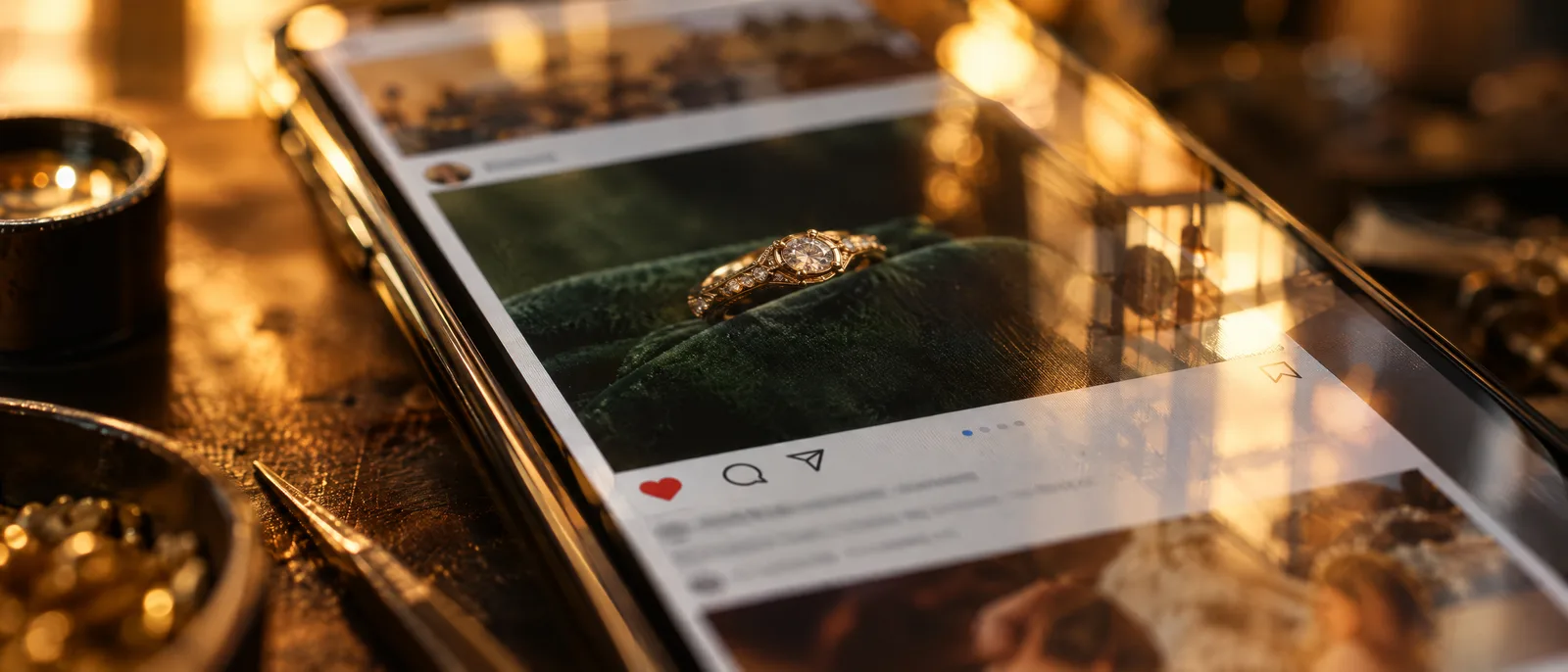

Open Instagram right now. Search for any luxury jewelry or watch retailer in your area. Scroll their feed. You'll see the same thing on every account: ring on velvet. Diamond on white. Watch on wrist, no context. "DM for details." Maybe a candle in the background if they're feeling creative.
Now think about what you actually stopped scrolling for today. A mechanic rebuilding a vintage engine. A chef breaking down a whole fish. Someone hiking a trail in Patagonia. A fifteen-second clip of a glassblower that you watched three times.
That's your competition. Not the jeweler two towns over. Not the retailer across the street. Your posts sit in the same feed as the most interesting content on the internet, and the algorithm treats them all the same. If your content doesn't hold attention, it doesn't get shown. Period.
Here's the pattern we see constantly: a jewelry and watch retailer hires a 20-year-old, hands them the company Instagram, and says "post some stuff." They photograph products on white backgrounds for twelve months. Followers grow by maybe 500. Engagement stays flat. The owner looks at the numbers after a year and says social media doesn't work for their business.
Social media works. The content strategy doesn't.
This post breaks down what to post instead, why it works with how the algorithms actually function in 2026, and how to produce it without a production budget.
Why Product Photos Fail on Social Media
The Algorithm Doesn't Care About Your Inventory
Instagram's algorithm in 2026 ranks content on three signals above everything else: watch time, likes per reach, and sends per reach. Adam Mosseri confirmed watch time as the number one ranking factor in January 2025, and nothing has changed since. The first three seconds are weighted heaviest, Instagram measures whether viewers continue watching past that initial window.
A static product photo gets scrolled past in under one second. There's no watch time to measure. Nobody saves a photo of a ring they can see on twenty other accounts. Nobody DMs it to a friend. So the algorithm does exactly what you'd expect: it shows it to almost no one.
Likes, by the way, are now the weakest engagement signal on the platform. If your social media strategy is optimized around getting likes on product photos, you're optimizing for the metric that matters least.
Meta's October 2025 algorithm update pushed 50% more Reels into Facebook feeds, and Instagram has been following the same trajectory. The recommendation engine now surfaces more Reels from creators who published content that day. Short-form video gets a distribution advantage that static images simply don't have access to. The platform is telling you what it wants. Nobody is listening.
And the baseline numbers are brutal. Luxury brand accounts average 0.2% engagement on Instagram according to Dash Social's 2026 benchmarks. If you have 3,000 followers and post a product photo, roughly six people interact with it. That's the reality of posting catalog content to a feed that rewards storytelling.
You're Competing With Everything, Not Just Other Retailers
Social feeds are interest-based, not industry-based. Your ring photo doesn't sit in a jewelry-specific section of Instagram. It sits between a car restoration video and a travel Reel from someone in the Maldives.
Short-form videos generate 2.5 times more engagement than long-form content, and Instagram Reels deliver 22% more engagement than standard posts.
The Six Content Types That Actually Work
If product photos are out, what goes in? These six content types are what we see driving real engagement, real saves, and real store visits for jewelry and watch retailers.
1. Behind-the-Scenes Process
Film your bench jeweler setting a stone. Shoot the watchmaker disassembling a movement. Capture the wax carving, the polishing wheel, the moment a prong closes over a diamond. This content works because it shows something almost nobody gets to see. The process behind the finished product is inherently fascinating, and it signals competence without you having to say a word about quality. A 15-second Reel of a hand-engraver at work will outperform a polished product photo every single time because it holds attention. People watch it twice. They send it to someone. Those are the exact signals the algorithm rewards.
2. Client Stories Without Showing the Client
You can't post your client's face with their $40,000 purchase. You shouldn't. But you can tell the story. A custom engagement ring that started as a napkin sketch. A three-generation estate piece that came in for restoration. The couple who flew in from out of state because they'd seen your work online. Tell the journey, show the piece, skip the person. The narrative carries the emotional weight without compromising anyone's privacy. These posts get saved and shared at rates that product photos never touch because they're stories, not listings.
3. Education That Positions You as the Expert
Show your audience what separates a well-cut stone from a mediocre one. Explain why two watches at the same price point aren't remotely comparable. Walk through what makes a particular movement worth the money. This positions you as the authority in your market, the person buyers trust before they walk through the door. Educational content also has the longest shelf life of anything you'll post. A Reel explaining how to read a GIA report gets saved, bookmarked, and referenced months later. That persistent engagement tells the algorithm your account produces content worth distributing.
4. Local Community Content
You're a local business. Act like one. Post about your neighborhood, the restaurant next door, the charity event you sponsored last weekend, the street fair that brings foot traffic past your windows. This does two things. First, it makes your account feel human and connected to a place, not like a faceless brand account. Second, it triggers local distribution. When you tag locations, mention local businesses, and engage with community content, Instagram surfaces your posts to more people in your area. Those are the people who can actually walk into your store. A national audience of jewelry enthusiasts is worth far less than 5,000 local followers who drive past your location every week.
5. The Team
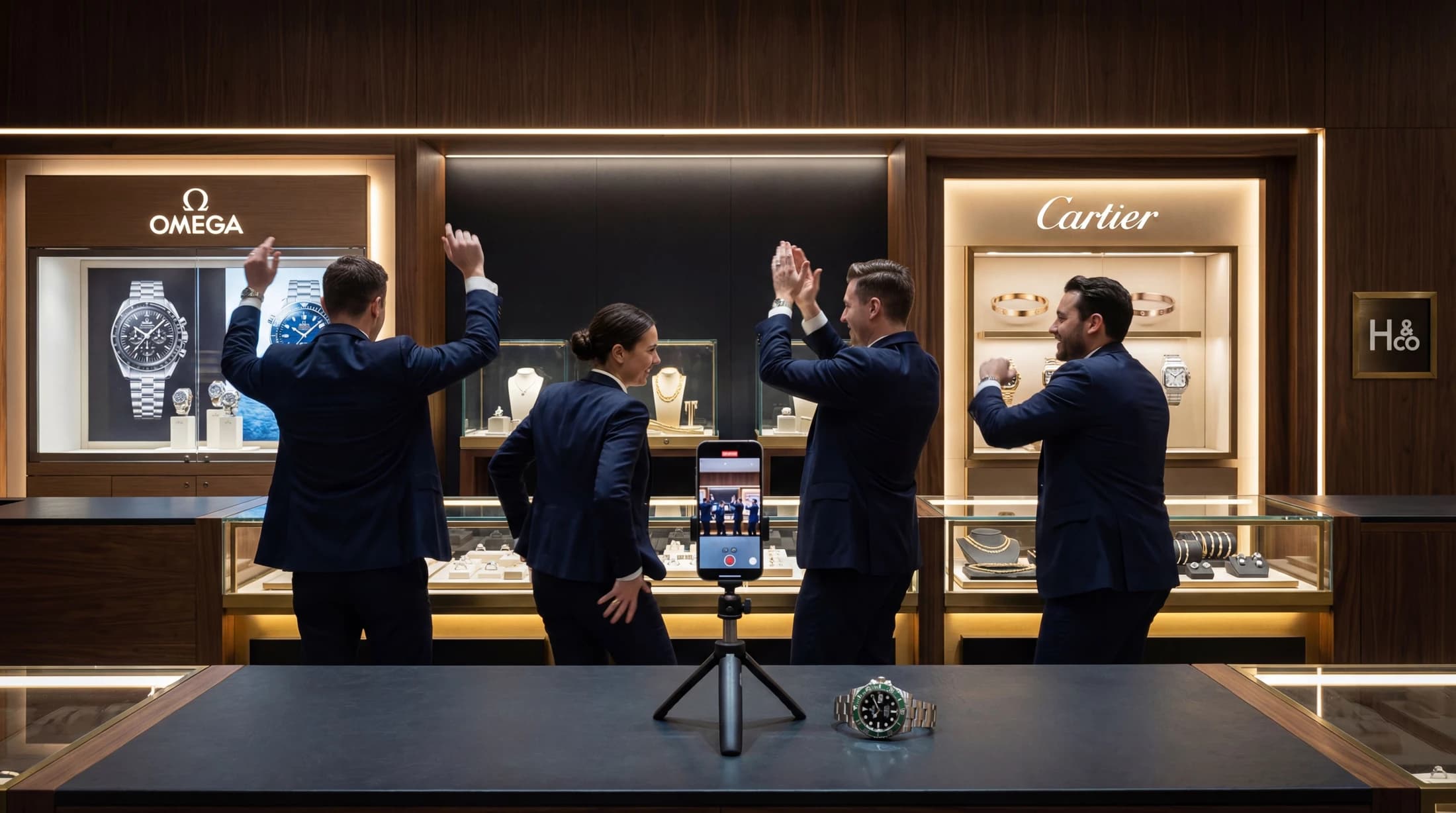
Introduce your people. Not with a corporate headshot and a title card, but with real moments. Your sales associate who's been with you for 15 years and knows every repeat client by name. Your gemologist geeking out over a new parcel. The new hire on their first day. People buy from people they know, and in luxury retail, the relationship with the salesperson is often the reason a client stays loyal for decades. When a potential buyer has already "met" your team through your feed, the first in-store visit feels familiar instead of intimidating. That lowers the barrier to walking through the door.
6. The Opinion Post
Take a stance. Lab diamonds vs. natural. Overrated watch brands. Why most online jewelry purchases are a gamble. Why the secondary market is misunderstood. Opinion content is uncomfortable because it risks alienating someone. That's exactly why it works. A strong take generates comments, debate, shares, and saves. It signals that there's a real person with real experience behind the account, not a marketing intern running a content calendar. You don't need to be controversial for the sake of it. You need to say what you actually think about a topic you know well. Your best clients will respect it. The people who disagree were never going to buy from you anyway.
The feed is where trust starts for luxury retail in 2026. Fix the content, and everything downstream improves.
Need a social strategy built for luxury retail? Talk to H&CO.

About the author
Hagop Imasdounian
Hagop Imasdounian is the founder of H&CO. Raised around his family’s jewelry businesses, he brings more than 15 years of digital marketing experience to helping jewelry and watch brands improve their websites, reach buyers and connect marketing with sales.