
Local SEO for a jewelry store means optimizing your online presence so your store appears when someone nearby searches for what you sell, whether on Google Maps, in the local pack, or in organic results. 46% of all Google searches have local intent (Search Engine Roundtable, Dec 2025). When someone searches "engagement rings near me" or "Rolex dealer Dallas," Google prioritizes businesses that are geographically close, contextually relevant, and well-established in their market.
Local searches convert at 28%, well above any other digital marketing channel (Think With Google, 2025). More than one in four people who search locally take action: they call, they visit, they buy.
For a luxury watch and jewelry retailer with a physical location, local SEO jewelry store optimization is the highest-ROI digital marketing investment you can make. We prioritize it with every retail client before we touch paid ads. Every improvement to your local presence, a better Google Business Profile, more reviews, cleaner citations, compounds over time and produces results long after the work is done.
This guide covers exactly what to do, in what order, to make sure your store shows up when someone in your city searches for what you sell.
*This article is part of our SEO series for luxury retailers. For content strategy, see How to Build Content That Ranks. For AI search optimization, read How to Show Up When Customers Ask AI Where to Buy.*
How Should a Jewelry Store Optimize Its Google Business Profile?
Google's own documentation on local ranking states that results depend on three factors: relevance, distance, and prominence. You can't control distance (the searcher's location determines that). But you can directly influence relevance and prominence through your Google Business Profile.
A fully optimized GBP is the single highest-impact move for local SEO jewelry store rankings. For many luxury jewelry searches, the map pack (the top 3 local results with the map) appears above all organic results. If you're not in the map pack, you're invisible to the highest-intent local searchers.
Categories: Be Specific
Your primary category should be the most accurate description of your main business: "Jewelry Store," "Watch Store," or "Jeweler." Then add every relevant secondary category.
Secondary categories to consider:
- Diamond Dealer
- Watch Repair Service
- Custom Jewelry Designer
- Ring Resizing Service
- Jewelry Appraiser
- Estate Jewelry Store
- Wedding Ring Shop
- Watch Store (if primary is Jewelry Store)
- Jewelry Store (if primary is Watch Store)
Each secondary category is a signal to Google about what searches you're relevant for. A store with only "Jewelry Store" as its category is invisible for "watch repair near me" even if they offer watch repair.
Business Description
You have 750 characters. Use them strategically. Include your city name, your specialties, your credentials, and what makes you different.
Weak: "We are a full-service jewelry store offering a wide selection of fine jewelry and watches."
Strong: "Family-owned jewelry store in [City] since 1985. Authorized dealer for Omega, TAG Heuer, and David Yurman. Specializing in custom engagement rings, GIA-certified diamonds, and luxury watch service by factory-trained watchmakers. Private appointments available."
The second version tells Google and the customer exactly what you do, where you are, how long you've been doing it, and why you're worth visiting.
Hours, Attributes, and Details
Hours: Keep them current. Update for holidays, special events, seasonal changes. Google tracks whether your listed hours match your actual availability. Inconsistency hurts.
Attributes: Fill in every relevant one. "Wheelchair accessible," "Free parking," "Private appointments available," "By appointment only." Each answers a question a potential customer might have and adds a relevance signal for Google.
Products and services: Add your service offerings with descriptions and price ranges. "Custom Engagement Ring Design, Starting at $3,000" gives Google content to match against relevant searches and gives the customer a reason to click.
Photos: Fresh, Real, Regular
Google tracks photo freshness. Stores with recent photos rank better and get more engagement than stores with stale or no photos.
What to upload monthly:
- Storefront exterior (so people recognize you when they arrive)
- Interior shots (so they know what to expect)
- Product photography (your actual inventory, not stock images or brand-provided photos)
- Team photos (faces build trust, so name your team members in the photo captions)
- Event photos (trunk shows, VIP nights, community events)
Aim for 5-10 new photos per month. They don't need to be professional grade. iPhone photos of real moments in your store outperform polished stock images every time.
Google Posts: Weekly Freshness Signals
Google Posts appear on your GBP and in some search results. They expire after 7 days, so consistency matters.
What to post weekly:
- New arrivals ("Just landed: the 2026 Omega Seamaster collection")
- Upcoming events ("This Saturday: trunk show with [Brand]. RSVP in bio.")
- Blog post links ("New on our blog: How to Choose an Engagement Ring in [City]")
- Seasonal content ("Valentine's Day is 2 weeks away. Here are our top picks.")
Each post is a freshness signal to Google and a reason to re-crawl your profile. A GBP that gets updated weekly outranks a GBP that hasn't been touched in months. For a framework on what to post and when, see our content calendar guide.
How Do Reviews Affect Local SEO for Jewelry Stores?
According to the GatherUp Beyond the Stars 2025:
- Expect businesses to respond to reviews
- BrightLocal, 2026
- Discouraged by generic or templated replies
- BrightLocal, 2026
- Won't use a business with fewer than 20 reviews
- BrightLocal, 2026
- Require a minimum of 4 stars
- BrightLocal, 2026
- Want reviews from the last 3 months
- BrightLocal, 2026
- Wrote a review when asked
- BrightLocal, 2026
For any local SEO jewelry store strategy, reviews affect both your ranking and your conversion rate. They also affect whether AI search engines cite your business, since ChatGPT and Perplexity cross-reference reviews when assembling recommendations. A store with 300 reviews averaging 4.7 stars will rank better and convert more clicks to visits than a store with 30 reviews at a perfect 5.0.
How to build review volume
Ask every customer. After the purchase, after the pickup, after the repair. The ask should be specific and easy: a follow-up text or email with a direct link to your Google review page. One tap to leave a review, not a three-step process.
Time the ask right. The best moment is when satisfaction is highest, right after they see the finished custom piece, right after the watch comes back from service looking new, right after the engagement ring reveal.
Make it systematic, not occasional. 78% of consumers who were asked to write a review did so (BrightLocal, 2026). The biggest barrier to review volume isn't reluctant customers. It's stores that forget to ask.
Train your team. Every associate should know how to ask for a review and how to send the link. "We'd love to hear about your experience. Can I text you our Google review link?" takes five seconds and produces results that last years.
How to respond to reviews
Every review gets a response. Positive and negative. Within 24-48 hours.
Positive reviews: Personal, specific, grateful. Reference something specific about their visit. "Thank you, Sarah! It was a pleasure helping you design your engagement ring. We hope Michael loved the surprise." Not "Thank you for your kind words! We look forward to serving you again."
Negative reviews: Empathetic, professional, take it offline. "We're sorry to hear your experience didn't meet expectations. We'd like to make this right. Please call us at [number] so we can discuss this personally." Never argue publicly. Never be defensive.
What Are Local Citations and Why Do They Matter for Jewelers?
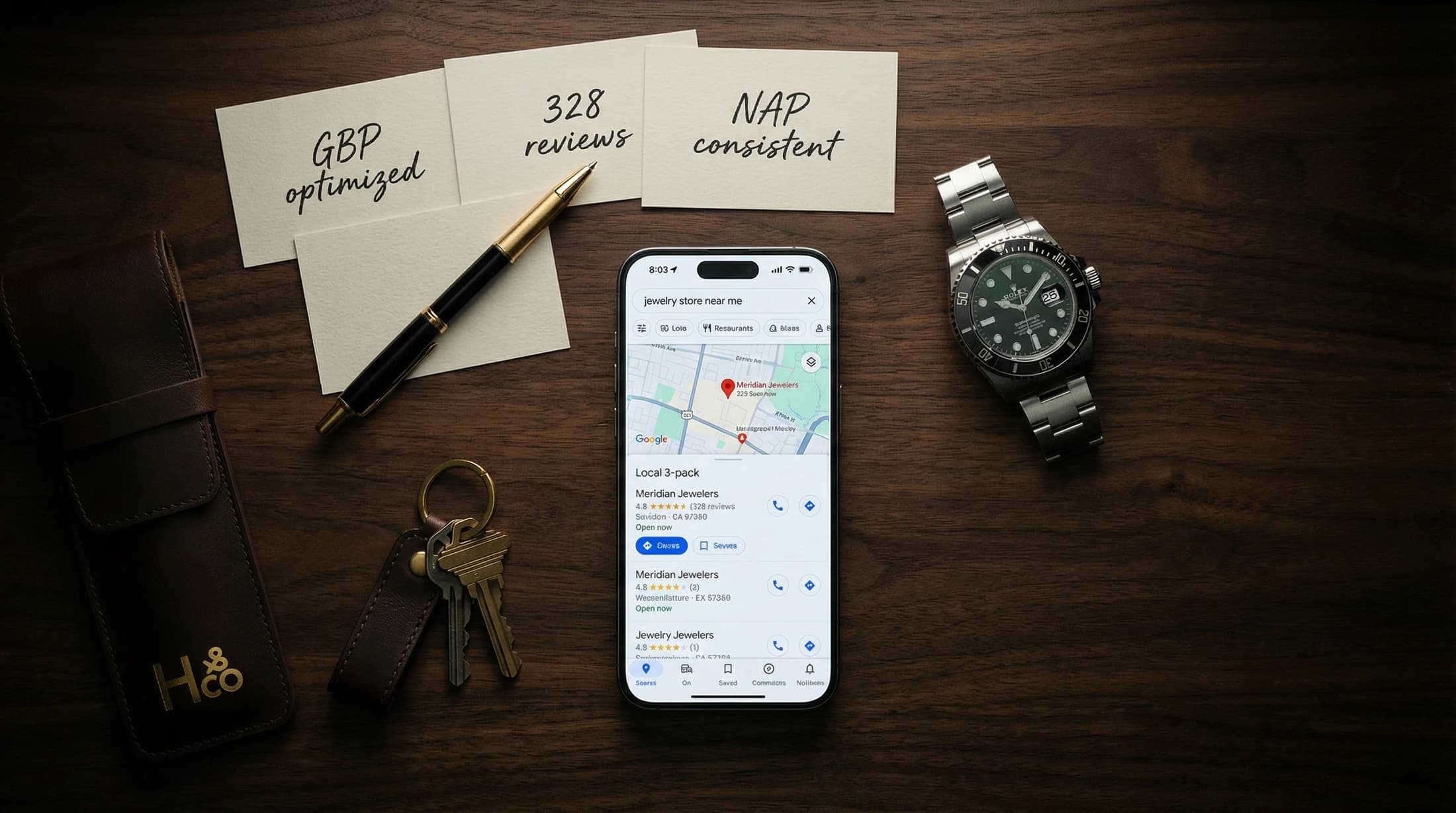
Your NAP (name, address, phone) must be identical everywhere. Not similar. Identical. If your Google listing says "Johnson's Fine Jewelers," your Facebook says "Johnsons Fine Jewelry," and your Yelp says "Johnson Jewelers," Google sees three different businesses and trusts none of them.
Where to check and fix:
Priority 1 (high authority):
- Google Business Profile
- Bing Places for Business
- Apple Maps Connect
- Yelp
- Facebook Business Page
Priority 2 (industry-specific):
- Jewelers of America directory
- American Gem Society directory
- JCK retailer listings
- Brand-specific authorized dealer locators (Rolex, Omega, etc.)
- Local chamber of commerce
Priority 3 (general directories):
- Better Business Bureau
- Yellow Pages / YP.com
- Angi (formerly Angie's List)
- Local business directories specific to your city
Audit these annually. Business moves, phone number changes, and rebrands create inconsistencies that accumulate over time. Entity consistency across these platforms also affects how AI search engines evaluate your business.
What Local Content Should a Jewelry Store Publish?
Blog posts and pages with local keywords signal relevance to Google for location-specific searches. Every piece of local content is another opportunity to rank for a "[city] + [product/service]" query.
Brand + city pages
Every brand you carry should have a dedicated page targeting "[brand] + [city]." An authorized Omega dealer in Dallas should have a page at `/brands/omega` with content targeting "Omega authorized dealer Dallas," "Omega watches Dallas," and "buy Omega Seamaster Dallas."
This captures demand the brand created through their own marketing. Rolex spends hundreds of millions on advertising globally. When someone in your city searches "Rolex dealer [city]," a dedicated brand page with unique content and local signals ensures your store appears, not the brand's website or a grey market dealer.
We build these for every retail client. One authorized dealer we work with went from invisible for "[brand] + [city]" searches to ranking in the top three for all six of their brand terms within five months. The content on each page matters. It can't be the brand's own marketing copy repurposed. It needs to communicate what your store brings: your team's expertise with that brand, your service capabilities, your history with the collection. Bain & Company reports brands are increasingly selling direct and reducing wholesale. Your brand pages need to answer one question: why buy this here instead of from the brand itself? For how to write this type of content so it ranks in both Google and AI search, see our content strategy guide.
Service + city pages
If you offer watch repair, jewelry appraisals, ring sizing, or custom design, each service needs a page targeting "[service] + [city]."
"Watch repair [city]" is a high-intent search with less competition than product searches. The customer searching for watch repair needs a physical location. There is no online alternative. These keywords convert to store visits at an extremely high rate.
Neighborhood and landmark content
Reference specific neighborhoods, landmarks, and local context in your content. "Located in the [City] Design District, two blocks from [Landmark]" anchors your content geographically in a way that "[City] jewelry store" alone doesn't.
Multi-Location Stores
If you have two or more locations, each needs its own:
- Google Business Profile (separate listing, separate management)
- Landing page on your website (unique URL, unique content, unique NAP)
- Location-specific content (blog posts, event pages, community involvement)
Do not use one page for all locations. A single page listing "Our locations: Dallas, Houston, Austin" dilutes local relevance for every city on the list. Each location competes in its own market and needs dedicated local signals.
How Do You Measure Local SEO Results for a Jewelry Store?
Google Business Profile Insights: Track views, searches, calls, direction requests, and website clicks from your GBP. These are the most direct measures of local SEO performance.
Google Search Console: Monitor which local queries drive impressions and clicks to your website. Filter by query to see performance for "[city] + [product]" terms.
Rank tracking: Monitor your map pack position for target local keywords weekly. Tools like BrightLocal (which we use for industry research, not as a product recommendation) track local rankings by location.
Call tracking: Assign a unique phone number to your GBP to track how many calls come from local search specifically. This connects local SEO investment to a measurable business outcome.
*For the complete SEO strategy including e-commerce, content, and technical SEO, read SEO for Luxury Watch and Jewelry Retailers. For how AI search is changing local discovery, see How to Show Up When Customers Ask AI Where to Buy.*
Local SEO jewelry store work is not a one-time setup. It's an ongoing system that rewards consistency.
Want a local SEO audit? Book a call and we'll pull your current rankings, review your GBP, and show you exactly where the gaps are.

About the author
Hagop Imasdounian
Hagop Imasdounian is the founder of H&CO. Raised around his family’s jewelry businesses, he brings more than 15 years of digital marketing experience to helping jewelry and watch brands improve their websites, reach buyers and connect marketing with sales.