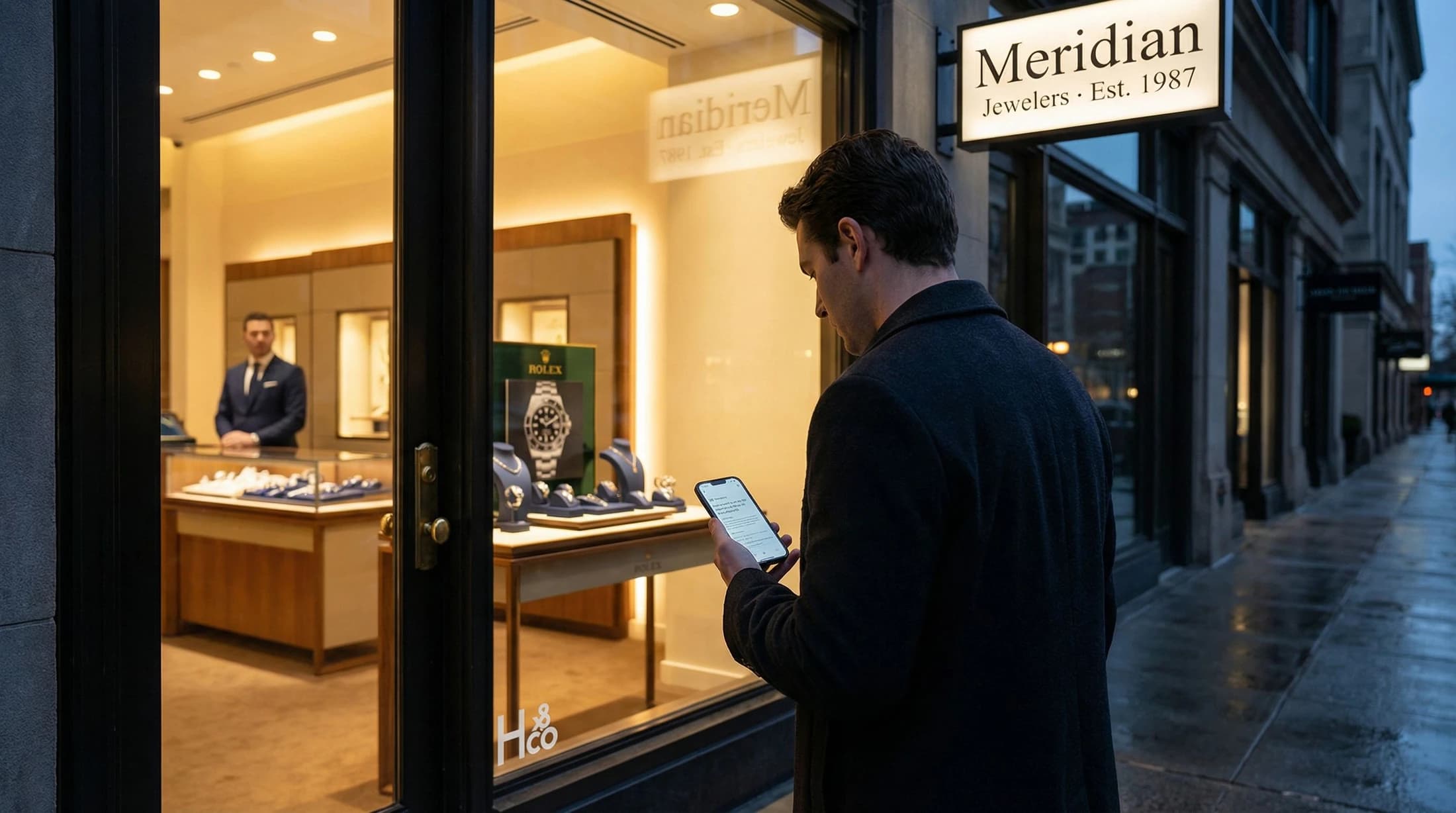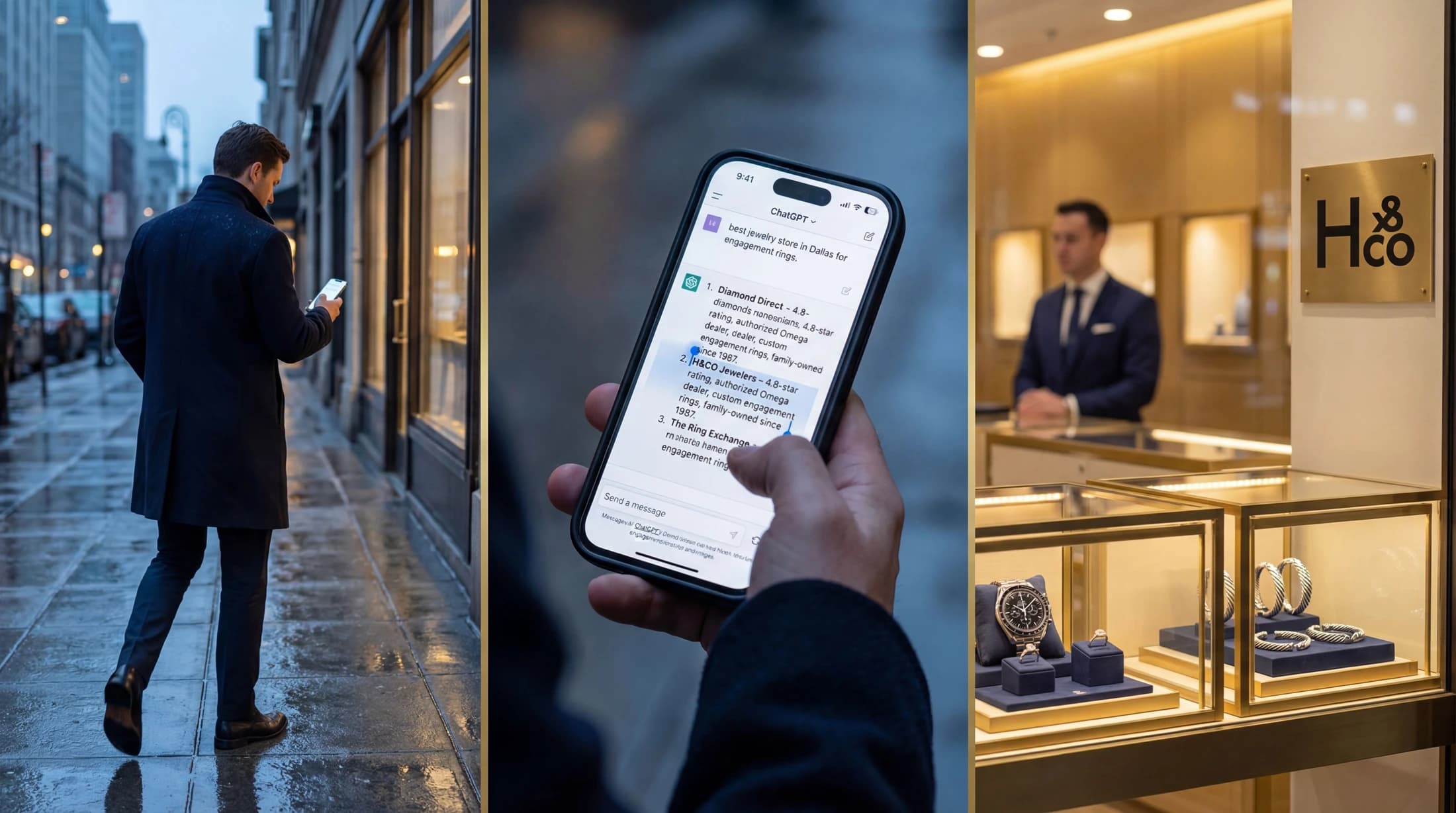


Generative Engine Optimization (GEO) is the practice of structuring your web content so AI search engines, including ChatGPT, Google AI Overviews, and Perplexity, can find, understand, and cite your business. 45% of consumers now use ChatGPT or other AI tools to evaluate local businesses. Last year, that number was 6% (GatherUp Beyond the Stars 2025). That is a behavior change happening in real time.
ChatGPT has over 900 million weekly active users (OpenAI, September 2025). 49% of those conversations are "asking," people using it as an advisor for decisions, recommendations, and research. Google AI Overviews now appear across a growing share of search results, synthesizing answers instead of listing links. Perplexity, Claude, and other AI search tools are gaining traction with research-heavy buyers.
When a luxury watch or jewelry buyer asks an AI "best jewelry store in Scottsdale for custom engagement rings" or "where should I buy an Omega Seamaster in Dallas," the AI doesn't show ten blue links. It assembles an answer. It cites specific businesses, pulls from structured web content, and recommends based on what it can verify.
If your website has vague marketing copy, "We create timeless pieces for discerning clients," the AI has nothing to work with. If your website has clear, factual, structured content, "We are a family-owned jewelry store in Scottsdale, AZ, specializing in custom engagement rings, estate jewelry, and authorized Omega watches since 1985," the AI can cite that.
GEO generative engine optimization for luxury retail is the competitive advantage almost nobody in the industry has started working on. We've been testing AI citability for our clients since late 2025. The results are consistent: retailers with structured, factual, specific content get cited. Retailers with vague marketing copy don't.
Takeaways:
- GEO generative engine optimization for luxury retail means structuring content so AI search can find and cite your business
- AI assembles answers from crawled data, structured data, and live website content, so consistency across all three matters
- Citable content is specific, factual, and self-contained. Vague marketing copy gets ignored.
- Entity signals (Google Business Profile, reviews, press mentions, schema markup) build the trust AI needs to recommend you
- The window to gain a first-mover advantage is now, while nobody has started
*This article is part of our SEO series for luxury retailers. For how to structure content for AI citability specifically, see What Makes Your Content Citable. For the broader consumer behavior shift, read 45% of Consumers Now Use AI to Evaluate Local Businesses.*
How Do AI Search Engines Decide What to Recommend?
AI search doesn't work like traditional search. Understanding the difference is the first step.
- How results form
- SEO: Ranks existing pages. AI: Synthesizes a new answer from multiple sources.
- What gets shown
- SEO: 10 blue links. AI: A generated paragraph citing 2-5 sources.
- Selection criteria
- SEO: Backlinks, authority, on-page signals. AI: Factual density, entity clarity, passage structure.
- User behavior
- SEO: Clicks through to your site. AI: Reads the answer in place, may never visit.
- What wins
- SEO: Comprehensive pages with authority. AI: Self-contained, citable passages with specific facts.
According to Microsoft Advertising's guide to AEO and GEO, AI systems use three data sources to form recommendations:
Crawled data: The information AI systems learned during training and retrieve from indexed web pages. This shapes your brand's baseline perception, your product categories, reputation, and market position.
Product feeds and structured data: The data you actively push to platforms through product feeds, schema markup, and APIs. This gives you control over how your products are represented in comparisons and recommendations.
Live website data: The real-time information AI agents see when they visit your site, including reviews, pricing, availability, and transaction capability. Traditional SEO remains relevant because AI systems perform real-time web searches throughout the shopping journey, and your site must rank well to be discovered, evaluated, and recommended.
The practical takeaway: AI doesn't read your website once and move on. It cross-references your web content, your structured data, your Google Business Profile, your social media, press mentions, reviews, and any other source it can access. Consistency across all of these is what builds the entity understanding that gets you cited.
What Makes Content Citable by AI Search Engines?
Not all content gets cited by AI. The content that does has specific structural qualities.
- Specific entity statements
- Citable. "We are an authorized Omega dealer in Scottsdale, AZ, specializing in custom engagement rings since 1985."
- Statistics with sources
- Citable. "89% of consumers expect owner responses to reviews (BrightLocal, 2026)."
- Question-and-answer format
- Citable. Clear H2 question followed by a direct, factual answer paragraph.
- Vague marketing copy
- Not citable. "We create timeless pieces for discerning clients."
- Walls of text
- Not citable. Long paragraphs without structure or specific claims.
- Generic descriptions
- Not citable. "We offer the best jewelry in town."
Self-contained paragraphs
AI pulls discrete passages, not whole pages. Each paragraph on your website should fully answer one specific question without requiring the reader to read surrounding context.
Not citable: "Our engagement rings are crafted with care, reflecting decades of expertise in the art of fine jewelry." (Vague. Doesn't answer a question. AI can't extract a useful fact from this.)
Citable: "Custom engagement rings at [Store Name] in [City] start at $3,000 for lab-grown diamond settings and $5,000 for natural diamond settings. The process takes 4-6 weeks from initial design consultation to finished piece. Every ring includes a GIA certification and lifetime maintenance." (Specific. Answers multiple questions. AI can cite this directly.)
Structured Q&A formatting
Format content as clear questions and answers. This mirrors how people query AI systems.
"What does a custom engagement ring cost in [City]? At [Store Name], custom engagement rings typically start at $3,000. The price depends on the center stone (lab-grown vs. natural, carat weight, quality) and the setting complexity. We offer a free design consultation to provide an exact quote."
AI engines can reason over this format, extract the answer, and cite your page as the source.
Modular, quotable blocks
Microsoft's AEO/GEO guide recommends providing "Q&A blocks AI can reason over and cite" and creating "modular, citable content." This means:
- Comparison tables ("Model A vs Model B" with specific differences)
- Feature lists with key/value pairs (not buried in prose)
- Product specifications displayed as structured data, not narrative text
- FAQ sections with direct, complete answers
Descriptive, specific titles
"About Us" tells AI nothing. "About [Store Name], Family-Owned Jewelry Store in [City] Since 1985" tells AI exactly what this page is about, who it's for, and why it's authoritative.
Google's own helpful content guidelines state that headings should be "descriptive rather than exaggerated or sensational." The same principle applies to AI citability, clear, factual titles get referenced. Clever or vague titles get skipped. For more on structuring content that AI can cite, see our guide on content strategy for luxury retailers.
How Do You Build an Entity That AI Recognizes?
Generative engine optimization for luxury retail starts with entity building. AI search engines don't read individual pages in isolation. They build an understanding of your business as an entity: who you are, where you are, what you do, what you're known for, and whether you're trustworthy.
This entity understanding is built from signals across the entire web, not only your website.
Consistency is everything
Your business name, address, phone number, specialties, and credentials must be identical across:
- Your website
- Google Business Profile
- Yelp, Bing Places, Apple Maps
- Facebook, Instagram, LinkedIn
- Jewelry industry directories (JCK, Jewelers of America, AGS)
- Any press mentions or publication features
If your website says you specialize in "custom engagement rings and luxury watches" but your Google Business Profile says "jewelry repair and appraisals," the AI sees two conflicting signals and trusts neither. Your local SEO foundation has to be consistent before GEO can work.
The owner's personal entity
For small and medium luxury retailers, the owner's personal brand is part of the business entity. The store owner's LinkedIn profile should reference the business with the same language used on the website. If the owner has authored articles, been quoted in trade publications, or spoken at industry events, those are entity signals the AI incorporates.
Google's E-E-A-T framework values named authors with visible expertise. A blog post signed by "Hagop Imasdounian, GIA-certified gemologist, founder of [Store Name]" carries more entity weight than an unsigned post from "[Store Name] Team."
Press and publication mentions
When InStore Magazine, JCK, National Jeweler, or a local publication mentions your store, that's a citation the AI cross-references. These third-party mentions confirm your entity in a way that your own website can't. It's someone else verifying who you are.
Pursue trade publication features actively. They pull triple duty: traditional SEO backlinks, E-E-A-T authority signals, and AI entity verification.
What Trust Signals Do AI Search Engines Look For?
Microsoft's AEO/GEO guide identifies trust as a distinct category of signals AI systems evaluate. AI penalizes low-trust language and prioritizes verified, factual content.
What Builds Trust for AI Systems?
Verified reviews with schema: Include reviews on your website marked with Review and AggregateRating schema. Surface review sentiment in a way AI can extract, like "highly rated for comfort and fit," is more citable than a star rating alone.
Certifications and credentials as factual entities: "GIA Certified Gemologist," "Authorized Rolex Dealer," "Member of Jewelers of America," surface these as facts, not marketing claims. AI can verify certifications against official databases.
Consistent brand voice across all touchpoints: Microsoft's guide notes that AI systems penalize inconsistency. If your website sounds professional and your Facebook page sounds casual and your Google Business Profile sounds like a different company, the AI's confidence in your entity drops.
No exaggerated or unverifiable claims: "The best jeweler in Dallas" is an unverifiable claim. "Family-owned since 1985, serving Dallas with custom engagement rings, luxury watches, and GIA-certified diamonds" is a factual statement AI can trust and repeat.
What hurts trust
- Inconsistent information across platforms
- Exaggerated superlatives without evidence
- Missing author attribution on content
- Content that reads as marketing copy rather than factual information
- Outdated information (old hours, discontinued products, former staff)
How Do You Ensure AI Crawlers Can Access Your Site?
For AI search engines to index your content, their crawlers need access to your website.
GPTBot (OpenAI/ChatGPT), ClaudeBot (Anthropic/Claude), and PerplexityBot (Perplexity) each have their own web crawlers. Check your robots.txt file to ensure these are not blocked.
Most jewelry retailer websites don't block AI crawlers by default, but some hosting platforms, security plugins, or CDN configurations block them without you knowing. Check your robots.txt at `yoursite.com/robots.txt` and confirm there are no `Disallow` rules targeting these bots.
llms.txt
An emerging practice: adding an `/llms.txt` file to your website, a structured plain-text summary of your business that AI systems can read quickly.
Include: business name, location(s), specialties, credentials, what sets you apart, founding year, and links to your most important pages. Think of it as a business card for AI crawlers.
This isn't yet an industry standard, but early adopters have a readability advantage. It takes 15 minutes to create and costs nothing.
How Do You Test Whether AI Search Cites Your Store?
Here's how to check where you stand right now.
Open ChatGPT, Perplexity, or Google AI Overviews. Ask:
- "Best jewelry store in [your city] for custom engagement rings"
- "Where should I buy an Omega in [your city]?"
- "Luxury jeweler in [your city] with good reviews"
- "Best place to get a watch serviced in [your city]"
If your store appears in the answers, your GEO foundation is working. Note exactly what the AI says about you and where it's pulling the information from.
If you're not mentioned, look at who is. Visit their websites. See what they have that you don't. Is their content more specific? Do they have more structured data? More reviews? More consistent entity signals?
Run this test monthly. Track your citations over time. As you implement the strategies in this guide, you should see your mentions increase.
Why Is Now the Time to Start GEO?
45% of consumers using AI to evaluate businesses is a trend line, not a ceiling. That number was 6% one year ago. Within 2-3 years, AI-assisted search will be the default for high-consideration purchases like jewelry and watches.
The retailers who build for generative engine optimization now, while competitors are still focused on traditional SEO and paid ads, will have a compounding advantage. Entity signals take time to build. Content takes time to index. Trust takes time to establish.
We ran the AI citation test for a client in the Mountain West, an authorized watch dealer with three brands and a strong custom jewelry program. Before GEO work, ChatGPT didn't mention them at all for jewelers in their city. Six months of structured content, schema markup, review responses, and consistent entity signals across all platforms later, they appeared in ChatGPT's recommendations for three of their five target queries. That advantage compounds. It happened because they started while their competitors were still focused on paid ads alone.
The window to be early is now. By the time every retailer is optimizing for AI search, the early movers will already own the citations.
*For the full SEO strategy including local SEO, brand pages, and e-commerce optimization, read SEO for Luxury Watch and Jewelry Retailers. For content strategy, see How to Build Content That Ranks. For the data on how consumers use AI for product research, see OpenAI's research on ChatGPT usage.*
Want to know if AI search engines can find your store? Book a call and we'll run the AI citation test for your business and show you exactly where you stand.

About the author
Hagop Imasdounian
Hagop Imasdounian is the founder of H&CO. Raised around his family’s jewelry businesses, he brings more than 15 years of digital marketing experience to helping jewelry and watch brands improve their websites, reach buyers and connect marketing with sales.