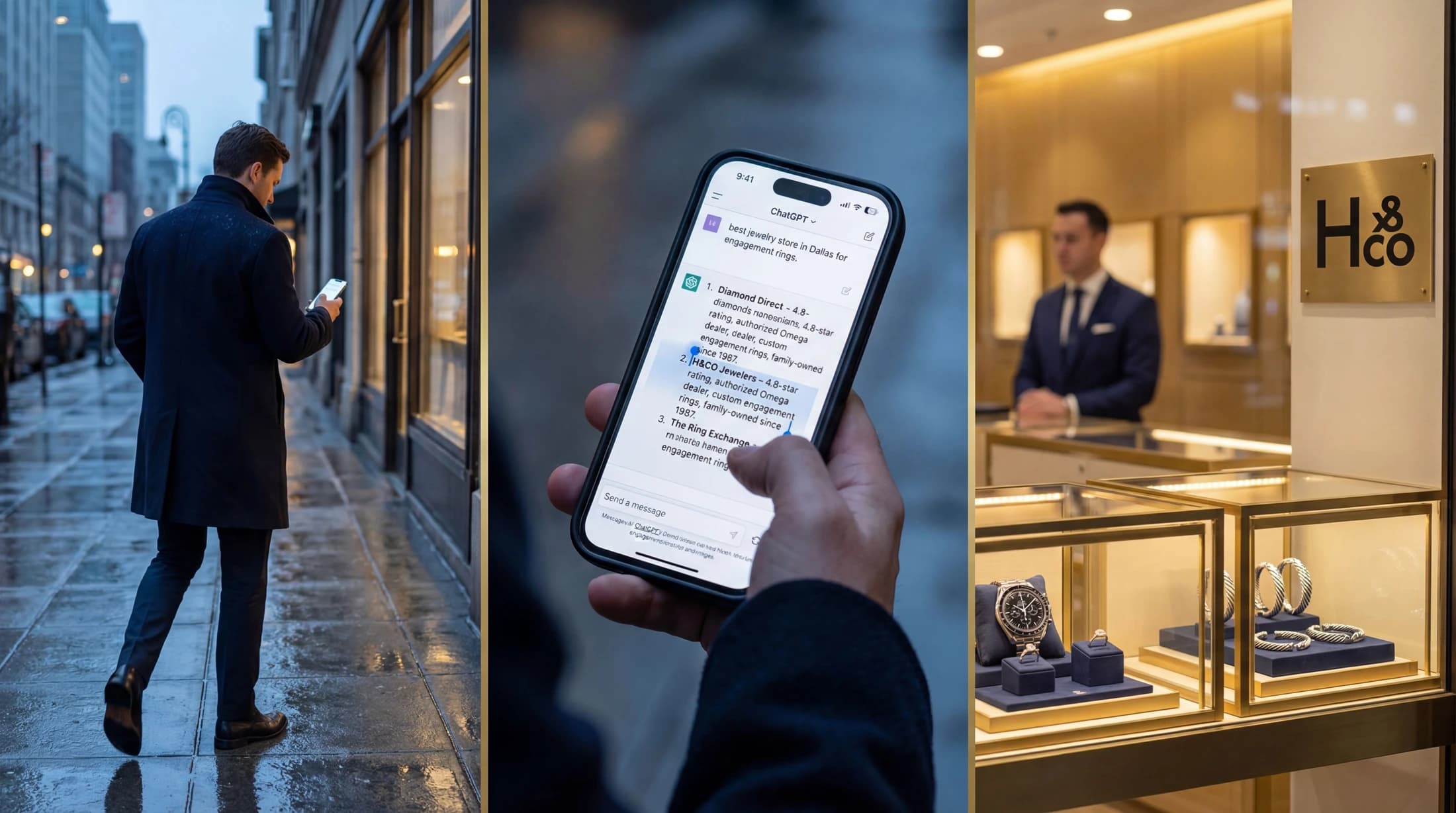

AI citability is the likelihood that AI search tools like ChatGPT, Perplexity, and Google AI Overviews will reference and cite your business when answering a user's query. A year ago, 6% of consumers used AI tools to evaluate local businesses. Today it's 45% (GatherUp, 2026). ChatGPT has over 900 million weekly active users, and 49% of those conversations are people using it as an advisor for decisions, recommendations, and research (OpenAI, September 2025). Google AI Overviews appear across a growing share of search results. Perplexity is processing hundreds of millions of queries per month.
When someone asks ChatGPT "where should I buy an engagement ring in Phoenix" or "best authorized Omega dealer in Miami," the AI assembles a synthesized answer. Your store is either in it or it isn't. Citability is the discipline of making sure you're in it.
Takeaways:
This article is part of our GEO series for luxury retailers. For the broader overview of GEO and how to rank in AI search, see 45% of Consumers Now Use AI to Evaluate Local Businesses. For the full SEO strategy, see SEO for Luxury Watch and Jewelry Retailers.
Research from Princeton (Aggarwal et al., KDD 2024) found that specific GEO techniques can increase content visibility in generative AI responses by up to 40%. The study tested nine distinct optimization strategies across 10,000 search queries and identified which content signals AI systems consistently respond to.
Why Does Paragraph Structure Determine Whether AI Cites You?
AI systems extract passages, not pages. When an AI assembles an answer, it identifies specific sentences or paragraphs that directly address the query, pulls them out of your content, and incorporates them into a synthesized response.
This means every paragraph on your site needs to be independently intelligible. It can't rely on surrounding context to make sense. The AI is picking individual blocks of text, not reading your whole page.
According to Microsoft Advertising's guide to AEO and GEO, AI engines "extract and recombine information" from your content, which means each unit needs to stand alone.
Compare these two paragraphs:
Not citable: "We've been helping couples find the perfect ring for over thirty years, and our expertise speaks for itself."
Citable: "[Store Name] in [City] specializes in custom engagement rings, offering lab-grown and natural diamonds starting at $2,500. We carry GIA-certified stones and provide 3D-printed prototypes before final fabrication. Custom orders take 4–6 weeks."
The second paragraph contains a business name, location, specialty, price range, certification, process detail, and timeline. An AI can extract that and use it to answer a specific customer query. The first paragraph gives an AI nothing it can use.
Where to apply this
Every service page, every FAQ answer, every brand page on your site. The about page. The store description. Service details with real specifics: what you offer, where you're located, what it costs, how long it takes, what credentials you hold.
If your website currently reads like a brochure, vague, general, aspirational, it is essentially invisible to AI search. AI can't cite "We create timeless pieces for discerning clients." It can cite "Our Scottsdale jewelry store specializes in platinum engagement rings, sapphire and colored stone settings, and diamond upgrades for existing jewelry."
What Makes a Heading Citable vs. What Gets Skipped?
AI systems use your headings to understand what a section is about. A vague heading tells the AI nothing. A specific heading tells the AI exactly what question that section answers.
Heading comparison:
Skipped: "Our Services" | Citable: "Custom Engagement Ring Services in [City]: Pricing, Timeline, and Process"
Skipped: "Watch Collection" | Citable: "Authorized Rolex and Omega Dealer in [City]: What We Carry and How to Buy"
Skipped: "About Us" | Citable: "About [Store Name]: Family-Owned Fine Jeweler in [City] Since [Year]"
The citable heading tells the AI: what service or product, where, and any relevant qualifier. If a customer asks an AI "who sells Rolex in [City]," an AI that has indexed a page titled "Authorized Rolex Dealer in [City]" has a direct match. A page titled "Our Collection" has nothing for the AI to match against.
Google's helpful content guidelines state that headings should be "descriptive rather than exaggerated or sensational." The same principle applies to AI citability: clear, factual, specific headings get extracted and referenced. Generic or clever headings get skipped.
How Does Q&A Formatting Increase Citability?
AI systems are trained on human language, which means they're optimized for questions and answers. When you structure content as explicit Q&A pairs, you're matching the format the AI was trained on. The result: AI can extract your answer and deliver it directly in response to the same or similar question.
Microsoft's AEO/GEO guide specifically recommends:
"Use question-and-answer formats where applicable. AI engines find it easier to extract and recombine information when content is structured around explicit questions."
The practical application for a luxury jewelry or watch retailer: build FAQ sections on every service page. Not generic FAQs. FAQs with real specifics about your store.
For a custom ring page:
Q: How long does a custom engagement ring take?
A: Custom engagement rings at [Store Name] typically take 4–6 weeks from design consultation to final delivery. Rush orders of 2–3 weeks are available for an additional fee. We begin with a design consultation, produce a 3D-printed prototype for approval, then fabricate the final piece.
For an authorized dealer page:
Q: Is [Store Name] an authorized Rolex dealer?
A: Yes. [Store Name] has been an authorized Rolex dealer since [year]. We carry the full Rolex line including Submariner, Datejust, and GMT-Master II. Purchases include manufacturer warranty and are fully authenticated.
Each of these is a citable unit. AI can extract that answer and deliver it verbatim (or near-verbatim) when a customer asks the same question.
What Are the Trust Signals That Determine AI Citability?
Factual content is necessary but not sufficient. AI also evaluates credibility before deciding whether to surface a business. Several signals build that credibility.
Microsoft's AEO/GEO guide identifies trust as a distinct signal category. AI systems penalize "exaggerated or unverifiable claims" and prioritize "verified, factual content."
What signals trust to AI:
Credentials stated as facts: "GIA Certified Gemologist" is verifiable. "Industry-leading gemology expertise" is not. Surface certifications, authorized dealer status, affiliations, and founding year as specific, verifiable facts.
Reviews integrated with schema: AI systems can read structured review data. Implement AggregateRating and Review schema on your pages. Surface your average rating, number of reviews, and specific review snippets in a format the AI can parse.
Third-party mentions: When a trade publication, local newspaper, or industry directory mentions your store, the AI cross-references that against your own claims. Pursue press mentions, JCK features, InStore write-ups, and local business coverage actively. Each one is a trust signal the AI can verify against an external source.
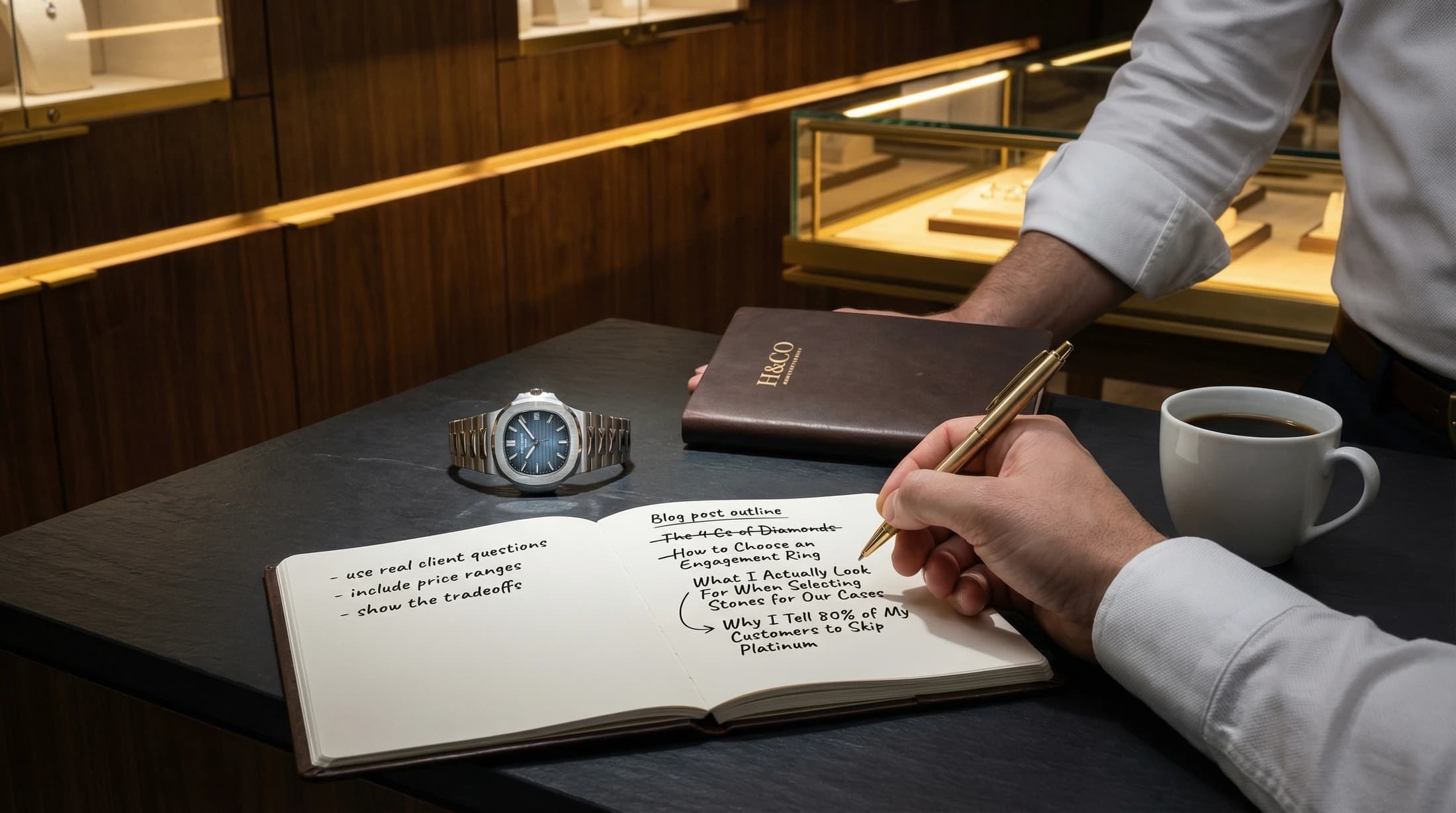
Named authorship: Content attributed to a named person with verifiable expertise carries more weight than anonymous content. Sign blog posts with the store owner or head gemologist's name and credentials. A post by "Sarah Chen, GIA Graduate Gemologist and founder of [Store Name]" carries more trust signals than an uncredited post.
Does Schema Markup Directly Affect AI Citability?
Schema markup helps, but it's not the primary driver. AI systems are primarily language models. They understand natural language content. Schema provides structured data that helps AI parsers identify what type of content they're looking at, but the AI still needs high-quality, factual content to cite.
The combination that works: clear, factual, structured natural language content supported by relevant schema markup. Neither alone is as effective as both together.
Microsoft's guide recommends deploying Product, Offer, AggregateRating, Review, Brand, ItemList, and FAQ schema types. Ship JSON-LD with correct types and attributes. Ensure the rendered page contains the same facts consumers see, never serve different content to bots.
For a luxury jewelry retailer, the highest-value schema types are:
LocalBusiness with detailed attributes: Name, address, phone, opening hours, geo coordinates, price range, payment methods, and a detailed description of what you specialize in.
Product schema on individual pieces: Name, description, price, availability, condition, material, and brand. Especially important for pre-owned and estate pieces where the AI can compare your inventory against queries.
AggregateRating: Pull your Google review average and count onto your pages with proper schema. AI systems cite highly-rated businesses more frequently.
FAQ schema on service pages: If you've built out Q&A sections, mark them up with FAQ schema. This helps both traditional search (featured snippets) and AI citability simultaneously.
What Kind of Content Gets Cited Most Often?
The Princeton GEO study identified specific content types that consistently produce higher citation rates in AI-generated responses. Across the luxury retail context, the content types that translate most directly are:
Statistics and specific data: AI systems are drawn to specific numbers. "Custom rings start at $2,500" is more citable than "We offer custom rings at various price points." "4–6 week timeline" is more citable than "timely delivery."
Expert quotations and attributed knowledge: Content that includes named expertise and direct quotes gets cited more. "Our head gemologist, [Name], explains: [direct quote about the custom process]" is more likely to be extracted than a generic process description.
Fluent, authoritative writing: The study found that content quality and authoritativeness significantly affect citation rates. Poorly written content, thin content, or content full of keyword repetition performs worse. This is one category where the typical jewelry retailer website is weakest.
Keyword optimization that matches AI query patterns: AI queries tend to be longer, more conversational, and more specific than traditional search queries. Your content needs to use the same language patterns. "What is the best way to buy an Omega watch in [City]" requires different content than "Omega watch [City]."
How Does the Consistency of Your Online Presence Affect Citability?
AI systems don't read your website in isolation. They cross-reference your web content against your Google Business Profile, third-party reviews, directory listings, social media, and any other indexed mentions of your business.
When these sources are consistent, same name, same address, same phone, same description of what you do, the AI's confidence in your entity increases. When they're inconsistent, the AI's confidence drops and you're less likely to appear in synthesized answers.
Common inconsistencies that hurt luxury retailers:
Store name variations: "Johnson Fine Jewelers" on the website, "Johnson's Jewelry" on Yelp, "Johnson Jewelry & Watches" on Google Business Profile. The AI sees three different entities and isn't sure they're the same store.
Service description drift: The website says "custom engagement rings, fine jewelry, and estate pieces." The GBP says "jewelry and watch repair." The AI can't build a coherent entity profile.
Outdated directory listings: Old addresses, old phone numbers, or closed locations still appearing in directories. Each one is a conflicting data point.
The fix is methodical: audit your top 10 directory listings (Google, Yelp, Bing, Apple Maps, Foursquare, Yellow Pages, BBB, industry-specific directories like WatchBox or Jewelers of America) and standardize the name, address, phone, and description across all of them.
What Is the Role of External Mentions and Press in AI Citability?
AI systems, particularly those used by ChatGPT and Perplexity, pull from web-indexed content including news articles, trade publications, directories, and third-party review platforms. A mention in InStore Magazine, JCK, National Jeweler, or a local publication isn't just a backlink. It's an independent verification that your store exists and is credible.
Think of it this way: when you claim something about your own store on your own website, an AI treats it as self-reported. When a third party says the same thing, the AI treats it as verified.
Practical moves:
Submit to InStore's Best Of lists and JCK trend features. Reach out to your local business journal about a notable piece or event. Build relationships with trade publication editors. A single InStore feature mentioning you as a specialist in sapphire engagement rings creates an external verification the AI can use.
Detailed reviews also function as external verification. Encourage customers to be specific: "They helped me design a custom sapphire ring with a platinum pavé band" is more useful to AI systems than "Great service, highly recommend." The specific review matches actual search queries.
How Do You Audit and Improve Your AI Citability Score?
There's no official AI citability score. But you can run your own audit with a systematic approach.
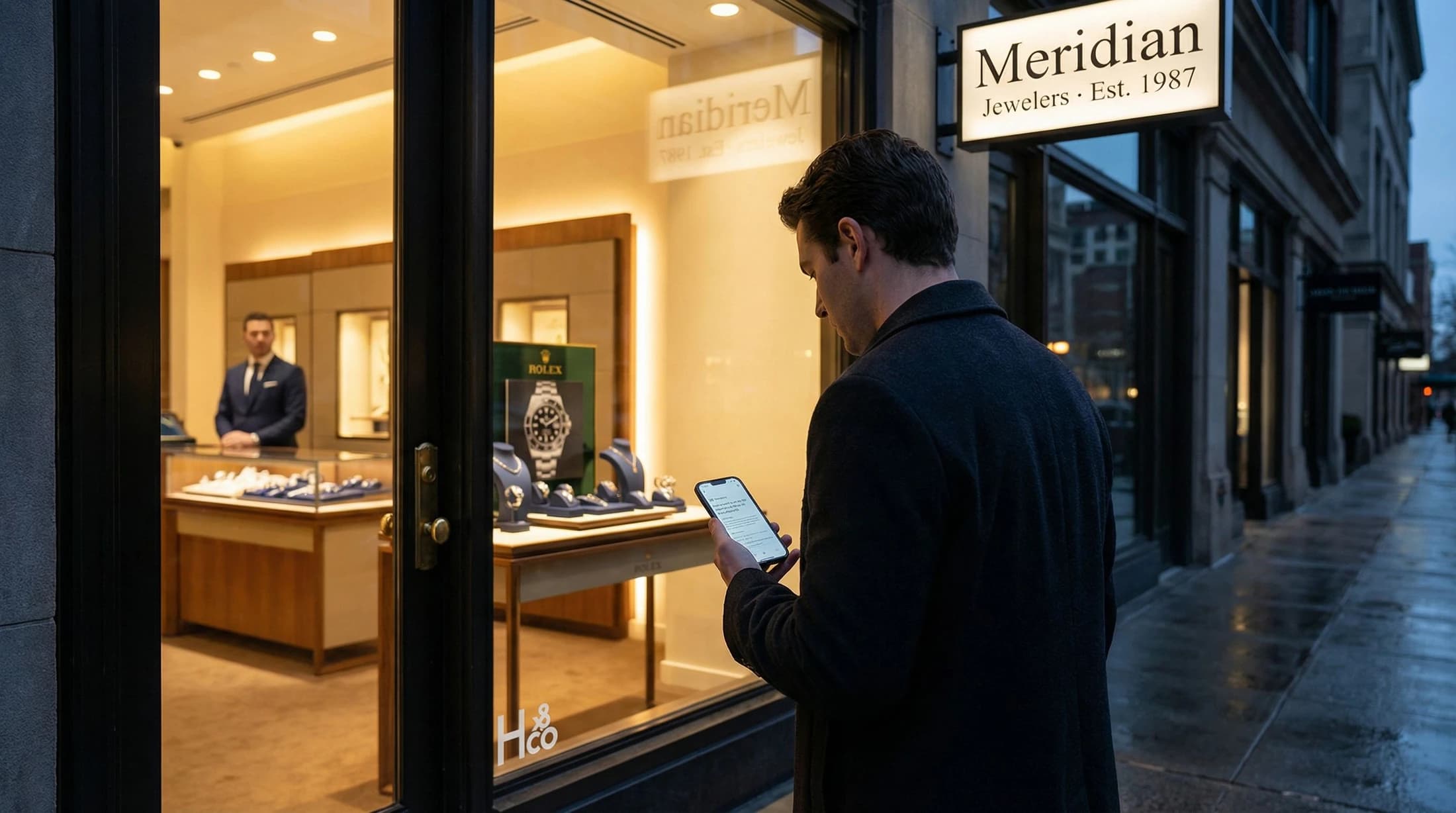
Step 1: Run the AI citation test. Open ChatGPT, Perplexity, and Google AI Overviews separately. Ask each one: "Best jewelry stores in [your city] for [your specialty]" and "[brand you carry] authorized dealer in [your city]." Note whether your store appears, what it says about you, and which competitors are mentioned instead.
Step 2: Audit your content for citability signals. Go through your website page by page. For each page, ask: Does every paragraph stand alone? Are headings descriptive and specific? Are there FAQ sections with real specifics? Are credentials and specialties stated as verifiable facts?
Step 3: Audit external consistency. Check your top 10 directory listings against your website. Name, address, phone, and description should be identical. Identify and correct discrepancies.
Step 4: Check your schema implementation. Use Google's Rich Results Test and Schema Markup Validator to verify your LocalBusiness, Product, Review, and FAQ schema is correctly implemented and error-free.
Step 5: Track your citations monthly. Run the same queries each month. Document when you appear, what's said about you, and which competitors appear. As you improve citability signals, you should see your mentions increase over time.
Why Is Now the Right Time to Focus on AI Citability?
45% AI adoption for business evaluation was 6% one year ago. That trajectory doesn't flatten. Within 2-3 years, AI-assisted search will be the default for high-consideration purchases.
The retailers building for AI citability now, while competitors focus on traditional SEO and paid ads, will compound an advantage that's difficult to replicate later. Entity signals take time to build. Third-party mentions accumulate over months. Content gets indexed gradually. The earlier you start, the more embedded you become in the AI's understanding of who the relevant businesses are in your market.
The Princeton GEO study showed visibility improvements of up to 40%. That's the upside for early movers in a space where almost nobody in luxury retail has started.
*For the full SEO strategy, read SEO for Luxury Watch and Jewelry Retailers. For the strategic overview of AI search, see How to Show Up When Customers Ask AI Where to Buy. For content that ranks in both traditional and AI search, see How to Build Content That Ranks.*
Want to know if AI search engines can find your store? Book a call and we'll run the AI citation test for your business and show you where you stand.
About the author
Hagop Imasdounian
Hagop Imasdounian is the founder of H&CO. Raised around his family’s jewelry businesses, he brings more than 15 years of digital marketing experience to helping jewelry and watch brands improve their websites, reach buyers and connect marketing with sales.