
Key Takeaways
- 45% of consumers now use AI tools like ChatGPT and Perplexity for local business recommendations. One year ago, that number was 6%.
- ChatGPT recommends only 1.2% of local business locations. If you're not in that 1.2%, you're invisible to the fastest-growing discovery channel.
- There is only a 45% overlap between Google rankings and AI recommendations. Ranking on Google does not mean AI will recommend you.
- AI gives 1-3 options per query, not 10 blue links. The winner-take-all dynamic is more extreme than traditional search.
- Reviews, structured data, entity consistency, and citable content are the four inputs AI uses to decide who to recommend.
- Shopping-related queries on AI platforms grew 4,700% between 2024 and 2025. This is happening now.
One year ago, 6% of consumers used AI tools to find local business recommendations. Today, that number is 45%.
That is not a typo. According to the BrightLocal 2026 Local Consumer Review Survey, AI-powered recommendation tools have become the third most popular way consumers find local businesses, behind only search engines and word of mouth. The survey covered 1,002 US adults. The data is clear.
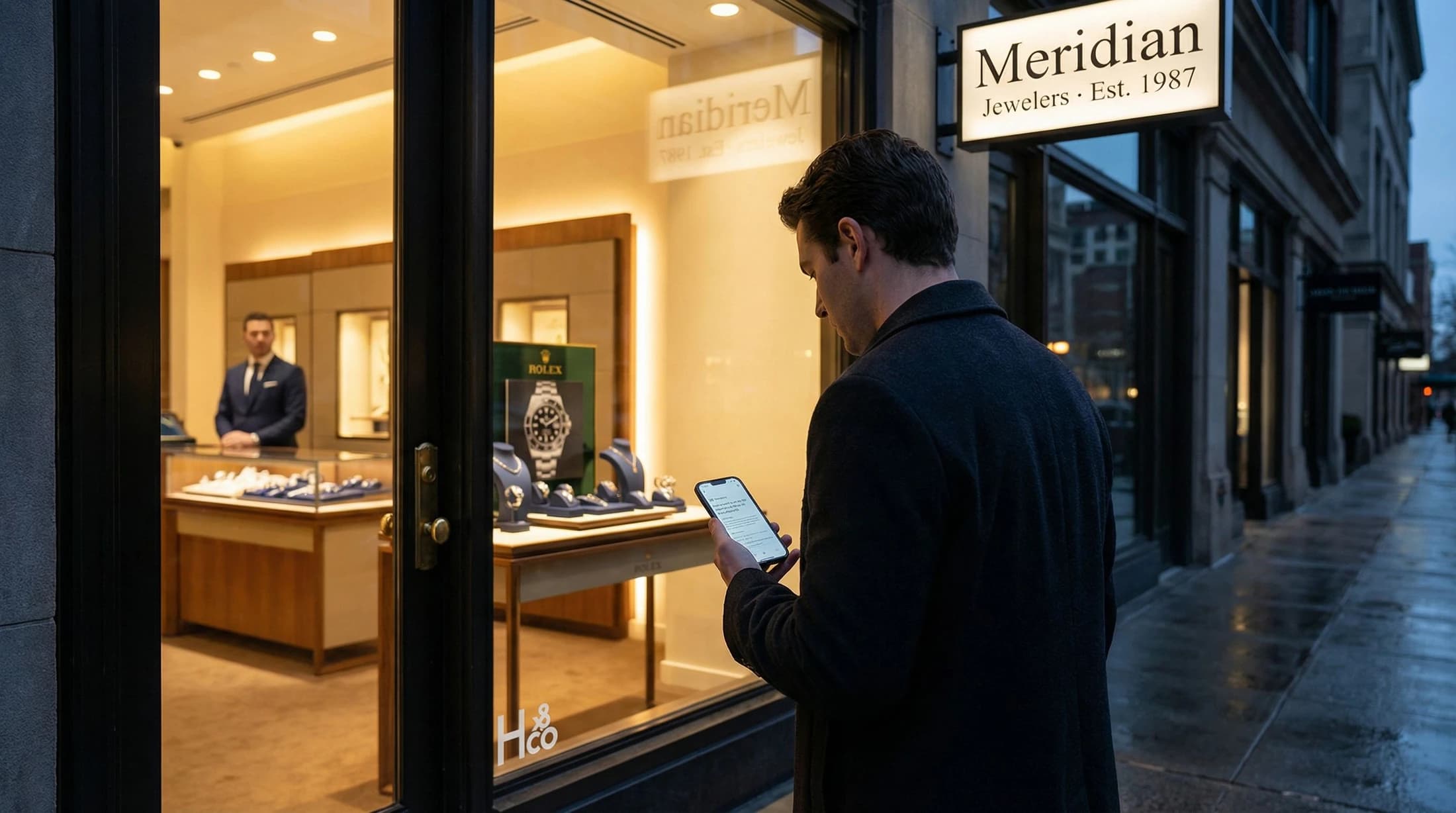
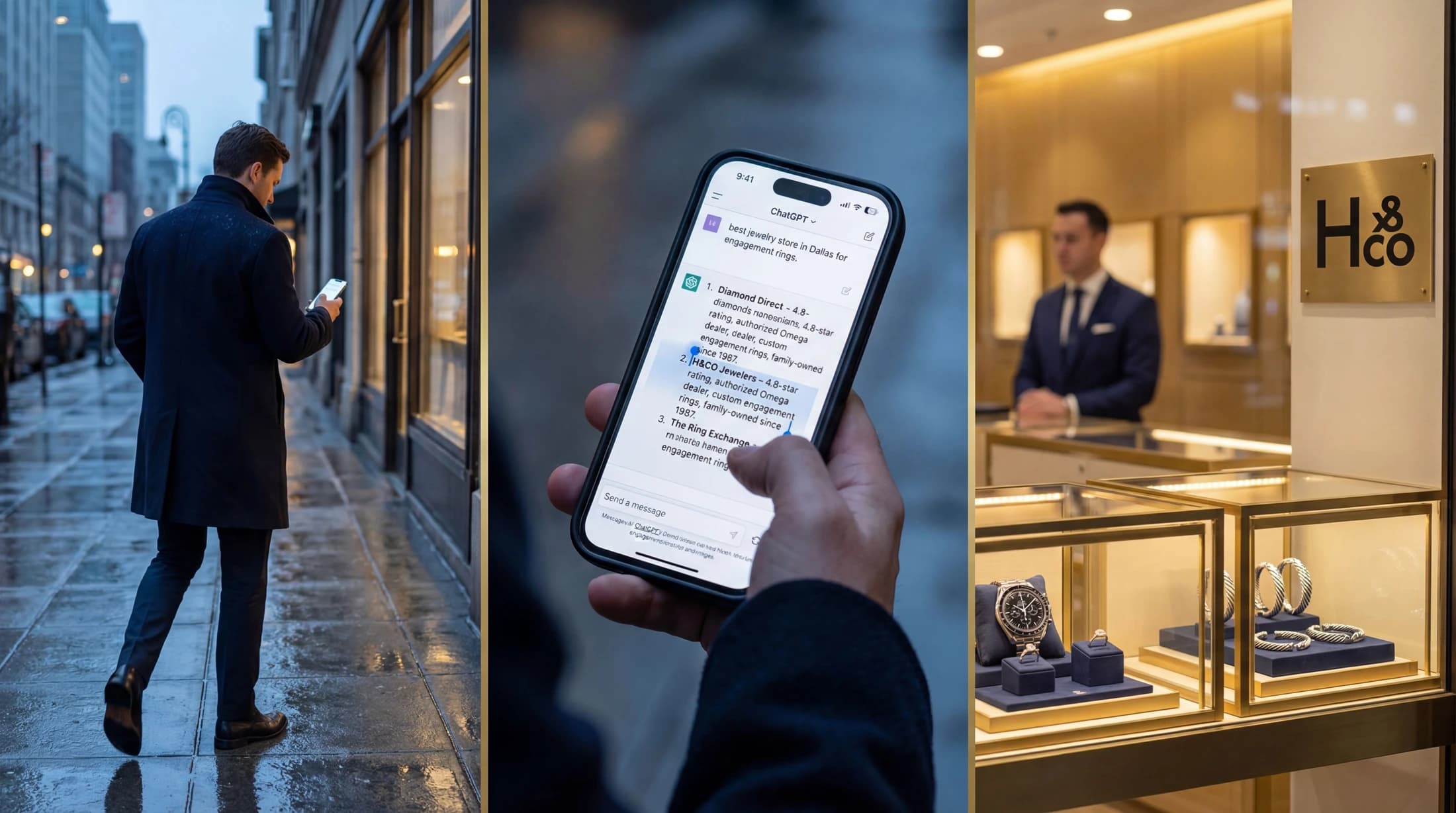
What does this mean for you? When a buyer in Scottsdale opens ChatGPT and asks "best jewelry store near me," the AI returns one to three names. Not ten blue links. Not a map pack with twenty pins. Three names, sometimes fewer. If yours isn't one of them, you don't exist in that channel.
And this channel grew 650% in a single year.
The Numbers That Should Worry You
The headline stat is bad enough. The supporting data is worse.
SOCi's 2026 Local Visibility Index analyzed over 350,000 business locations across 2,751 brands and found that ChatGPT currently recommends just 1.2% of local businesses. That means 98.8% of local businesses are invisible when someone asks AI for a recommendation in their category.
Here's the number that changes everything: there is only a 45% overlap between businesses that perform well in traditional Google search and those that appear in AI recommendations. More than half the businesses ranking on page one of Google do not show up in AI answers at all.
The search behavior shift is accelerating. Shopping-related queries on generative AI platforms grew 4,700% between 2024 and 2025. Nearly a quarter of global consumers already use AI as their starting point when shopping.
Meanwhile, AI Overviews on Google are absorbing clicks that used to go to organic results. An Ahrefs study of 300,000 searches found organic CTR drops 34.5% when an AI Overview appears. The zero-click rate for queries with AI Overviews is 83%.
The implication for luxury retailers: your Google Ads and SEO are still necessary, but no longer sufficient. A parallel discovery channel has emerged where different rules apply. Most of your competitors haven't noticed yet. That's your window.
What AI Actually Looks At
AI doesn't crawl your site the way Google does. It doesn't care about your domain authority or your backlink profile the way a search engine algorithm does. It synthesizes information from across the web and makes a judgment call about which businesses to recommend.
Four inputs matter more than anything else.
Reviews
Reviews are the single strongest signal AI uses for local business recommendations. The data backs this up: 97% of consumers read reviews for local businesses. 47% won't consider a business with fewer than 20 reviews. 68% demand a minimum of four stars.
AI models cross-reference your review volume, recency, and sentiment across Google, Yelp, and other platforms. If your last Google review is from eight months ago, AI interprets that as a signal, either you're not active or your customers aren't motivated enough to talk about you. Neither is good.
For a luxury jeweler, this is compounded by the fact that your transaction volume is lower than a restaurant or a dentist. You serve fewer customers, which means every review counts more. A jeweler with 200 thoughtful reviews will outperform one with 30 generic ones in AI recommendations, even if the second jeweler has a better website.
Structured Data
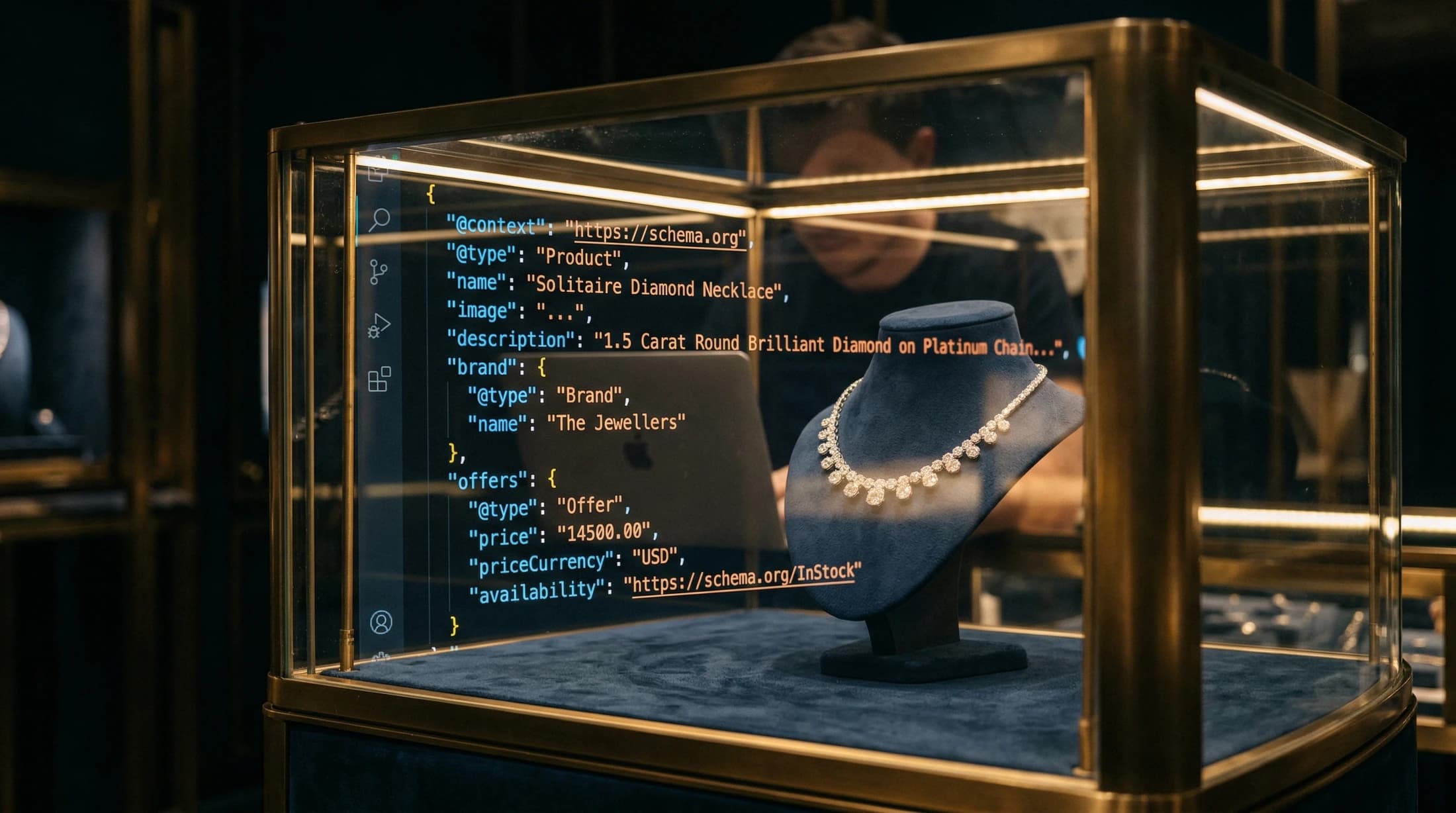
Schema markup is the language you use to tell AI exactly what your business does. LocalBusiness schema communicates your address, hours, and contact information. Product schema tells AI which brands and models you carry. FAQ schema answers the questions AI is trying to resolve on behalf of the user.
Without structured data, AI has to guess what you sell and where you're located. With it, you're handing the AI pre-formatted answers it can cite directly.
Entity Consistency
AI cross-references your business across every source it can access, your website, Google Business Profile, Yelp, Apple Maps, Bing Places, social media, and directory listings. If your business name, address, phone number, or description varies between sources, it breaks the AI's confidence in your identity.
This is the same NAP consistency principle from local SEO, but the stakes are higher. Google can usually figure out that "Smith Fine Jewelers" and "Smith Fine Jewelers LLC" are the same business. AI models are less forgiving. Consistency across every listing is a prerequisite.
Citable Content
AI needs a specific, factual statement it can extract and present as an answer. This is the citability principle, your content must contain sentences that work as standalone answers to questions.
"We are an authorized dealer for Rolex, Omega, Tudor, and Breitling with 35 years of experience in the Dallas-Fort Worth market" is citable. An AI can extract that, verify it against other sources, and present it as a recommendation.
"Discover our stunning collection of timepieces" is not citable. It tells the AI nothing it can use.
Every page on your site that describes what you do, what you carry, or what makes you different should contain at least one sentence that could be pulled verbatim into an AI answer.
Why Google Rankings Don't Transfer
The 45% overlap stat deserves emphasis. It means that if you have strong Google rankings today, there is a better than even chance that AI is not recommending you at all.
The reason is structural. Google ranks pages. AI evaluates entities. Google rewards backlinks and on-page optimization. AI rewards mentions, citations, and consistent presence across multiple sources. Google indexes your site. AI synthesizes your reputation across the entire web, reviews, directories, press mentions, social media, and third-party content.
You can rank #1 for "jewelry store [city]" on Google and not appear in a single AI answer, because the AI is looking at different signals entirely.
This is not a replacement for SEO. Your organic traffic still matters. Your paid campaigns still matter. But if you're only optimizing for Google, you're leaving the fastest-growing discovery channel completely uncovered.
For the full strategy on showing up in AI search, read our GEO guide for luxury retailers.
Why This Matters More for Luxury Retail
The AI shift hits luxury retailers harder than most industries, for three specific reasons.
Your buyer researches longer. A $15,000 watch purchase takes weeks, sometimes months. During that research window, the buyer is asking AI for recommendations, comparisons, and validation multiple times. If you're not in the AI's answer set on day one, you're not in the consideration set when they're ready to buy on day forty.
The path to the store runs through AI. 81% of luxury watch sales still happen in-store. But the journey to the store increasingly starts with an AI query. "Where should I buy a Rolex in [city]?" "Best independent jeweler in [city]?" These are the new top-of-funnel questions, and AI is the new answer engine.
AI favors national brands and chains by default. Large retailers have more web mentions, more reviews, more directory listings, more press coverage. AI models have a natural bias toward businesses with the most data. Independent retailers need stronger, more specific signals to compete, and that means being more deliberate about every signal you send.
The good news: the considered-purchase buyer is exactly the type of consumer who uses AI for research. They want validation, comparison, and trusted recommendations before walking into a store. If you can get into the AI's recommendation set, you're reaching the most qualified buyer in your market.
Seven Things You Can Do This Month
1. Check If AI Recommends You
Open ChatGPT and Perplexity. Ask: "Best jewelry store in [your city]." "Where to buy an Omega in [your city]." "Top rated watch dealer in [your city]." Screenshot the results. If you don't appear, you now know the problem.
2. Get to 50+ Google Reviews
If you're under 50, this is job one. Ask every customer who has a good experience. Make it easy, a QR code at the register, a follow-up text with a direct link. Recent reviews are weighted more heavily than old ones by both Google and AI.
3. Add LocalBusiness and Product Schema
Your website should tell AI exactly what you are, where you are, and what you carry in structured data format. Hours, address, brands authorized, services offered. This is a one-time setup that pays dividends across every AI platform.
4. Make Your About Page Citable
One clear paragraph: who you are, how long you've been in business, what brands you carry, what services you offer, what makes you different. Write it as a statement of fact, not marketing copy. AI will extract it.
5. Claim and Optimize Every Directory
Yelp, Apple Maps, Bing Places, Facebook, The Knot (if you do bridal). Consistent name, address, phone number, and description across every listing. Inconsistency is the easiest way to disqualify yourself from AI recommendations.
6. Publish Answers to the Questions AI Is Fielding
"Best engagement ring stores in [city]." "Where to get a watch appraised in [city]." "Custom jeweler near [city]." These are real queries people are asking AI. You should have pages on your site that answer them directly, with specific and factual language.
7. Audit Your Content for Citability
Read your homepage, About page, and top service pages. For each one, ask: is there a single sentence AI could pull out and use as a recommendation? If the answer is no, rewrite until there is.
Want to know if AI recommends your store? We'll run a live check across ChatGPT, Perplexity, and Google AI Overviews for your business and show you exactly where you stand. Book a strategy call.
Research & Sources
- BrightLocal: Local Consumer Review Survey 2026, 45% AI usage stat, review behavior data
- BrightLocal: AI Trust in Local Recommendations, AI recommendation trust analysis
- SOCi 2026 Local Visibility Index, 1.2% ChatGPT recommendation rate, 45% Google overlap
- Bain & Company: Finding a New Longevity for Luxury, 81% in-store luxury watch sales, market outlook
- BoF / McKinsey: State of Fashion 2026, 4,700% AI shopping query growth
- Ahrefs / Dataslayer: AI Overview CTR Study, 34.5% CTR reduction, zero-click rates

About the author
Hagop Imasdounian
Hagop Imasdounian is the founder of H&CO. Raised around his family’s jewelry businesses, he brings more than 15 years of digital marketing experience to helping jewelry and watch brands improve their websites, reach buyers and connect marketing with sales.