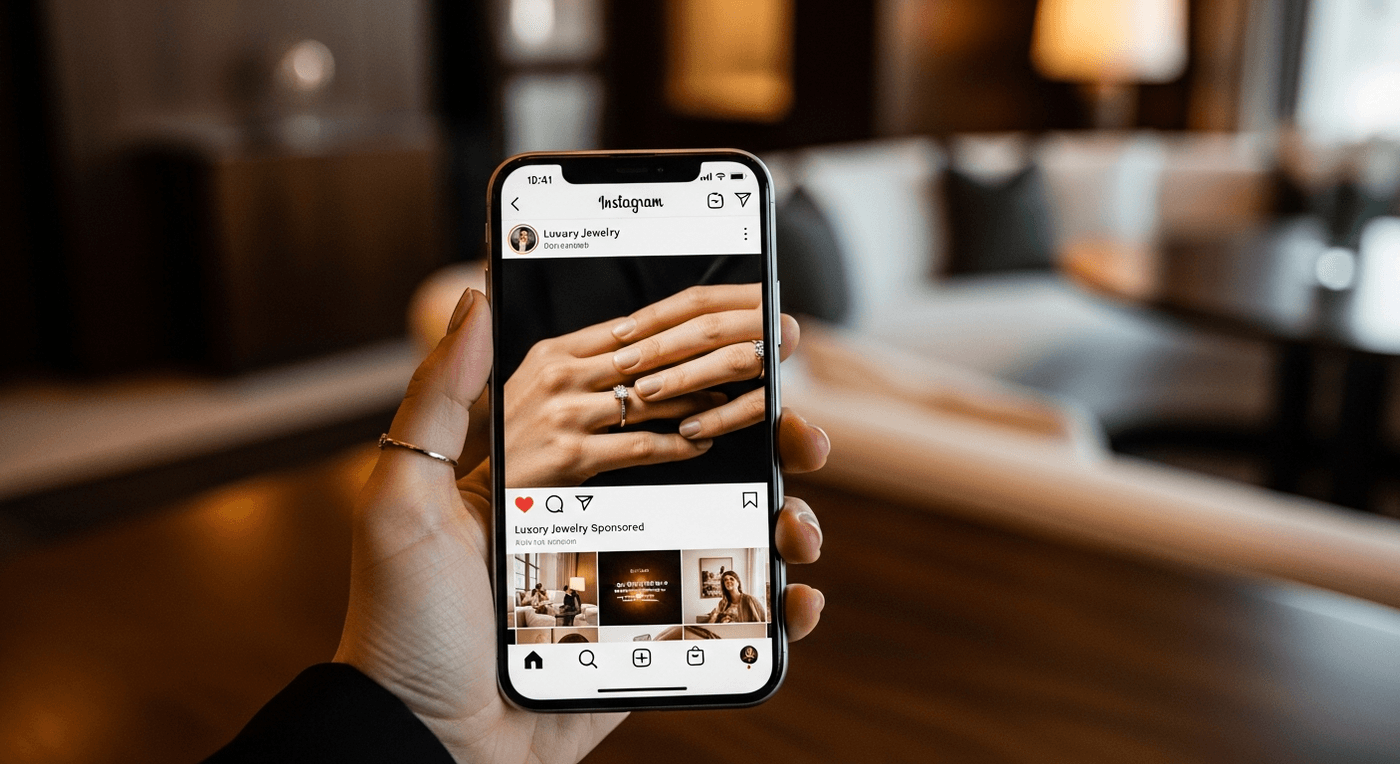


Paid Social Media
Meta Ads That Drive Revenue for Luxury Retailers
Facebook and Instagram are the same ad platform. Same campaigns, same budget, same algorithm. When we say Meta Ads, we mean both.
Get StartedTrusted By
Facebook and Instagram are the same ad platform. Same campaigns, same budget, same algorithm. When we say Meta Ads, we mean both.
The platform works for luxury retail. It works well, actually, when the setup is right. The problem is that most luxury retailer accounts are set up wrong in ways that waste money quietly, month after month, while the reports look busy.
Most Luxury Retailers Are Optimizing for the Wrong Thing
The most common mistake we see is the simplest one: boosting posts. You publish a photo of a new collection, it gets some likes, Instagram suggests you boost it for $50. You do. It gets more likes. None of those people buy anything. You do it again next week.
Boosted posts optimize for engagement. Likes, comments, shares. These are vanity metrics that feel good and produce nothing. Meta's algorithm is very good at finding people who tap the heart button. Those are not the same people who walk into a store and spend $8,000 on a watch.
Traffic campaigns are the next trap. They send people to your website. Great. But if there's no conversion event set up, no retargeting pixel firing correctly, no follow-up sequence, those visitors leave and never come back. You paid for a page view with no business outcome attached to it.
The deeper problem is data. Without offline conversion tracking, Meta's algorithm has no idea what a real customer looks like. It optimizes for whatever signal you give it. If you give it clicks, it finds clickers. If you give it page views, it finds browsers. If you feed it actual purchase data from your POS system, it finds buyers.
Without a proper product catalog connected, you're also leaving performance on the table. Catalog ads let Meta show the right product to the right person dynamically. Running image ads manually when you have hundreds of SKUs means you're doing the algorithm's job worse than the algorithm would.
Advantage+ Catalog Ads Built Around Your Inventory
Catalog ads are Meta's most effective format for retailers with product inventory. They pull directly from your product feed and serve the right items to the right people based on browsing behavior, purchase history, and intent signals.
Feed Setup and Optimization
Your product catalog feed is the foundation. If the data is messy, the ads underperform regardless of how much you spend.
Title structure follows the same logic as any product search: brand first, then collection, material, and any distinguishing detail. "Cartier Love Bracelet 18K Yellow Gold" performs better than "Love Bracelet" because Meta's algorithm uses the title to match products to user interest signals. Be specific.
Image requirements vary by placement. Feed ads favor clean product shots. Stories and Reels favor lifestyle imagery with the product in context. Sending the wrong format to the wrong placement hurts click-through rates. Meta's own data shows that ads with format-optimized creative see up to 33% lower cost per result (Meta Business Help Center).
Description copy needs to sell without discounting. No "Sale" language, no "Limited time offer." Luxury buyers respond to specificity: materials, provenance, craftsmanship details, exclusivity. The copy should make the product feel worth its price, not try to convince someone it's a deal.
Price and availability sync from your e-commerce platform or POS keeps the catalog accurate. Nothing kills trust faster than clicking an ad for a product that's out of stock or priced differently on the landing page. Automated syncs on a daily or more frequent cadence prevent this.
Catalog Segmentation
Dumping your entire inventory into one catalog campaign is like dumping all your Google Ads keywords into one ad group. It technically works. It works badly.
Product sets by category let you control budget and bidding per segment. Bridal gets its own set. Watches get their own. Fashion, home, estate, art, each operates independently. The margins are different, the buyer profiles are different, and the seasonality is different. Your campaigns should reflect that.
Price-tier segmentation matters because a $500 pendant and a $50,000 necklace attract different audiences and require different bidding strategies. Lumping them together means Meta's algorithm defaults to showing whichever product gets the most clicks, which is almost always the cheaper one.
Seasonal product sets rotate with the retail calendar. Holiday, Valentine's Day, Mother's Day, bridal season, back-to-school for fashion retailers, design weeks for furniture and art. Pre-building these sets means you can launch seasonal campaigns quickly instead of scrambling.
Brand-specific sets serve double duty: they let you run brand-focused campaigns for your strongest lines and they make co-op reporting clean if you're claiming brand advertising dollars.
Retargeting Sequences for Buyers Who Take Weeks to Decide
Standard retargeting windows are built for impulse purchases. Someone looks at a $30 shirt, you retarget them for 7 days, they buy or they don't. Done.
Luxury doesn't work that way. A $15,000 purchase involves weeks of consideration. Sometimes months. The buyer visits your site, looks at three watches, leaves. Comes back a week later. Visits a competitor. Reads reviews. Talks to their partner. Comes back again. The 7-day retargeting window that most agencies set as default misses this buyer entirely.
For high-ticket goods, retargeting windows need to extend to 30, 60, even 90 days depending on the product category. Engagement rings have some of the longest consideration windows in retail, often 6 to 8 weeks from first search to purchase.
Retargeting Audiences
Build your retargeting pools from multiple data sources, not just website traffic.
Website visitors by product category and time spent are your most obvious audience. But segment them. Someone who spent 4 minutes on your Rolex page is a different prospect than someone who bounced after 10 seconds. Time on site is a quality signal.
Catalog viewers and add-to-cart abandoners show explicit purchase intent. These audiences are small but extremely high-value. They already picked a product. Something stopped them, price hesitation, distraction, wanting to see it in person. Your retargeting ad addresses that objection.
Email list segments synced to Meta let you retarget your existing customer base with new collections, events, or complementary products. A customer who bought an engagement ring six months ago is a strong candidate for wedding band ads.
CRM audiences from POS purchase history are the most underused data source in luxury retail. Your POS system knows who bought what, when, and how much they spent. Uploading that data to Meta (hashed and privacy-compliant) creates retargeting and lookalike audiences based on actual buyers, not just browsers.
Creative Sequencing
Different stages of the buying decision need different messages.
Early awareness: lifestyle imagery, brand storytelling, the feeling of owning the product. This isn't about specifications. It's about desire.
Mid-consideration: specific product features, materials, craftsmanship details, what makes this piece different. The buyer has interest. Now they want information.
Decision stage: social proof, the in-store experience, customer stories, appointment booking. The buyer is close. Remove friction. Give them a reason to take the next step today.
Sequential delivery means someone sees the awareness ad first, then the consideration ad a week later, then the decision ad after that. Not random rotation. Deliberate sequencing that mirrors how people actually make high-ticket purchasing decisions.
Creative That Stops the Scroll Without Looking Like an Ad
The best-performing luxury ads on Meta don't look like ads. They look like content you'd actually stop scrolling for.
Production Workflow
Monthly shoot cadence is the minimum for keeping creative fresh. One well-planned shoot can produce 30 or more ad variations: different angles, different lighting, different crops, with and without lifestyle context. The shoot itself might take half a day. The editing and formatting takes longer but yields a full month of content.
Organic-to-paid pipeline is one of the highest-ROI moves in social advertising. Your organic posts are already being tested for free. The ones that get outsized engagement relative to your follower count are telling you something. Turn those into paid ads with proper tracking and targeting, and you skip the creative testing phase entirely.
Customer content repurposing works when you have proper rights management in place. A customer who shares an unboxing video or a photo wearing their new piece has created authentic content that performs better than anything a studio produces. Get written permission, credit them if appropriate, and run it.
Format Strategy
Reels and Stories demand vertical, full-screen creative. Movement matters here more than anywhere else. A slow pan across a watch dial, hands placing a ring in a box, the clasp clicking shut on a bracelet. These micro-moments stop the scroll in a way static images cannot.
Carousel ads work for collections and multi-piece styling. Show the full bridal set: engagement ring, wedding band, earrings, pendant. Show a watch collection progression from entry-level to flagship. Let the buyer swipe through a curated selection.
Static vs video performance data from Meta's internal research shows video ads generate 20% to 30% higher engagement on average, but for catalog ads specifically, static product images often outperform because the buyer wants to see the product clearly (Meta for Business). Test both. The winner varies by product category and audience.
Creative refresh cycle for luxury is typically 4 to 6 weeks before fatigue sets in. You'll see frequency climb and click-through rates drop. That's the signal to rotate. Having a pipeline of creative ready means you're never scrambling to replace a fatigued ad.
Conversion API Setup: The Pixel Alone Is Not Enough
If you're still relying only on Meta's pixel for conversion tracking, you're seeing a fraction of the picture. iOS 14.5 changed everything in 2021, and the gap has only widened since.
When Apple gave users the ability to opt out of tracking, roughly 75% did (Flurry Analytics). That means three-quarters of iPhone users are invisible to Meta's pixel. Your campaigns are optimizing based on the 25% who didn't opt out, which skews the data and degrades performance.
The Conversions API (CAPI) sends event data server-side, bypassing the browser entirely. When someone makes a purchase, submits a form, or books an appointment, that event fires from your server to Meta's server. No cookie dependency. No browser blocking.
Deduplication between pixel and CAPI events is required. Without it, you count every conversion twice, once from the pixel and once from the server. Meta provides event IDs specifically for this purpose.
Event match quality scores measure how well Meta can match your server events back to a specific user. Higher scores mean better attribution and better optimization. The score improves when you pass more first-party identifiers: email, phone, first name, last name, city, state. All hashed before transmission.
First-party data strategy is the long game. Every email capture, every appointment booking form, every loyalty program signup builds your pool of identifiable users. This data fuels both CAPI matching and audience building. The retailers who invested in first-party data collection starting in 2021 have a meaningful advantage today.
Connecting Meta Ad Clicks to In-Store Sales
This is where the math changes for brick-and-mortar luxury retailers.
Offline conversion tracking matches your POS transaction data to Meta ad click identifiers. When someone clicks a Meta ad, visits your site, then comes into your store and buys, the data connects those events. You see which campaigns, ad sets, and individual ads drove actual register transactions.
Without this, you're guessing. You might feel like Meta is working because foot traffic seems good on days you run ads. That's not data. That's a hunch.
Upload cadence should be weekly at minimum. More frequent uploads give Meta's algorithm more data to learn from. The format requirements are specific: Meta expects customer identifiers (hashed email, phone) matched to purchase values and timestamps.
What this unlocks is the ability to optimize for real buyers. Meta's algorithm stops chasing clicks and starts chasing the patterns it finds in people who actually purchase. This is the same principle as Google Ads offline conversion imports, and the impact is just as significant. Over 60 to 90 days, the algorithm recalibrates toward higher-value outcomes.
Privacy-compliant matching uses SHA-256 hashing on all customer identifiers before transmission. Meta never receives raw email addresses or phone numbers. The matching happens through hashed values that can't be reversed.
H&CO's Felix attribution platform automates this entire pipeline. It pulls transaction data from your POS system, hashes the identifiers, formats the upload file, and sends it to Meta on a scheduled cadence. No manual work, no formatting errors, no missed uploads.
E-Commerce Conversion Tracking Done Right
If you sell online, your Meta Ads Manager ROAS and your analytics platform ROAS will never match. That's normal. The question is whether you understand why and whether your actual numbers are accurate.
Meta counts conversions based on its own attribution model and conversion window (default: 7-day click, 1-day view). Your analytics platform uses different rules. A purchase that Meta claims credit for might be attributed to organic search in Google Analytics. Neither is lying. They're measuring with different yardsticks.
Conversion value optimization trains Meta's algorithm on actual purchase amounts, not just conversion counts. A $200 purchase and a $20,000 purchase are not equal outcomes, and your bidding strategy shouldn't treat them that way. When you pass real revenue values, Meta optimizes toward higher-value transactions.
Server-side purchase events through CAPI give you the most accurate ROAS reporting available. Browser-based pixel data is incomplete. Server-side data captures conversions that the pixel misses, especially from iOS users.
Return and cancellation handling keeps your ROAS grounded in reality. If 15% of online jewelry orders get returned, your reported ROAS is 15% too high. Building return adjustments into your tracking means the numbers you use for budget decisions reflect actual retained revenue.
Lookalike Audiences Built From Actual Purchasers
Lookalike audiences are Meta's most powerful prospecting tool. They find new people who resemble your existing customers. The quality of the lookalike depends entirely on the quality of the seed audience you build it from.
CRM and POS exports create seed audiences from real buyers. Not website visitors, not email subscribers, actual purchasers. A lookalike built from your top 500 customers by lifetime value will outperform a lookalike built from your last 10,000 website visitors every time. The algorithm models different patterns, and the purchase-based patterns are the ones that matter.
High-value buyer lookalikes versus all-customer lookalikes make a measurable difference. Segment your seed audience by purchase value. A 1% lookalike based on customers who spent $5,000 or more targets a different demographic and psychographic profile than one based on all customers. The former finds more high-value prospects.
Category-specific lookalikes get even more granular. Build separate seeds from bridal buyers, watch collectors, fashion customers, furniture buyers. Each category attracts a different buyer profile. A lookalike that blends them all together dilutes the signal.
Geo-targeted lookalikes restrict the audience to your market area. If you're a single-location retailer in Scottsdale, a national lookalike wastes impressions on people who will never visit. Restrict it to your DMA or a radius around your store.
Refresh cadence matters because lookalike audiences decay as Meta's user base and your customer profile evolve. Rebuild your seed audiences quarterly with fresh purchase data. Stale seeds produce stale results.
Using Brand Co-Op Funds on Meta
If you carry authorized brands that offer co-op advertising support, those dollars can fund Meta campaigns. Most of it goes unclaimed because the reporting and compliance requirements feel burdensome. They don't have to be.
Campaign architecture for co-op compliance starts at setup. Brand-level campaigns keep spend data clean and reportable. Each authorized brand gets its own campaign with its own budget. When the co-op coordinator asks for a spend report on Brand X for Q2, you pull it in thirty seconds.
Brand-level reporting and documentation feeds directly into reimbursement submissions. Impressions, reach, spend, and any brand-specific metrics the manufacturer requires are all available per campaign without manual allocation.
Creative approval workflows vary by brand. Some require pre-approval of all ad creative. Some provide pre-approved assets. Some only require that you use official product images and logos. Build the approval step into your creative production timeline so it doesn't delay launches.
Separate campaign architecture for co-op and house campaigns keeps things clean. Co-op campaigns follow the brand's rules and creative guidelines. House campaigns follow yours. Both feed data into your overall account performance.
Not every luxury retailer has co-op eligibility. But if you do, and you're not claiming it, you're subsidizing your advertising budget from your own margin when someone else is willing to share the cost. Combined with a full paid advertising strategy and organic search visibility, co-op funds stretch your total marketing budget further.
What Good Looks Like: Meta Ads Benchmarks for Luxury Retail
General e-commerce benchmarks are misleading for luxury retail. A $5 CPC means something very different when your average order value is $4,000 versus $40.
According to Revealbot's 2024 Meta Ads benchmark data, average CPCs across all industries run roughly $0.50 to $2.00. Luxury retail CPCs are higher, typically $2.00 to $6.00 for prospecting campaigns and $1.00 to $3.00 for retargeting (Revealbot). That's fine. You're not selling commodity products.
CPMs (cost per thousand impressions) for luxury audiences typically run $15 to $40, compared to $8 to $15 for general retail. Higher CPMs reflect a more targeted, higher-income audience. The metric that matters isn't CPM. It's whether the revenue generated justifies the spend.
ROAS by campaign type varies significantly. Retargeting campaigns should produce 5:1 to 15:1 ROAS because you're reaching people who already know you. Prospecting campaigns typically run 2:1 to 4:1. Catalog ads fall somewhere in between depending on the audience and product mix.
Seasonal shifts follow predictable patterns. CPCs rise in Q4 as every advertiser competes for attention during the holiday season. January sees a dip. February spikes again for Valentine's Day. Bridal campaigns peak in spring and fall engagement seasons. Planning your budget around these patterns, rather than running flat monthly spend, gets more out of the same dollars.
The comparison that matters isn't your numbers versus an industry average. It's your numbers this month versus your numbers last month, with the same seasonal context. Are CPAs declining? Is ROAS improving? Is offline-attributed revenue growing? Those trends tell you whether the strategy is working.

Where Your Buyers Scroll
Your Products in the Feed, Not Just Your Brand
Advantage+ catalog ads show personalized product selections to each viewer. Combined with retargeting sequences that match the 2-8 week research window.

Creative Production
Content Your Team Can Produce in 30 Minutes a Week
We build the system, not the studio. Batch filming workflows, creative direction, and an organic-to-paid pipeline where your best content becomes your best ads.
Related Services
Other Services
PPC Advertising
Google Ads
Search, Shopping, and Performance Max campaigns structured around your actual product lines and margins.
Learn MorePaid Social
Pinterest Ads
Reach high-intent shoppers during the discovery phase with Pinterest campaigns built for luxury products.
Learn More