

Most jewelry marketing advice tells you to post on Instagram and run Facebook ads. Maybe partner with an influencer. That playbook is crowded and expensive. The returns get worse every year.
This is the other playbook. The channels and tactics that jewelry retailers underweight or ignore entirely, where attention is cheaper and buyer intent is higher. You're not bidding against every other jeweler in the country for the same eyeballs.
1. Own Local Search Before You Chase National Rankings
SEO matters for jewelers. But most bite off more than they can chew.
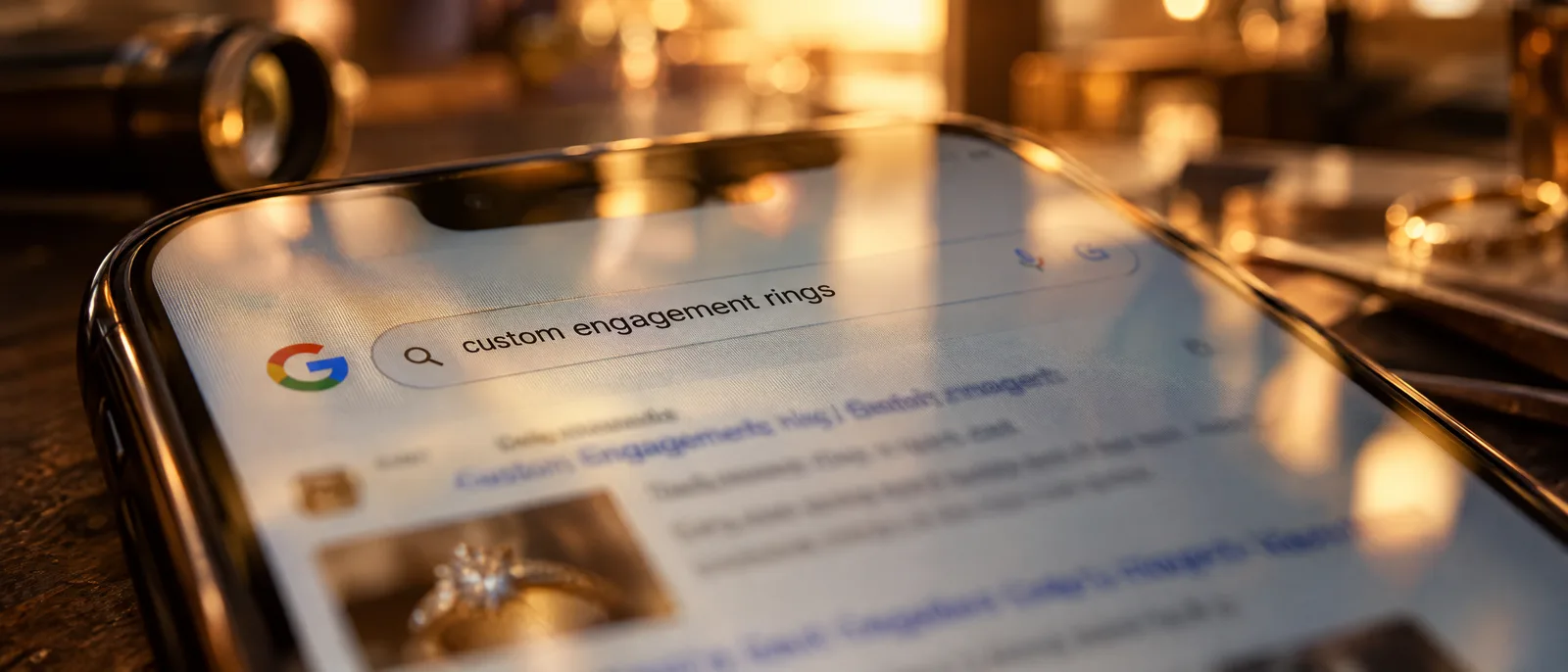
Trying to rank for "custom engagement rings" nationally is a years-long war against brands with ten times your budget. You won't win it, and you don't need to. The jeweler in Providence, Rhode Island doesn't need to outrank Blue Nile. They need to own "custom engagement rings Providence" and every variation of it.
Get specific. Identify who you're most uniquely positioned to close, then build your SEO around that.
What this looks like in practice:
- Target "[city] + engagement rings," "[city] + custom jewelry," "[city] + jeweler" and every long-tail variation you can find
- Write blog content around informational queries with local intent that your competitors ignore: "best jeweler in [city] for custom engagement rings," "where to buy lab diamonds in [city]," "engagement ring shopping guide [city]"
- Every blog post should link back to your product or service pages. Content supports commerce, not the other way around
- Publish on a cadence. Two to four posts per month, optimized for featured snippets
Build hub-and-spoke content clusters. This is the compounding play. Create one comprehensive pillar page, then surround it with supporting posts that link back to it.
Example for an engagement ring jeweler:
- Hub page: "The Complete Guide to Buying an Engagement Ring in [City]"
- Spoke posts: Lab Diamonds vs. Natural, Ring Settings Guide, Sizing Guide, Metal Comparisons, Budget Breakdown, Custom Ring Process
Each spoke post links to the hub. The hub links to each spoke. Google sees a cluster of related, authoritative content, and the whole group rises together. Over six months, this structure will outperform fifty disconnected blog posts.
The compounding effect is real. A blog post that ranks today still drives traffic two years from now. Paid ads stop the second you stop paying.
2. Run Search Ads on Google and Bing
Search ads still convert better than any social channel for jewelry because the buyer is already looking. They've typed "custom engagement ring near me" into Google. That's intent you can't manufacture with a carousel ad. (We analyzed over 20,000 ads from 99 jewelry retailers and the data backs this up.)
Google Search
- Target long-tail queries: "custom engagement ring [city]," "ethical diamond alternatives," "handmade gold bracelet"
- Google Shopping requires clean, white-background product shots. But Google gives you up to 10 additional image slots and they are usually left empty. Fill those slots with styled, editorial-quality images.
Meta Ads (where lifestyle imagery actually leads)
- Unlike Google Shopping, Meta lets you lead with lifestyle creative. A close-up of a ring on a real hand in natural light will outperform a white-background product shot every time.
- Use carousel ads to tell a story: the piece being worn, the unboxing, the reaction. Video and UGC-style creative outperform static product shots.
Bing (the one everyone skips)
- Bing skews older and wealthier. A significant share of US Bing users earn over $100K per year. That's your jewelry buyer (Microsoft Advertising audience, 2026).
- Bing is overwhelmingly a desktop search engine. Desktop searchers are more deliberate, higher-intent buyers.
- CPCs run 20-35% lower than Google Ads with comparable click-through rates (Improvado, 2026)
- If you're running Google Search and not mirroring those campaigns on Bing, you're leaving money on the table.
Target ROAS: 4:1 or better on search. If you're not hitting that, the issue is usually landing pages or targeting, not the channel.
3. Treat Pinterest Like a Search Engine, Not a Social Network
Pinterest is the most underused channel in jewelry marketing. It is a visual search engine where users go to plan purchases.
Eighty percent of weekly Pinners say they feel inspired by the shopping experience on Pinterest, and 96% of top searches on the platform are unbranded, meaning users are actively open to discovering new brands. Pins rank in search results for months after posting (Pinterest internal, 2026).
How to use it
- Write keyword-rich Pin descriptions with five or more keywords per Pin
- Build boards aligned to buyer intent: "Engagement Ring Inspiration," "Wedding Day Jewelry," "Gold Jewelry Styling"
- Link every Pin back to a blog post or product page
- Run Promoted Pins alongside organic. CPCs are lower than Meta for high-intent lifestyle categories
Expect 6 to 12 months for significant organic traction. Front-load content now.
4. Build Authority on YouTube
"How to choose an engagement ring" has massive search volume and almost no quality content from actual jewelers. That gap is yours to fill.
YouTube videos rank on both YouTube search and Google search. A single well-made video can drive traffic for years.
Formats that work
- Behind-the-scenes craftsmanship footage. Show the work that goes into a custom piece.
- Stone and metal education. Lab diamonds vs. natural, platinum vs. white gold, the four Cs explained by someone who actually handles these stones daily
- Styling guides. How to stack rings, how to match jewelry to necklines.
- Customer stories. Real people, real pieces, real emotions
Use Shorts for quick hooks and discoverability. Use long-form (8 to 15 minutes) for search authority.
You don't need a production studio. A good DSLR, a macro lens, decent lighting, and a clean background will get you there.
5. Use Reddit Where Real Purchase Research Happens
Subreddits like r/EngagementRings (250K+ members), r/jewelry, and r/Diamonds are where real purchase research happens. People post ring photos, ask for advice, compare options, and share honest reviews. This is mid-decision buyer behavior.
The rules are different here
- Reddit users verify authenticity obsessively. This is an advantage for legitimate jewelers.
- Add value first. Answer questions, educate, share knowledge. Build karma.
- Do not hard-sell. Ever. Let the craftsmanship speak.
- Reddit Ads targeted to jewelry subreddits reach buyers mid-decision at a fraction of Meta CPMs.
Reddit rewards patience and expertise. The jeweler who shows up consistently with real knowledge will earn trust that no ad budget can buy.
6. Make Email Your Highest-ROI Channel
Email marketing isn't glamorous. It is, however, the highest-ROI channel for repeat buyers in jewelry by a wide margin.
A past customer who bought an engagement ring will eventually need wedding bands, anniversary gifts, push presents, holiday gifts for the next thirty years. Email is how you stay in front of them.
Segments to build:
- Engagement shoppers (pre-purchase nurture)
- Past purchasers (anniversary reminders, new collection announcements)
- Bridal show and event leads
- Website browsers who gave you an email but haven't bought
Automated sequences worth building:
- Welcome series for new subscribers
- Post-purchase care guide (builds goodwill, reduces returns)
- Anniversary reminder with personalized suggestions (set this up once, it runs forever)
- Cart abandonment recovery
- Re-engagement for lapsed subscribers
Personalize based on what they bought and when. A customer who bought a sapphire engagement ring doesn't want emails about diamond solitaires. They want sapphire earrings and a matching pendant. (Need help picking the right tool? See our guide to the best CRM for jewelers.)
Not sure where to start? Get a free AI audit of your current marketing.
7. Work With Influencers at Scale, Not as One-Offs
Influencer partnerships work in jewelry. They are usually done wrong.
The typical approach: spend a large sum on one or two influencers with big followings, hope for a spike in traffic, and then wonder why nothing moved.
What actually works is volume. Fifteen to twenty micro-influencer partnerships will outperform two large ones every time.
- Micro-influencers (10K to 50K followers) have higher engagement rates and more trust
- The cost per partnership is a fraction of a macro-influencer deal
- More creators means more content and more data on what resonates
Be cost-effective about it. Set a per-partnership budget you can sustain across fifteen or more creators over a quarter. Track which partnerships drive actual traffic and conversions, then double down.
We wrote a deeper playbook on this: luxury influencer marketing strategy for 2026.
8. Create Content That Doesn't Look Like Content
The best ads don't look like ads. They look like organic content that someone posted because they genuinely loved the product.
User-generated content (UGC) is the most powerful creative asset in jewelry marketing. A real customer showing off their new engagement ring on their hand, in their kitchen, with their dog in the background, will outperform a polished studio shot in paid ads almost every time.
How to build a UGC engine
- Ask every customer to share a photo or video with their piece
- Create a branded hashtag and feature customer content on your channels
- Encourage unboxing videos. The anticipation of opening a jewelry box is inherently shareable.
- Repurpose UGC in paid ads. These perform well because they feel authentic.
Study what already works before you create anything. Follow twenty or thirty large influencers in the jewelry space. Pay attention to which posts get saved, not just liked. Notice the angles, the lighting, the captions that generate real comments instead of emoji spam.
9. Dominate Your Local Market
Google Business Profile (the quick win)
Your profile is probably incomplete. Full optimization, meaning photos updated monthly, weekly Google posts, answered Q&A, and active review management, is often enough to break into the local pack.
Geo-targeting (the precision play)
- Geo-fence competitor locations during peak seasons. Holidays, Valentine's Day, and engagement season are when mobile ads served near competing jewelers hit hardest.
- Geo-fence bridal expos, wedding venues, and luxury events. Capture attendees during and after events.
- Run Google Local Services Ads for "jeweler near me" and "[city] engagement rings"
Local partnerships (the long game)
- Cross-referral programs with bridal boutiques and wedding planners
- Proposal packages with fine dining restaurants and luxury hotels
- Presence at charity galas and fashion events where your target buyer socializes
- Trunk shows with designer brands you carry. These give customers a reason to visit on a specific date, create urgency without discounting, and position your store as the local authority for that brand.
- Pop-up shops at luxury events, country clubs, or high-end hotel lobbies. You meet buyers where they already spend money, outside of a traditional retail setting.
Bridal shows (the high-intent pipeline)
Bridal shows put you face-to-face with buyers who are actively planning. Focus your booth on appointment booking, not discounts. Capture every email and phone number, and follow up within 24 hours.
Host your own events too. Private shopping evenings, "Design Your Ring" workshops, anniversary celebration nights. These build exclusivity and direct relationships.
Virtual showcases work here too, especially for out-of-town buyers or couples who found you through search but haven't visited yet. A 30-minute live session where you walk through pieces on camera, answer questions in real time, and book follow-up appointments can close buyers who would otherwise never make the trip.
10. Collect Reviews Like Your Business Depends on It (It Does)
Jewelry is a high-trust purchase. Nobody drops thousands of dollars on an engagement ring without reading reviews first.
Where to collect reviews: Google Business Profile (directly impacts local rankings), your website (dedicated testimonial page with photos), Yelp, Facebook, and any platform your buyers check.
How to get more: Ask after every purchase. Send the request when the customer is happiest. Make it easy with a direct link to your Google review page. Respond to every review, positive and negative.
Reviews now feed AI, too. AI tools like ChatGPT, Google Gemini, and Claude are reading your reviews to build a picture of your business. When someone asks an AI "what's the best jeweler in [city] for custom engagement rings," the AI pulls from your review corpus to decide if you're worth recommending. A jeweler with 200 detailed reviews mentioning "custom design" and "patient" will get surfaced over a jeweler with 50 generic "great experience" reviews.
11. Retarget Everyone Who Didn't Buy the First Time
Jewelry purchases aren't impulse decisions. Someone visits your site, browses engagement rings for twenty minutes, and leaves. That doesn't mean they're not interested. It means they're not ready yet.
Retargeting tactics
- Dynamic retargeting pulls the exact products they viewed and puts them back in front of the buyer. This is the highest-performing retargeting format.
- Layer in social proof. Ads with customer testimonials or review counts convert better than product-only creative.
- Show UGC in retargeting. They've already seen your polished product shots on your website.
- Set frequency caps. Persistent, not irritating.
- Cover Google Display, Meta, and Pinterest. If they browse on one platform, they'll see you on all three.
Target ROAS for social retargeting: 2:1 or better. For search retargeting, expect higher.
What NOT to Do
Don't run giveaways. Giveaways attract freebie-seekers, not buyers. Your engagement rate spikes for a week and your conversion rate stays flat forever. It's vanity, not strategy.
Don't overspend on a handful of big influencers. Two partnerships with large creators won't move the needle. Influencer marketing works at volume or not at all.
Don't hire a professional photographer for every shoot. A good DSLR and a quality macro lens will get you 80 to 90 percent of the way there. Invest in equipment and basic training, not a recurring photographer retainer.
Don't chase TikTok organic. It's saturated, algorithm-dependent, and purchase intent for high-ticket items is low.
Don't bother with Facebook organic. Organic reach on Facebook is effectively zero for business pages. Spend that time on Pinterest or YouTube instead.
Don't try to rank for broad national keywords. "Custom jewelry" has millions of competing pages. "Custom jeweler in [your city]" has a handful. Win the winnable fight first.
How to Measure What's Working
None of this matters if you can't measure it. A customer might click an ad in January, visit the store in March, and buy in April. Standard analytics loses that thread entirely.
Metrics to track by channel:
- Customer acquisition cost by channel (paid vs. organic vs. events)
- ROAS on ad spend (target 4:1+ for search, 2:1+ for social)
- Organic traffic growth month-over-month, with keyword ranking movement
- Email list growth and revenue attributed to email
- Bridal show lead-to-close rate
- Google Business Profile impressions, clicks, and direction requests
- Pinterest impressions, saves, and outbound clicks
- Review count and average rating across platforms
Review these monthly. Kill what's not working. Double down on what is. For deeper measurement guidance, read our guide to event tracking for small business ROI.
Pick Three and Start
You don't need to do all eleven at once. Pick three that match your budget, your bandwidth, and where your customers already spend time. Run them for 90 days. Measure. Adjust. Then add the next two.
Local jeweler with a physical store: Start with Local SEO, Google Business Profile, and Email. Fastest path to foot traffic and repeat purchases.
Ecommerce-first retailer: Start with Search Ads, Pinterest, and Retargeting. Captures high-intent buyers and brings them back.
Team that can create content: Start with YouTube, Local SEO, and Email. Compounds over time and builds authority.
Budget-constrained: Start with Local SEO, Email, and Reviews. All three are cheap and they punch above their weight.
The jewelers who win aren't doing everything. They're doing the right three things well and ignoring the rest until they've earned the right to expand.
Ready to figure out which three are right for your store? Get your free AI marketing audit or talk to our team and we'll build the 90-day sprint together.

About the author
Hagop Imasdounian
Hagop Imasdounian is the founder of H&CO. Raised around his family’s jewelry businesses, he brings more than 15 years of digital marketing experience to helping jewelry and watch brands improve their websites, reach buyers and connect marketing with sales.