What This Report Is
Every month, we scrape the Google Ads Transparency Center and Meta Ad Library for 101 luxury watch and jewelry retailers across the US and Canada. We capture every visible ad — the creative, the copy, the advertiser, the format, the platform. Then we classify it, count it, compare it to last month, and publish what we find.
This blog post is the highlight reel. The trends, the tables, and the takeaways.
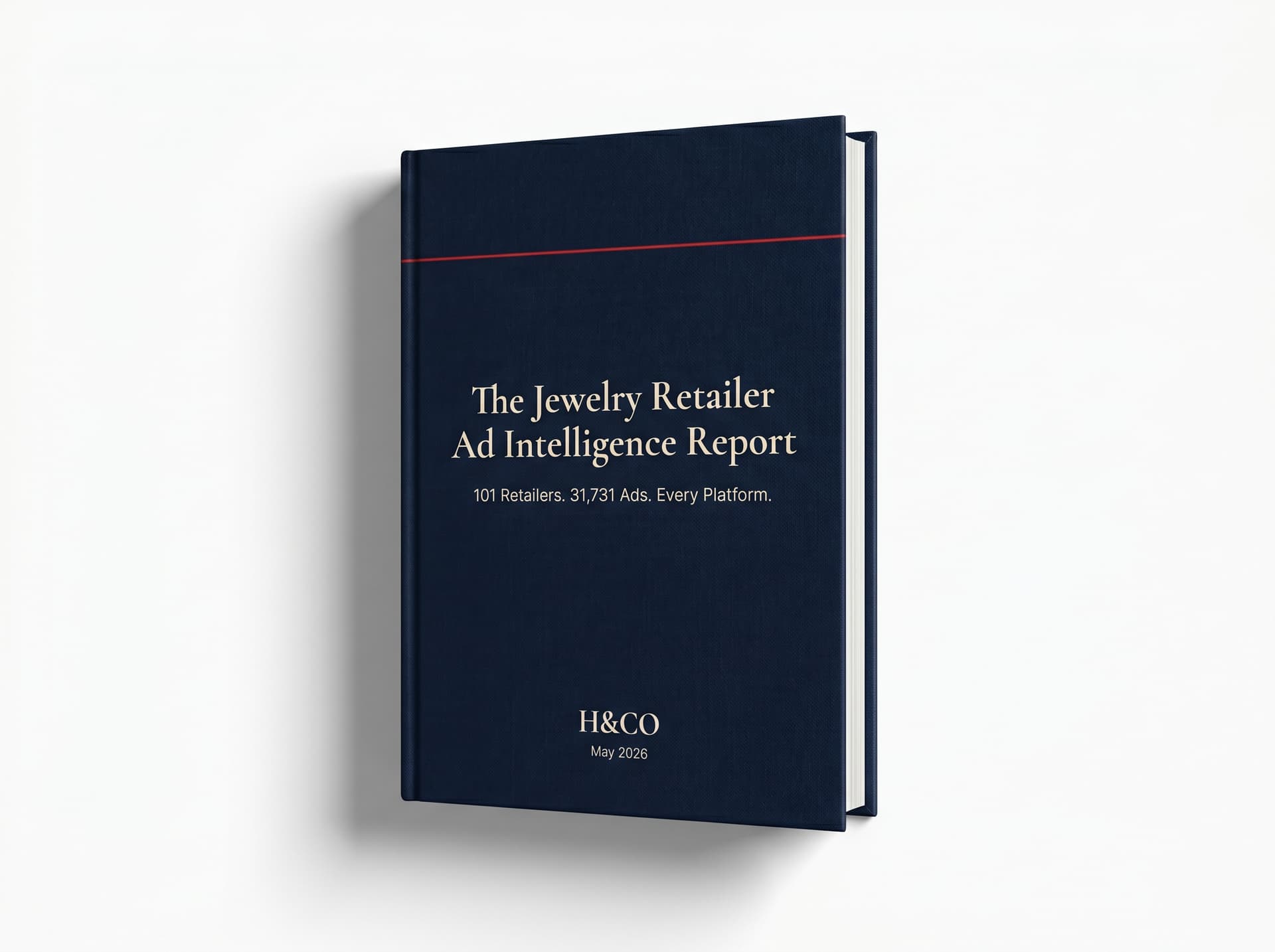
The full report goes deeper: retailer-by-retailer ad counts, creative screenshots from both platforms, format breakdowns with charts, activity tier rankings, and the longest-running ads in the dataset. We publish it as a PDF every month and deliver it to subscribers the day it drops. Subscribe here if you want the full version.
This is month two. April 2026 data compared against March 2026.
The Numbers: March vs. April
Metric | March 2026 | April 2026 | Change |
|---|---|---|---|
Total Ads | 22,408 | 31,731 | +41.6% |
Google Ads | 21,661 | 30,867 | +42.5% |
Meta Ads | 747 | 864 | +15.7% |
Retailers on Both Platforms | 61 (60.4%) | 68 (67.3%) | +7 |
Google Only | 30 | 25 | -5 |
Meta Only | 2 | 0 | -2 |
No Detected Ads | 8 | 8 | 0 |
Avg Google Ads per Retailer | 233 | 332 | +42% |
Avg Meta Ads per Retailer | 8 | 9 | +13% |
The market is accelerating. 71 of 101 retailers grew their ad volume this month. 11 shrank. 19 were unchanged. The 8 retailers with zero detected ads have been dark both months — they are either not running paid media or running it through channels we cannot track (TikTok, programmatic, direct buys).
The total ad count jumped 41.6% in a single month. That is not seasonal noise. The retailers who are investing are investing more, and the ones who were testing are committing.
Meta Is Getting More Retailers. It Is Not Getting More Money.
Twelve retailers added Meta ads for the first time in April: razny.com, chpremier.com, maisonbirks.com, longsjewelers.com, raffijewellers.com, schiffmans.com, tappers.com, royaldeversailles.com, persinandrobbin.com, montalvojewelers.com, octannerjewelers.com, and lvluxuryjewelers.com.
Dual-platform adoption went from 60.4% to 67.3%. The two retailers who were Meta-only in March added Google, bringing Meta-only to zero. The direction is clear: more retailers are on both platforms than ever before.
But the ratio got worse, not better.
March: 29 Google ads for every 1 Meta ad. April: 36 to 1.
Google grew by 9,206 ads. Meta grew by 117. The average active retailer now runs 332 ads on Google and 9 on Meta. Nine.
What this tells you: Meta is a testing ground for most retailers, not a budget priority. The typical setup is a handful of Advantage+ Creative ads left running with minimal creative variety and no audience strategy behind them.
The opportunity is the same as last month, only wider. If you run more than 9 Meta ads with real creative — product carousels, video, lifestyle content, retargeting sequences — you outspend the vast majority of competitors on that platform. For the full breakdown of what a serious Meta strategy looks like for luxury retailers, we wrote the guide.
Where the Money Is Moving
Strategy classification tells you what retailers are actually saying in their ads — not just where the ads run, but what the ad is trying to accomplish.
Strategy | March | April | Ad Δ | Retailers Using (Δ) |
|---|---|---|---|---|
General Store Promo | 4,110 | 6,809 | +2,699 | 90 (+3) |
Brand Co-Op | 10,082 | 12,158 | +2,076 | 68 (+2) |
Product-Specific | 1,513 | 2,419 | +906 | 74 (+7) |
Certified Pre-Owned | 500 | 767 | +267 | 42 (+7) |
Lifestyle & Aspirational | 182 | 323 | +141 | 55 (+6) |
Service & Repair | 166 | 258 | +92 | 58 (+4) |
Buy / Sell / Trade | 143 | 206 | +63 | 39 (+4) |
Product Catalog Retargeting | 357 | 420 | +63 | 47 (+10) |
Events & Seasonal | 135 | 195 | +60 | 32 (+9) |
Four things jump out.
General Store Promo grew the most in raw volume. "Visit our store." "Shop our collection." "Discover our jewelry." It is now 21.5% of all advertising and 90 of 101 retailers run some version of it. It works when nobody else is doing anything more specific. But 90 retailers running the same message means zero differentiation. The question is whether you can say something more targeted.
Product Catalog Retargeting had the biggest adoption jump: 10 new retailers. Someone browses an Omega Seamaster on your site, they see that exact watch in their Instagram feed the next day. The product feed setup takes a few hours. After that, these campaigns largely run themselves. The fact that 54 of 101 retailers are still not doing this is the real number in that row.
CPO ads are up 53%. From 500 to 767 ads, with seven new retailers entering the category. The Rolex Certified Pre-Owned program is the driver. Polacheck's, Hamra, and several other ADs started running CPO-specific campaigns for the first time. If you have CPO allocation and are not advertising it separately from your general inventory, you are leaving the highest-intent buyers to someone else.
Service and repair is at 0.8%. 258 ads out of 31,731. "Watch repair near me." "Jewelry appraisal [your city]." "Ring resizing." These searches happen every day with virtually no paid competition. A service customer who trusts you with a $200 repair is the same person who comes back for a $15,000 purchase. Almost nobody is advertising for these terms.
The Biggest Movers
Which retailers scaled their advertising the most from March to April?
Retailer | March | April | Total Δ | Google Δ | Meta Δ |
|---|---|---|---|---|---|
Wempe | 2,423 | 4,881 | +2,458 | +2,462 | -4 |
Bachendorfs | 305 | 2,339 | +2,034 | +2,029 | +5 |
Exquisite Timepieces | 50 | 890 | +840 | +840 | 0 |
Benari Jewelers | 214 | 1,013 | +799 | +798 | +1 |
Bob's Watches | 242 | 856 | +614 | +616 | -2 |
Fink's | 92 | 703 | +611 | +616 | -5 |
Razny | 218 | 522 | +304 | +286 | +18 |
CH Premier | 41 | 250 | +209 | +206 | +3 |
Wempe leads in absolute volume — corporate-level media buying across multiple entities (Gerhard D. Wempe GmbH, American Wempe Corporation, Wempe France). Their +2,458 increase is almost entirely Google Display, which is consistent with a brand running coordinated campaigns across its own retail locations.
Bachendorfs is the story of the month. 305 to 2,339. A 7x increase in one month. But it is not just volume — they added five new strategy types they were not running in March: Buy/Sell/Trade, CPO, Events & Seasonal, Lifestyle, and Product Catalog Retargeting. That is not incremental optimization. That is a retailer who made a strategic decision and executed it in 30 days. Either they hired an agency, brought someone new in-house, or the owner sat down and said "we are doing this now." Whatever happened, they went from running a basic Google presence to running a diversified, multi-strategy ad operation overnight.
Pre-owned specialists are scaling hard. Exquisite Timepieces jumped from 50 to 890 ads, almost all on Google. Bob's Watches went from 242 to 856. The pre-owned market is investing in paid search aggressively heading into summer.
New entrant: safajewelers.com appeared for the first time with 10 ads.
Stopped advertising: westime.com went from 4 ads to zero.
Video Doubled. It Is Still Barely There.
Google video ads went from 993 to 2,008 — a 102% increase. Meta video held flat at 62. Total video is now 6.5% of all ads in the dataset, up from 4.7% in March.
That means 93.5% of advertising in this industry is static images and text.
This is an industry that sells the way light catches a dial. The way a stone refracts color at different angles. The way a bracelet drapes on a wrist. The way a clasp closes with a satisfying click. Every one of those moments is a video, not a photograph. A 15-second close-up of a movement finishing does something a static image banner will never do.
The retailers running video are not doing anything sophisticated. Phone camera, clean display case, 15 seconds, posted as a Reel and boosted for $50. That is the bar. And 93.5% of the industry has not cleared it.
For the full paid advertising strategy — including how to structure video campaigns for luxury retailers across Google and Meta — we wrote the guide.
Brand Co-Op: What the Brands Are Running For You
Ads where the brand itself — not the retailer — is the advertiser of record.
Brand Advertiser | Ad Count |
|---|---|
Rolex | 11,424 |
Breitling | 154 |
Patek Philippe (Henri Stern) | 92 |
Richemont (Cartier, IWC, JLC) | 72 |
Chanel | 36 |
Omega | 7 |
Rolex is a different category. 11,424 ads — 36% of the entire dataset, from a single brand. Google Search and Display ads pointing traffic directly to authorized dealers' websites. If you are a Rolex AD, those ads are running right now on your behalf.
The numbers above only capture ads where the brand is the confirmed advertiser of record. Many co-op arrangements work through backend reimbursement — the retailer runs ads under their own name and submits proof of performance for partial refund. That model is invisible in transparency data. The actual level of brand-supported advertising across this dataset is higher than what appears here.
If your brand partners are not listed above, it does not mean co-op is unavailable. Contact your brand reps and ask what digital co-op programs exist. Several brands have expanded their co-op offerings in the last 12 months.
Five Things To Do With This Data
Based on the gaps and trends in this month's report:
1. Connect your product catalog to Meta. Ten new retailers set it up this month — the biggest adoption jump of any strategy. Feed your product catalog to Meta, set up Advantage+ Catalog Ads, and let the algorithm retarget site visitors with the exact items they browsed. Setup takes a few hours. After that, the campaigns largely run themselves.
2. Launch a service campaign on Google Search. 258 ads in the entire dataset. 0.8% of all advertising. "Watch repair near me," "jewelry appraisal [your city]," "ring resizing" — these are queries with real intent and virtually no paid competition. The customer who trusts you with a repair is the one who comes back for the engagement ring.
3. Name the models. Product-specific ads grew by 906 this month, with 7 new retailers adding them. If you carry Submariner, Speedmaster, Santos, Royal Oak — call them out by name in your ad copy. These are the highest-intent searches in the category. For the full approach to structuring Google Ads campaigns around specific products, we covered it in depth.
4. Record three videos this week. Your phone. A clean case. 15 seconds. A dial catching the light, a stone under the loupe, a bracelet clasp closing. Post them as Reels. Boost the best one for $50. You are competing against an industry where 93.5% of ads are still static.
5. Build your summer campaigns now. Wedding season, graduation, Father's Day are all in the next 60 days. The data shows seasonal advertising ramps just 2-4 weeks before the event — and most retailers never start at all. Get your June creative brief done in May.
How We Collect This Data
Every month, we scrape the Google Ads Transparency Center and the Meta Ad Library for 101 luxury watch and jewelry retailers across the US and Canada. We use network request interception to capture the raw API responses — the same data the platforms return to their own interfaces.
For each ad, we capture the advertiser name, creative format, headline, body copy, CTA, landing URL, start date, and platform placement. We then classify each ad by strategy type and messaging theme.
Caveats: Google ad counts include brand co-op (Rolex alone accounts for 11,424 ads). Meta API returns are capped, so Meta counts may be conservative. Local Inventory Ads do not appear in the Transparency Center. We cannot see spend, impressions, clicks, or conversions — only what your competitors are choosing to run, where they are running it, and what they are saying.
*Updated monthly. Next update: June 2026.*
Get the Full Report
This post covers the trends. The full Ad Intelligence Report has the detail:
- Retailer-by-retailer ad counts and strategy classifications
- Creative screenshots from Google and Meta
- Format analysis with charts
- Activity tier rankings (who is dominant, active, moderate, light, or dark)
- Longest-running ads in the dataset
- Copy and creative theme analysis
- Month-over-month change data for every retailer
We publish it as a PDF every month.
[Subscribe to get it delivered to your inbox](/subscribe/ad-intelligence-report) — no spam, no sales sequences. Just the data, the day it publishes.
*Want to know where your store stands in this data?* We track 101 retailers every month. If you are one of them — or want to benchmark against them — book a strategy call and we will walk through your competitive position.