
Marketing

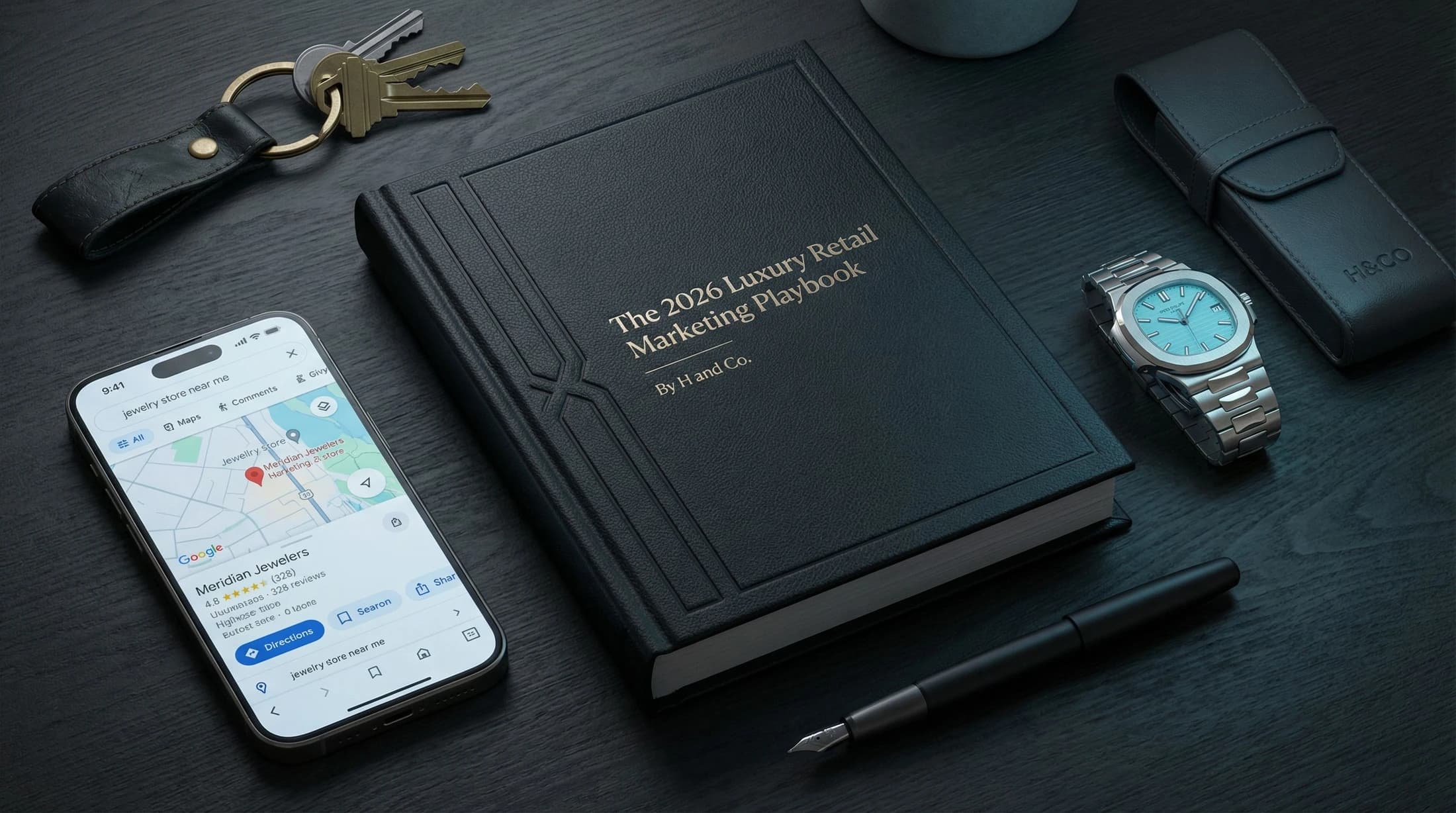
The 2026 Luxury Retail Marketing Playbook

The complete marketing playbook for luxury watch and jewelry retailers. What to do first, how to measure it, and why the channel depends on what you sell.

H

Hagop

Founder & Chief Strategist

March 24, 2026
11 min read
Book

Key Takeaways

  • The starting point depends on what you sell. Carried brands people search for → Google Ads. House brand nobody knows yet → influencer and social. Most retailers need both running in parallel.
  • Do things worth marketing first. A trunk show, a one-of-a-kind piece, a brand exclusive. One event feeds social, ads, email, press, and SEO. Without raw material, marketing is noise.
  • Fix measurement when you add a second ad platform. Google and Meta both claim the same sale. Without deduplication, your attributed revenue is double your actual revenue.
  • SEO compounds. Paid ads stop the day you stop paying. Brand pages capturing demand for every brand you carry will replace paid spend over time.
  • 45% of consumers now use AI to evaluate local businesses. Structured, factual content gets cited. Vague marketing copy gets ignored. The window to be early is closing.

A luxury jewelry marketing strategy is the system that connects every dollar a watch or jewelry retailer spends on advertising, SEO, social media, and events to measurable revenue at the register. Every marketing guide for jewelers ignores this. "Optimize your Google Business Profile. Post on Instagram. Run some ads." That advice is written for a $200 vermeil brand selling on Shopify. It has nothing to do with your business.

You sell $8,000 engagement rings and $15,000 watches. Your customers research for weeks, sometimes months, before they walk in. The sale happens in person, across a counter, after a conversation that builds enough trust to justify the price.

Your marketing? Probably managed by someone who runs the same playbook for dentists and HVAC companies. That disconnect is costing you six figures a year in missed revenue.

We work with luxury watch and jewelry retailers across the US and Canada: authorized dealers, independent jewelers, multi-brand stores with house lines. This playbook is built from what we see working across those businesses. Not theory. Not recycled listicle advice. The actual hierarchy of what to do, in what order, based on what you sell.

Jewelry is the fastest-growing fashion category, growing at 4x the rate of clothing (McKinsey/BoF State of Fashion 2026). The buyers are spending. The question is whether they can find your store when they do.


What Should a Luxury Retailer Do First?

Not everything at once. The single biggest mistake we see is a retailer trying to launch Google Ads, Meta Ads, SEO, social media, and email simultaneously on a $5K/month budget. They spread thin across five channels. None of them get enough investment to produce results. Three months later they conclude that "digital marketing doesn't work."

It does work. But the starting point depends on what you're selling.

If you carry brands people are already searching for (Rolex, Omega, Cartier, David Yurman), start with Google Ads. Someone searching "Omega Seamaster authorized dealer Dallas" is ready to buy. You're capturing demand the brand spent millions creating. This is the highest-intent, most measurable starting point.

If you need to create awareness for the brands you carry or your store itself, layer in Meta advertising and social media. Nobody is searching for your store by name yet. You need to interrupt them on Instagram while they're scrolling, stay visible during the months of research that precede a luxury purchase, and be the name they remember when they're ready to walk in. That awareness gap is the reason your competitor down the street gets the walk-in, even when your inventory is better.

If you're building a house brand or custom line, influencer marketing makes more sense earlier in the hierarchy because you're investing in your own brand equity, not a third party's. Fifteen to twenty micro-influencers with the right local audience will build demand for a house line faster than paid ads to a cold audience.

If you do custom, bridal, house jewelry, and carry watch and jewelry brands (which is 90% of the retailers we work with), you're running multiple strategies in parallel. Brand-carry campaigns capture existing demand. Custom and bridal campaigns create demand with storytelling. House brand campaigns build equity that belongs to you. Treat them as separate strategies with separate budgets. One blended campaign that tries to do everything will underperform across the board.

The hierarchy is a pyramid. Google Ads and local SEO form the base. Meta and social form the middle. Influencer, content marketing, and AI search optimization are the top. You build from the bottom up. Skip a layer and the ones above it underperform.

For guidance on how much to allocate at each stage, we break down budget ranges by business lifecycle.


Why Should You Do Things Worth Marketing?

This is the section most marketing guides skip entirely. It's the most important one.

The retailers who struggle with marketing have nothing to market. They open the store, stock the cases, and wait. Their Instagram is product flat-lays on white backgrounds. Their Google Ads say "Shop our collection." Their website reads "We offer a curated selection of fine jewelry and timepieces." Swap out the logo and it could be any of the 30,000 jewelry stores in America. There is nothing to talk about.

The retailers who win at marketing create moments worth talking about. Every channel feeds off that same source.

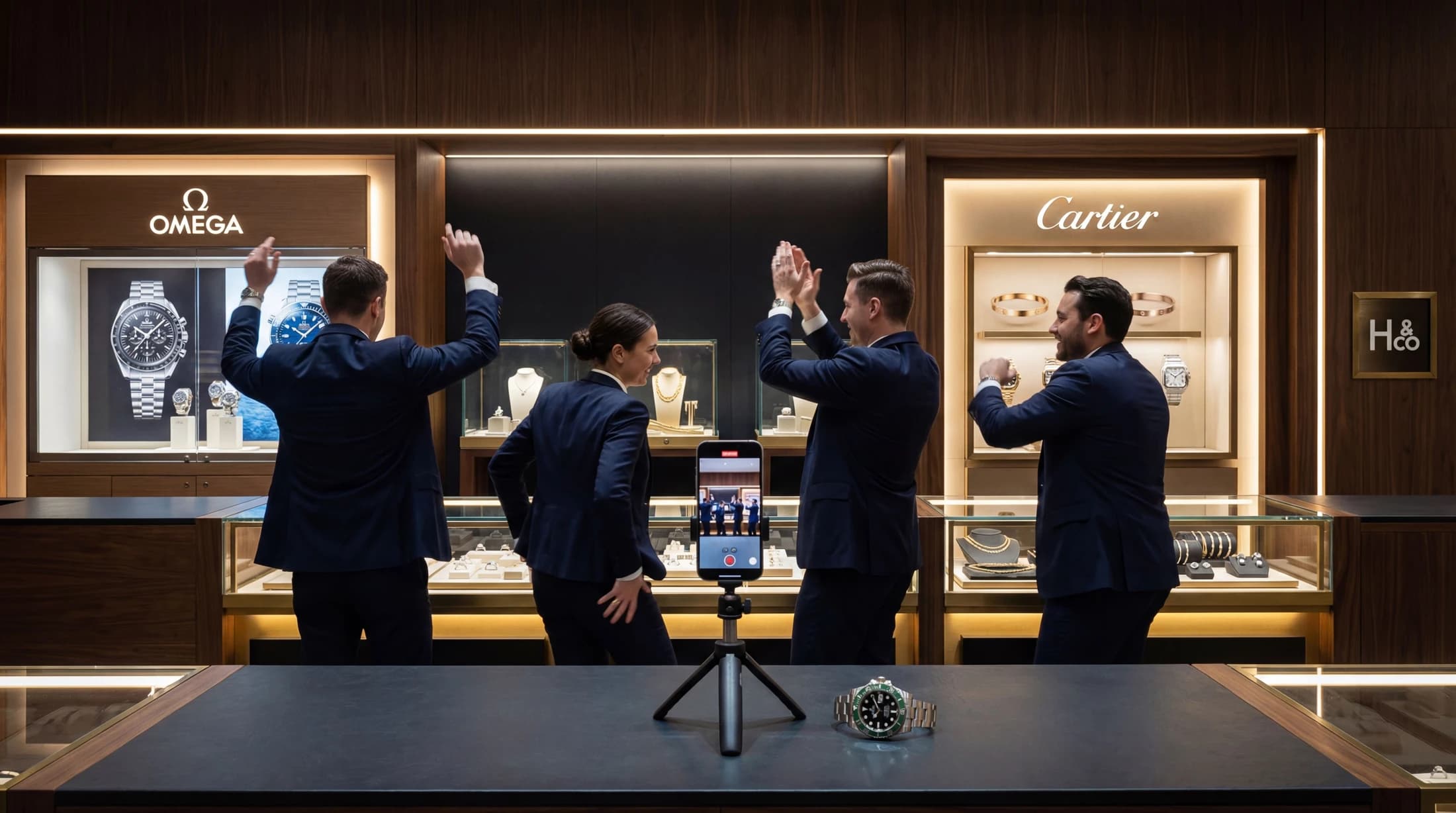
The flywheel works like this: You host a trunk show with a brand partner. You film the event on a Sony point-and-shoot. That footage becomes three Instagram Reels and a TikTok.

The best-performing Reel gets boosted as a Meta ad at a lower cost, because the algorithm already validated it. You email your customer list the event recap with photos. A local publication or trade magazine like InStore or JCK picks up the story.

That press mention becomes a backlink that improves your SEO authority. The press mention and your structured website content get cited when someone asks ChatGPT to recommend a jeweler in your city. One event. Every channel fed.

What counts as "worth marketing":

  • Trunk shows and brand launch events with RSVP-only access
  • One-of-a-kind pieces that deserve a professional photoshoot and a press push to every jewelry and watch publication and Instagram account in the space
  • Brand exclusives: a collaboration with a carried brand on a piece available only at your store
  • Custom design reveals: the moment a client sees their finished piece for the first time (filmed with permission)
  • Community involvement: charity events, local partnerships that anchor your store in its city
  • For watch retailers, limited edition releases and auction consignment pieces that generate collector interest

The point is not "do more events." Marketing without raw material is noise. Create something real, and the marketing has substance behind it.

A trunk show is content. A one-of-a-kind sapphire necklace photographed properly is content. A customer's engagement ring reveal is content. The content feeds the ads, the ads feed the traffic, the traffic feeds the revenue.

If you have nothing to market, that's the first problem to solve. Not the ad budget.


How Do Paid Ads Work for Luxury Retailers?

84% of luxury watch and jewelry retailers run some form of paid advertising. Only half run Google and Meta at the same time, which means they're leaving money on one side of the funnel. That's from our analysis of 20,946 ads across 99 retailers.

Google Ads captures existing demand. Someone searching "custom engagement ring [city]" or "[brand] authorized dealer [city]" is close to a purchase. Google Ads for luxury retailers covers campaign structure, keyword strategy, Shopping ads, and the mistakes that kill most campaigns (broad targeting, homepage landing pages, giving up before the algorithm has enough data).

Meta Ads (Facebook and Instagram) creates and nurtures demand. Someone isn't searching for an engagement ring today, but they will be in three months. Meta keeps your store visible during that research window so you're the first name they think of when they're ready. Our Meta Ads guide covers creative strategy, the retargeting sequence, and why better creative lowers your distribution costs.

Co-op advertising is money most authorized dealers leave on the table. Rolex, Breitling, Richemont, and other brand partners fund ads that drive traffic to their dealers. In our data, Rolex alone accounted for over 7,700 co-op ads across its entities. Yet 9.9% of authorized dealers had no detectable advertising on either platform, even with co-op dollars available. Call your brand reps about digital co-op this week. The budgets exist. Your competitors are probably already using them.

One thing to understand about co-op: it builds the brand's awareness, not yours. 38.7% of all ads in our dataset are brand co-op, and they look identical from one dealer to the next. That means co-op alone won't differentiate you. Layer it on top of your own campaigns. Never let it replace your voice.


Why Is SEO the Highest-ROI Long-Term Investment?

Paid ads stop producing the day you stop paying. SEO compounds. A blog post you publish this month will still drive traffic three years from now. A local SEO foundation you build this quarter makes every other channel more effective because it lowers your cost to acquire each customer.

46% of all Google searches have local intent (Search Engine Roundtable). Local searches convert at 28%, far above any other digital channel. If you have a physical store, local SEO is the foundation.

Brand pages are the play most retailers miss. Every brand you carry should have a dedicated page targeting "[brand] + [city]." When someone searches "Omega authorized dealer Dallas," a dedicated page with unique local content ensures your store appears, not the brand's own website or a grey market dealer. Across our client base, retailers who built these pages saw 2-3x organic traffic from brand-specific local searches within eight months.

Content builds authority over time. Your competitors' agencies are producing hundreds of blog posts for them. You don't need to match their volume. You need content that only you can write: your expertise, your opinions, your market observations. Generic "4 Cs of Diamonds" content won't rank against Tiffany and Blue Nile. Your perspective on what you look for when selecting stones for your cases will, because no one else can write it.


When Should You Fix Your Measurement?

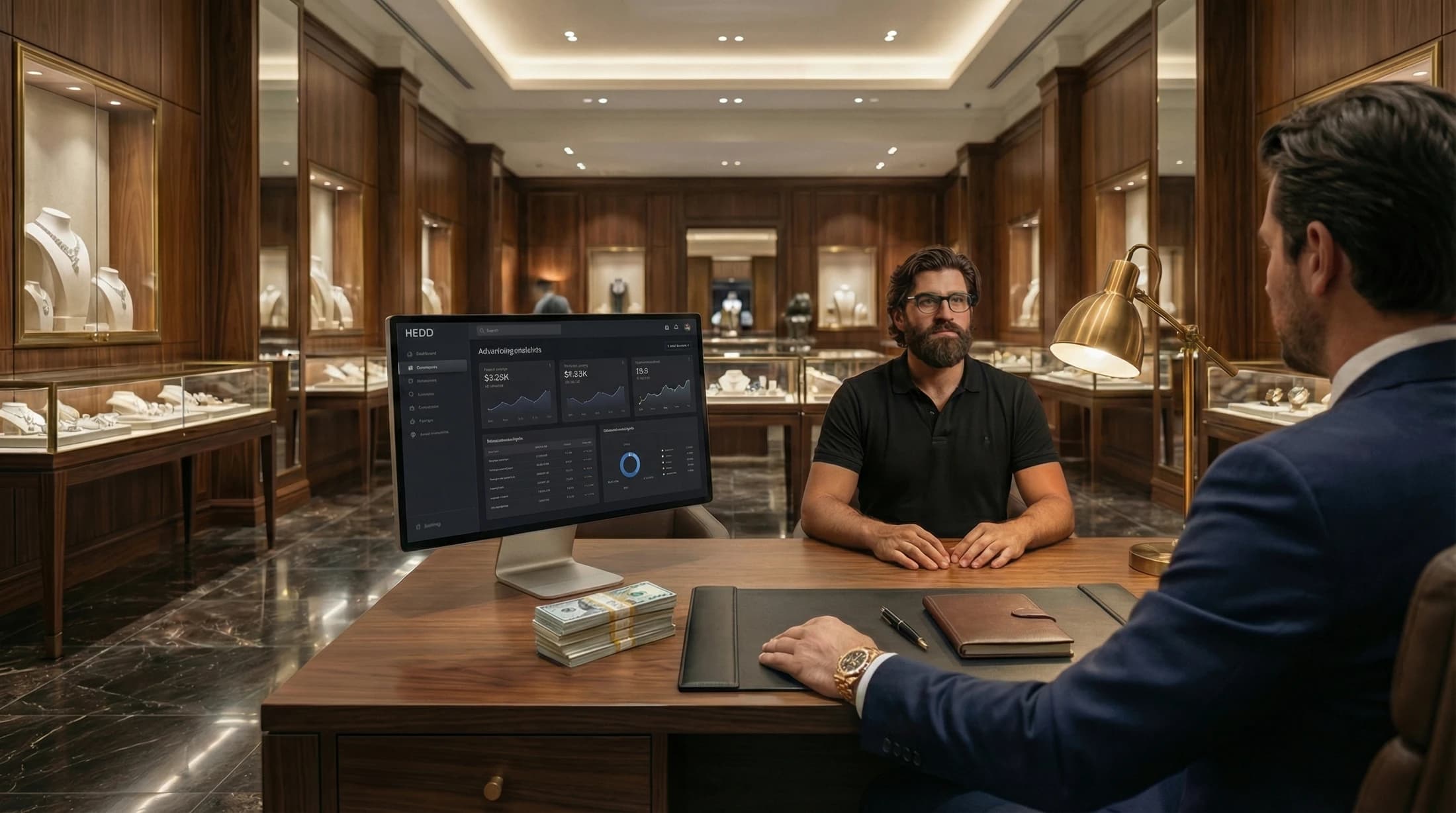
Before you spend another dollar on ads, read this section. When you're running ads on two or more platforms, you need a single source of truth. Here's why.

A customer clicks a Google Ad on Monday. Sees a Meta retargeting ad on Wednesday. Walks into your store on Saturday and buys a $10,000 ring. Google reports a $10,000 conversion. Meta reports a $10,000 conversion. Your POS shows one sale. If you add up what both platforms claim, your "attributed" revenue is double your actual revenue.

Every ad platform is greedy with attribution. Each one claims full credit for the sale.

It gets worse. Safari's Intelligent Tracking Prevention deletes cookies after 7 days. Your jewelry buyer researches for 2-8 weeks. The connection between their first ad click and their in-store visit disappears. Standard tracking can't bridge that gap, and Safari holds 55% of mobile browser share in the US.

This is why most retailers can't tell what's working. You're not bad at reading dashboards. The dashboards are lying to you.

The fix: server-side tracking, POS integration, email-based attribution that ties in-store buyers back to their original online interactions, and cross-channel deduplication so you see one accurate revenue number per customer. We built HCO App to solve this specific problem, but the principle applies regardless of what tool you use. If you can't see the full path from ad click to in-store sale, you're optimizing blind.

When the measurement works, every other decision gets easier. You see which campaigns drive phone calls and store visits. You see which creative produces the highest-value customers. You stop guessing and start allocating based on what your register says.


How Does Social Media Feed Everything Else?

Social media for a luxury retailer is not a revenue channel. Treat it as one and you'll be disappointed. It's the training ground where you build the content muscle that feeds every other channel.

The video you learn to make for Instagram Reels becomes the creative that lowers your Meta ad costs. The product post you put on TikTok teaches you what your audience responds to. Behind-the-scenes content that earns saves and shares will drive store visits and make your paid advertising cheaper.

Instagram and TikTok are the two-platform play. Short-form vertical video works on both. One piece of content, two distributions. A content calendar mixing craftsmanship footage, owner-on-camera clips, product spotlights, education, and event content keeps the feed varied and the audience growing.

The organic-to-paid pipeline is the practical reason to invest time in social. Post content organically. After 48-72 hours, check which posts got the most saves and shares. Turn the winners into paid ads on Meta.

Because the content is already proven to engage, your cost per impression drops. Retailers who skip organic social and go straight to paid ads are paying for creative testing they could have done for free.


Why Is Your Customer List Your Most Profitable Channel?

Email and CRM are the highest-ROI channel for any luxury retailer with an existing customer base. The math is simple: it costs 5-7x more to acquire a new customer than to bring back an existing one, and repeat customers spend more per visit.

Most retailers have a customer list of 2,000 to 15,000 names and do almost nothing with it. No birthday outreach, no anniversary reminders, no "new collection" announcements, no VIP event invitations. That list is the most profitable marketing asset you own, and it's sitting in your POS system collecting dust.

What a luxury jewelry marketing strategy for existing customers looks like: anniversary reminders triggered 30 days before (with product suggestions based on purchase history), post-purchase follow-ups at 2 weeks and 3 months, VIP early access to trunk shows and new collections, and seasonal campaigns for Valentine's Day, Mother's Day, and holiday gifting. These emails convert at 3-8x the rate of any paid ad because the recipient already trusts you.

If you have a CRM with 5,000+ contacts and purchase history, that's also a targeting asset for paid ads. Upload it to Google and Meta as a custom audience. Both platforms build lookalike audiences from it, finding new people who resemble your best customers. The customer list feeds the acquisition engine.


How Is AI Search Changing How Customers Find Jewelry Stores?

45% of consumers now use ChatGPT or other AI tools to evaluate local businesses. Last year that number was 6% (GatherUp Beyond the Stars 2025). Shopping-related searches on AI platforms grew 4,700% between 2024 and 2025 (Adobe via Digital Commerce 360). Read that number again. This shift is happening whether you prepare for it or not.

When someone asks ChatGPT "best jewelry store in Scottsdale for custom engagement rings," the AI doesn't show ten blue links. It assembles an answer and cites specific businesses. Your store is either in that answer or it isn't.

Generative Engine Optimization (GEO) is the practice of structuring your content so AI can find, understand, and cite your business. It rewards specificity over domain authority. A detailed page about your custom engagement ring process, your credentials, and your specific services in your specific city is more citable than a massive brand's generic website.

The signals that matter:

  • Specific, factual website content with clear entity statements ("We are an authorized Omega dealer in Scottsdale, AZ")
  • Consistent information across every platform: Google, Yelp, social, directories
  • Detailed customer reviews that mention specific services and experiences
  • Press coverage that gives AI a third-party source to cross-reference

The retailers who build for AI citability now will have a compounding advantage over those focused on traditional SEO and paid ads alone. Entity signals take time to build. The window to be early is closing.


What Should You Prioritize Based on What You Sell?

Every retailer's mix is different. This matrix shows where to start based on which part of your business you're marketing.

Where to Start Based on What You're Marketing

ItemDetails
Engagement RingsFirst: Local SEO + Google Ads. Second: Meta retargeting. Third: Content (buying guides, proposals).
Luxury WatchesFirst: Brand pages + local SEO. Second: Co-op Google Ads. Third: YouTube (unboxings, reviews).
Custom / BespokeFirst: Portfolio content + Instagram. Second: Google Ads (custom + city). Third: Pinterest.
Estate / Pre-OwnedFirst: Google Shopping + Search. Second: eBay/Chrono24 marketplace. Third: Meta retargeting.
Bridal PartyFirst: Pinterest + Instagram. Second: Meta Ads (interest targeting). Third: Content (styling guides).
Service / RepairFirst: Local SEO + GBP. Second: Google Ads ("watch repair near me"). Third: Email to existing clients.

Most retailers sell across several of these categories. A complete luxury retail marketing playbook isn't "pick one channel." It's "know which strategy applies to which part of your business, and don't blend them into one generic campaign." The jewelry store marketing guide that tells you to do everything at once is setting you up to do nothing well.


The Playbook in One Sentence

Every channel works. The right one depends on what you're selling. The only way to know what's producing is to connect your marketing to your register.

Do things worth talking about, and the marketing has substance. Skip that, and you're making noise nobody asked for. That's the luxury jewelry marketing strategy in its simplest form.

If you're spending money on marketing and can't point to the revenue it generated, that's not a marketing problem. It's a measurement problem. Fix that first.

Want to know where you stand? Book a strategy call. We'll walk through what you're running, what it's producing, and where the gaps are. It's a 30-minute conversation, not a sales pitch. You'll leave with a clear picture of what's working, what's not, and what to prioritize next, whether you work with us or not.

Topics
MarketingSEOJewelryAdvertisingSocial MediaWatchesContent Strategy
Share this article
Continue Reading

Read Next