

How Much Revenue Does a Slow Website Actually Cost?
For jewelry and watch retailers spending thousands on ads and SEO, a site that fails these metrics is burning money at every stage of the funnel.
- Bounce increase (1s→3s)32
- CPC increase (QS drop)28
- Form submissions lost15
- CDN speed improvement50
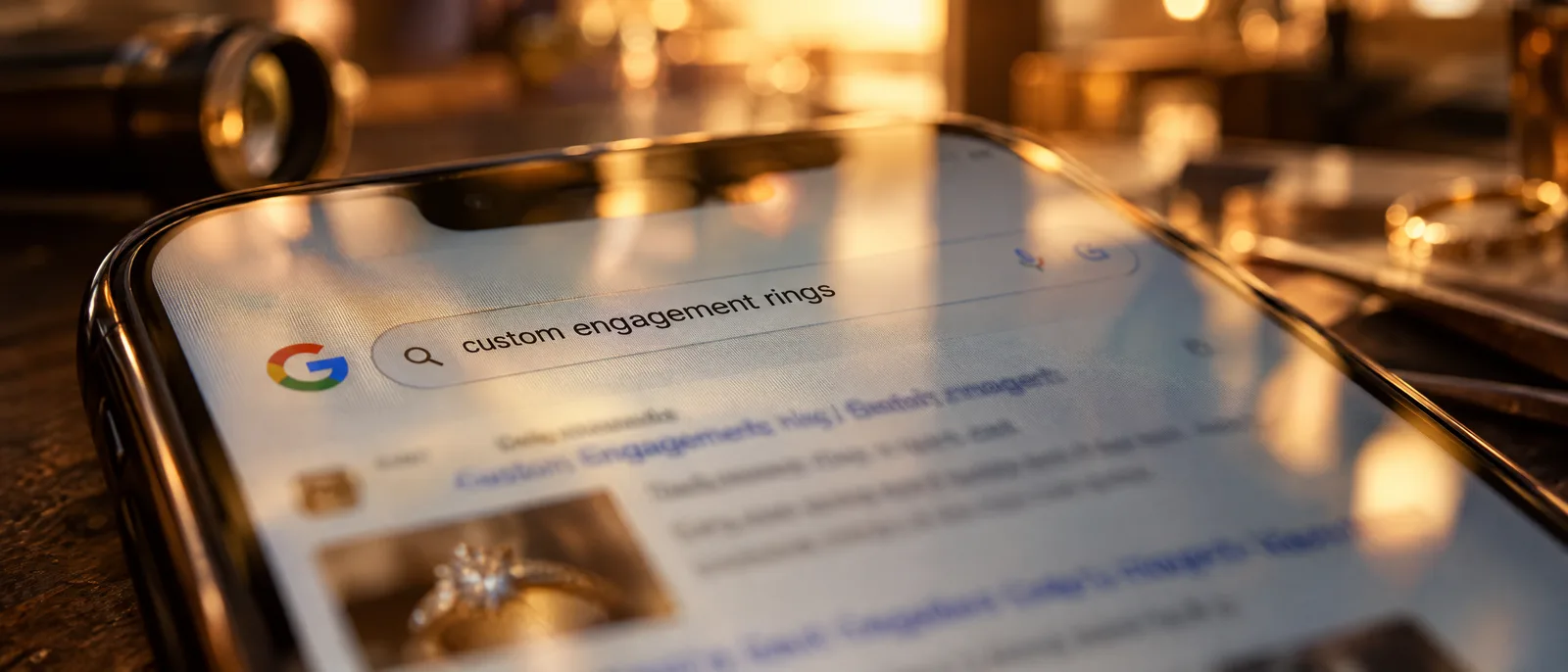
This matters even more in an era of visual discovery. Google Lens now processes roughly 20 billion visual searches per month. If a user "snaps" a watch or ring and your site takes too long to load the visual match, they will bounce to a faster competitor.
H&CO is a digital marketing agency for luxury jewelry and watch retailers. We audit dozens of jewelry sites a year, and the same performance problems show up over and over.
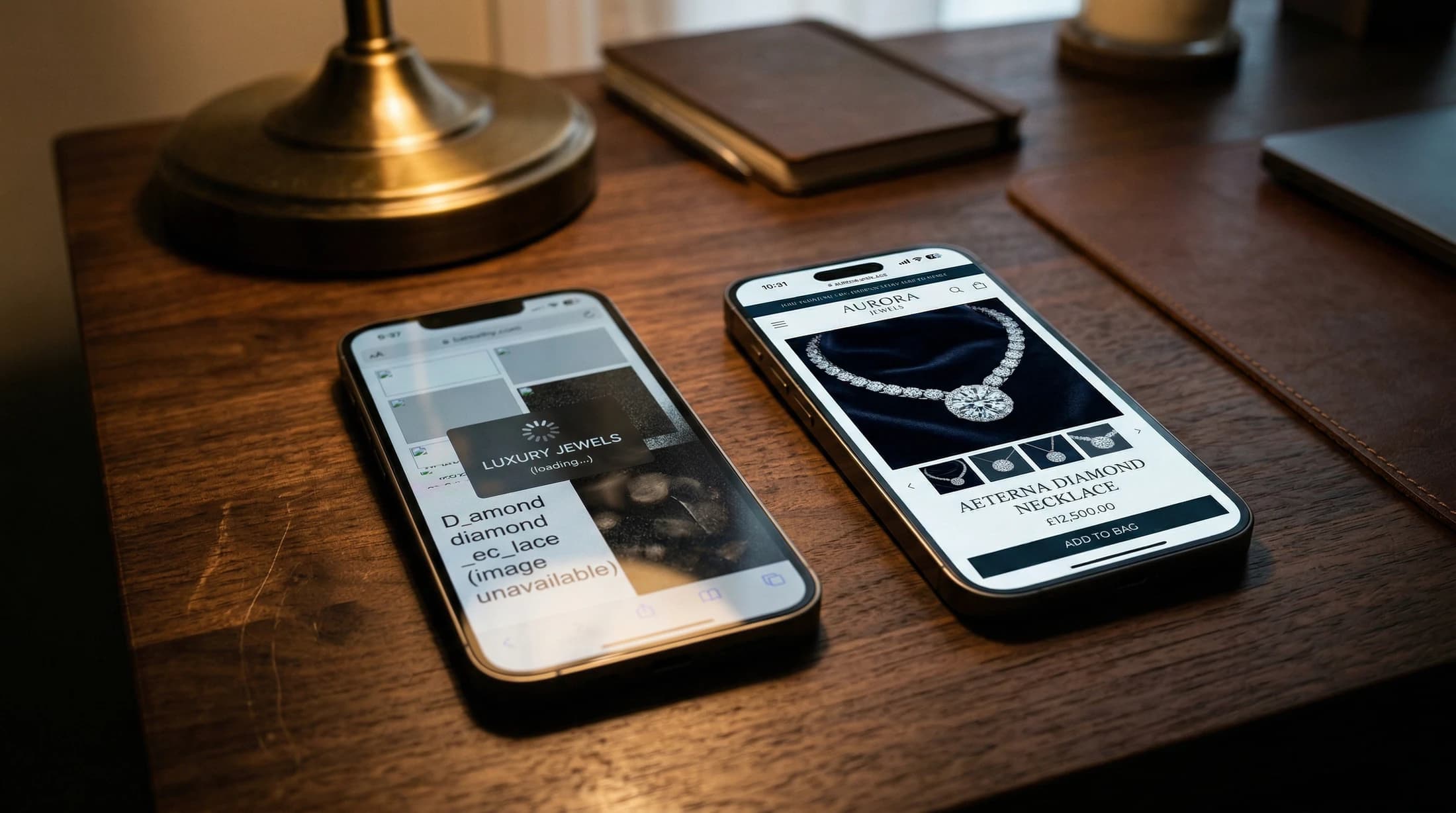
If your website takes four seconds to load on a mobile device, your "digital showroom" has the equivalent of a rusted, locked front door. As page load time goes from one second to three seconds, the probability of a bounce increases by 32% (Think With Google, 2018). In luxury retail, a bounce is a lost $15,000 sale.
According to Fortune Business Insights, 81.4% of sales are offline, but the vast majority of those journeys start on a mobile screen. Many of these high-intent shoppers come from Pinterest, where users are 27% more likely to buy luxury products than on other platforms. Pinterest is a mobile-first experience; if your mobile speed is lacking, you are invisible to their 700 million projected users.
Why Do Jewelry Sites Have Worse Speed Than Almost Any Other Retail Category?
Jewelers face a unique performance trap. The product demands beautiful photography, high-resolution macro shots that show every facet. But beauty and speed are at war if you don't handle images correctly.
Modern luxury consumers now expect interactive features like AR try-ons. These tools require significant processing power and optimized code; if your foundation is slow, these high-conversion features will never function correctly.
What Does Slow Speed Actually Cost You in Dollars?
- Ad Waste: Google penalizes slow landing pages with a lower Quality Score in paid advertising. A Quality Score drop from 7 to 5 can increase your cost-per-click by 25-30%.
- SEO Rankings: Since 2021, Core Web Vitals have been a direct ranking factor. Google has confirmed this repeatedly. If two pages have similar content and backlink profiles, the faster page wins.
- The Trust Gap and Security: A slow site feels "cheap" and insecure. In a market where the average U.S. data breach cost is $10.22 million, a jittery or slow-loading mobile site signals a lack of investment in technical infrastructure. For a buyer about to share sensitive personal and financial data for a $25,000 purchase, performance is a proxy for security (IBM, 2025).
- Conversion Rate: Even among visitors who don't bounce, slow speed reduces engagement. Pages that load faster see measurably more form submissions than pages that take twice as long.
How Do You Fix Speed Without Sacrificing Visual Quality?
1. Modern Image Stack
Convert all images to WebP or AVIF format. Implement responsive image sizing so mobile devices receive a 400px-wide image, not the 3000px original.
2. Kill Widget Bloat
Audit every third-party script. If a script doesn't directly contribute to revenue, remove it. Replace heavy iframe embeds with lightweight alternatives.
3. Server-Side Rendering and Modern Frameworks
Modern frameworks like Next.js offer server-side rendering, meaning the browser receives pre-built HTML instead of waiting for JavaScript to construct the page.
4. CDN and Edge Caching
Deploy a Content Delivery Network so images and assets are served from a server physically close to your customer. This alone can cut load times by 40-60%.
5. Font Optimization
Custom luxury fonts are often the hidden speed killer. Use `font-display: swap` so text renders immediately with a system font, then swaps in your custom font once it's loaded.
Run your site through Google PageSpeed Insights right now. If you're under 70 on mobile, we should talk.
Research & Sources
- Google: *Lens product update, October 2024.* Google Lens processes nearly 20 billion visual searches per month.
- Pinterest Business: *Luxury Shopper Trends 2024.* Pinterest users are 27% more likely to purchase luxury products than other social platform users.
- IBM Security: *Cost of a Data Breach Report 2024.* Average cost of a data breach in the U.S. is $10.22 million.
- Deloitte: *The Digital Luxury Experience.* 40% of luxury consumers demand high-performance AR try-on features.

About the author
Hagop Imasdounian
Hagop Imasdounian is the founder of H&CO. Raised around his family’s jewelry businesses, he brings more than 15 years of digital marketing experience to helping jewelry and watch brands improve their websites, reach buyers and connect marketing with sales.