


Generative Engine Optimization
Generative Engine Optimization: Get Cited by AI, Not Just Ranked by Google
Forty-five percent of consumers now use AI tools to evaluate local businesses before visiting (SOCi's 2024 Consumer Behavior Index). That number was negligible two years ago. It will be higher next year.
Get StartedTrusted By
Forty-five percent of consumers now use AI tools to evaluate local businesses before visiting (SOCi's 2024 Consumer Behavior Index). That number was negligible two years ago. It will be higher next year.
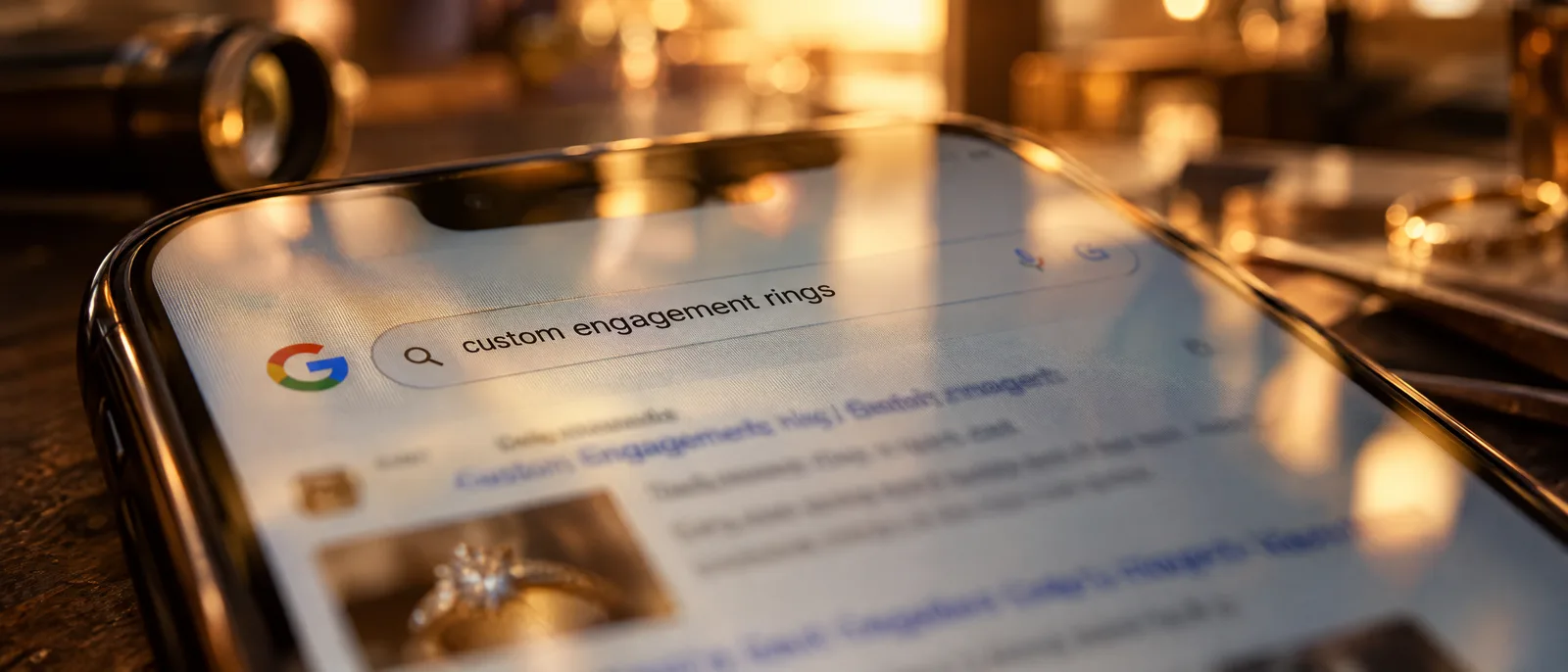
When someone asks ChatGPT "best jewelry store in Dallas for engagement rings" or types that same query into Google and gets an AI Overview at the top, your store is either in the answer or it isn't. There's no position two. There's no "above the fold." The AI picks a handful of businesses to name, and everyone else is invisible in that conversation.
Generative Engine Optimization is the practice of structuring your online presence so AI systems cite your business when they answer these questions. It's related to traditional SEO, but the mechanics are different, the content requirements are different, and most luxury retailers haven't started.
That last part is an opportunity. The window to establish authority in AI search results for your market is open right now. The retailers who act first will be the ones the algorithms learn to cite. Everyone else will be playing catch-up.
How AI Search Engines Decide What to Cite
Understanding what AI systems pull from your site, and why, is the starting point.
AI models don't rank pages the way Google's traditional algorithm does. They don't care about your backlink profile or your domain authority in the same way. What they do is crawl indexed web content and extract specific, factual, attributable statements to include in their responses.
The word to focus on is "attributable." AI systems are looking for content they can point to and say "according to [source]." Vague marketing copy gives them nothing to work with. A sentence like "we offer an amazing selection of fine jewelry" contains no fact an AI can cite. A sentence like "authorized dealer for 12 Swiss watch brands with GIA-certified gemologists on staff since 1985" contains four citable facts in one line.
This is a fundamental shift in what your website content needs to do. Traditional SEO optimized for relevance signals. GEO optimizes for citability.
The Major AI Search Platforms
Google AI Overviews appear above organic results for an increasing percentage of queries. Google pulls content from its existing index and synthesizes an answer. You can rank number one organically and still not appear in the AI Overview above your own listing. According to BrightEdge research, AI Overviews now appear for roughly 30% of search queries, with local and product queries among the fastest-growing categories (BrightEdge).
ChatGPT with web search is growing rapidly. OpenAI reports over 400 million weekly active users as of early 2025 (OpenAI). A significant and growing portion of those users search for product recommendations and local businesses. When a buyer asks ChatGPT "where to buy a Rolex in Scottsdale," ChatGPT searches the web, reads your site (if it can), and decides whether to name you.
Perplexity positions itself as an "answer engine" and cites sources inline, making it easy for users to see where information came from. It's smaller than Google or ChatGPT but growing fast among research-oriented users, exactly the profile of someone making a high-consideration purchase.
Bing Copilot integrates AI answers into Microsoft's search engine. Market share is smaller, but the format is the same: AI reads the web and names businesses in its responses.
We cover how these platforms work in more depth in our post on how AI evaluates local businesses.
Why This Matters More for Jewelry and Watch Retailers
GEO matters for every local business. It matters more for yours because of how people buy what you sell.
Nobody impulse-buys a $15,000 watch. The research phase is long, and AI is becoming part of that research. A buyer who asks an AI assistant "best authorized Omega dealer in [city]" is deep in the consideration phase. They're ready to visit a store. The question is which one.
Local intent queries are exactly the type AI answers directly. "Best engagement ring store in [city]," "authorized Rolex dealer near me," "custom jewelry designer in [city]." These are the queries that used to produce ten blue links and now increasingly produce a direct answer with two or three named businesses.
Your authorized dealer status, brand portfolio, certifications, years in business, and staff credentials are precisely the type of structured, verifiable facts AI systems prefer to cite. A retailer who has been in business for 40 years, carries 15 authorized brands, and employs GIA-certified gemologists has a stronger GEO position than a retailer whose website says "we have a stunning collection." One gives AI something to cite. The other gives it nothing.
Your competitors probably haven't touched this yet. Most agencies haven't either. The strategies for appearing in AI search results are less than two years old, and the field is still being defined. That means the first movers in each local market will build the AI citation history that becomes self-reinforcing. The more an AI system cites you, the more likely it is to cite you again, because it references its own prior outputs as a trust signal.
Writing Content That AI Systems Actually Use
Getting cited by AI isn't a mystery. It's a writing problem. Your content either contains statements AI can extract and attribute, or it doesn't.
Entity Statements
An entity statement is a clear, factual declaration about your business. Who you are, what you carry, where you operate, what differentiates you. Written plainly, without marketing spin.
Example: "Family-owned since 1985, authorized retailer for Rolex, Omega, and TAG Heuer in downtown Scottsdale, Arizona. On-site certified watchmaker with 25 years of service experience."
That sentence contains six citable facts: ownership type, founding year, three brand authorizations, location, on-site watchmaker, and years of experience. An AI system scanning your site can extract any one of those facts and attribute it to you.
Compare that to: "We're passionate about bringing you the finest timepieces." Zero citable facts. Invisible to AI.
These entity statements need to appear consistently across your website, your Google Business Profile, your structured data markup, and any third-party directories where your business is listed. Consistency across sources is a trust signal for AI systems, just as it is for traditional local SEO.
Content Structure for AI Readability
AI systems parse content differently than human readers. Structure matters.
Direct answers to common questions should appear early on relevant pages, not buried in the third paragraph. If someone asks "does [store name] carry Rolex" and the answer is on your site but wrapped in three paragraphs of introduction, the AI might miss it. Put the answer first.
FAQ sections with specific, factual responses are among the most cited content types in AI search results. Not soft, marketing-flavored FAQs like "why choose us?" Concrete questions like "what brands does [store name] carry?" with concrete answers that list the brands.
Service pages that state capabilities plainly instead of obscuring them in marketing language. "We offer ring resizing, stone replacement, prong re-tipping, and full watch servicing for mechanical and quartz movements" is citable. "We provide a complete range of jewelry and watch services" is not.
Location-specific content that ties your business to geographic queries. Every page should make it clear where you operate. Not just on your contact page, on every page where location relevance matters.
We break down what makes content citable in detail in our guide on content citability for ChatGPT, Perplexity, and AI Overviews.
Making Sure AI Can Actually Read Your Site
You can write the most citable content on the internet and it won't matter if AI crawlers can't access it. This is a surprisingly common problem.
Robots.txt Configuration
AI search engines use their own web crawlers, separate from Googlebot. The major ones:
- GPTBot (OpenAI / ChatGPT)
- ClaudeBot (Anthropic)
- PerplexityBot (Perplexity)
- Bingbot (powers Bing Copilot)
Many websites block these crawlers without realizing it. An overly restrictive robots.txt file, or one that was written before AI crawlers existed, might allow Googlebot but block everything else. If GPTBot can't read your site, ChatGPT can't cite you. Simple as that.
Auditing your robots.txt takes five minutes. Fixing it takes another five. The impact on your AI visibility can be immediate, since these crawlers revisit sites regularly.
llms.txt Implementation
The llms.txt file is a newer standard, similar in concept to robots.txt but designed specifically for AI systems. It tells AI crawlers what your site is about and directs them to the most relevant content.
Think of it as a concise briefing document for AI. It includes your business description, service areas, brand authorizations, locations, and pointers to your most important pages. Not every AI system reads llms.txt yet, but adoption is growing, and having one in place is a low-effort signal that your site is AI-ready.
Schema Markup for AI Citation
Structured data markup has always mattered for traditional SEO. For GEO, specific schema types carry extra weight.
LocalBusiness schema tells AI systems your address, hours, service area, and business type in a machine-readable format. This is the most direct way to ensure AI systems have accurate factual data about your location.
Organization schema establishes your brand entity with founding date, location, and other corporate facts that AI systems reference when describing businesses.
Product schema marks up individual products with brand, price, availability, and identifiers like GTINs. AI systems increasingly reference product-level data when answering purchase-intent queries.
FAQ schema wraps your question-and-answer content in a format that AI systems can parse and extract directly. A well-marked-up FAQ section is one of the easiest GEO wins available.
Review and rating markup feeds into AI-generated recommendations. When an AI system says "highly rated jewelry store in [city]," it's pulling from aggregated review data, and schema markup is how you make that data accessible.

How AI Decides
Your Content Either Gets Cited or Gets Ignored
AI systems extract specific, factual, attributable statements. Vague marketing copy gives them nothing to work with. A sentence with four citable facts beats a paragraph of brand positioning every time.

First-Party Research
Original Data Is the Strongest Citation Signal
AI systems cite primary sources over aggregators. Your sales data, market observations, and team expertise are GEO assets nobody else can replicate. We help you turn proprietary insights into citable content.

Measurement
Track Who's Citing You and Who's Not
Brand mention tracking, AI citation monitoring, share of voice against competitors, and traditional ranking data alongside AI visibility metrics. You see exactly where you stand in both search worlds.
First-Party Research Is the Strongest Citation Signal
There is one type of content AI systems cite more than anything else: original research and first-party data that doesn't exist anywhere else on the internet.
When every retailer in your market publishes the same recycled advice, AI has nothing to differentiate between them. But when your website contains data, insights, or frameworks that originated from your own experience, AI systems treat you as a primary source. Primary sources get cited. Aggregators get ignored.
What First-Party Content Looks Like for a Luxury Retailer
Your own sales data, anonymized and contextualized. "Engagement ring buyers who book an appointment convert at 3x the rate of walk-ins" is a finding only you can publish. No one else has your transaction data. AI systems cite findings like this because they can't find them anywhere else.
Original market analysis. We published a study analyzing 20,946 ads across 99 luxury retailers. That single piece of research has generated more AI citations than dozens of standard blog posts combined. The reason: it's a primary source. AI systems that want to reference luxury retail advertising data have to cite us because nobody else ran that study.
Subject matter expertise documented on your site. Your head watchmaker has 30 years of experience servicing complications. Your gemologist has graded thousands of stones. That expertise, written up as specific, factual content on your website, is exactly what AI systems look for when answering questions about watch maintenance or diamond quality in your city.
Customer behavior patterns you've observed firsthand. How long your average buyer researches before purchasing. What percentage of your sales start online and close in-store. Which product categories have the longest consideration windows. These are proprietary insights that position you as the authority, not just another retailer repeating manufacturer talking points.
Why This Matters for GEO Specifically
Traditional SEO rewards content that matches search intent. GEO rewards content that provides answers no one else can provide. The more unique and verifiable your content is, the more likely AI is to cite it, because AI systems are designed to find the best available source for each claim they make.
A retailer whose site contains ten pieces of original research, client surveys, market observations, service data, will consistently outperform a competitor whose site is entirely composed of content that could have been written by anyone. AI doesn't need another generic "guide to buying an engagement ring." It needs the version written by the person who has sold 5,000 of them.
We help our clients identify the first-party data they're already sitting on and turn it into citable content. Most retailers don't realize the insights locked in their POS, CRM, and team expertise are their strongest GEO assets.
The Difference Between Ranking on Google and Being Cited by AI
These are not the same thing, and treating them as interchangeable is a mistake.
You can rank number one for a keyword and not appear in the AI Overview displayed above your listing. The AI Overview pulls from a different selection process. It looks for citable statements, not relevance signals. A page that ranks well because of strong backlinks and domain authority but contains nothing specific enough to cite will be ignored by the AI summary.
Conversely, a page with weaker traditional ranking signals but highly specific, factual, well-structured content can get cited in AI results even if it sits on page two of organic search.
GEO and SEO are complementary. They share some foundations, site structure, content quality, technical health, but they diverge in what the content itself needs to accomplish. SEO content needs to be relevant. GEO content needs to be citable. The best content is both.
A page optimized for both ranks in organic results and gets cited in AI answers. That's the goal, and it's achievable for every page on your site when the content is written with both purposes in mind.
For a deeper look at what's changing, read our analysis of GEO for luxury watch and jewelry retailers.
Measuring What Matters in AI Search
GEO performance measurement is newer and less standardized than SEO measurement. That doesn't mean it's unmeasurable.
Brand mention tracking across AI platforms is the most direct metric. Are you being named in ChatGPT responses? In Perplexity answers? In Google AI Overviews? We monitor these across your target queries on a regular basis.
AI citation monitoring goes deeper than brand mentions. Which specific pages on your site are being pulled into AI responses? Which statements are being cited? This tells you what's working and what to produce more of.
Share of voice in AI results compares your citation frequency to your competitors for the same queries. If there are five jewelry stores in your market and the AI names your competitor three times for every one time it names you, that's a gap you can close with better content.
Competitor AI visibility comparison tracks who else is showing up for your target queries. This informs both your content strategy and your urgency. If no one in your market has invested in GEO yet, you have a first-mover advantage. If a competitor is already getting cited, you know what you're up against.
Traditional ranking data alongside AI citation data gives you the complete picture. A page might rank well organically but never get cited by AI. A different page might get cited regularly but rank poorly in traditional results. You need both datasets to make informed decisions.
Start With a GEO Audit
If you're not sure where you stand in AI search, a GEO audit gives you the answer.
We offer GEO audits as a standalone engagement, $1,500 to $3,000 depending on the scope of your online presence and the number of locations involved.
What the audit covers:
- Current AI visibility: Are you showing up in AI search results at all? We test your business across ChatGPT, Perplexity, Google AI Overviews, and Bing Copilot for your target queries.
- Crawler access review: Can AI systems actually read your site? We audit your robots.txt, check for AI crawler blocks, and assess your llms.txt implementation (or lack of one).
- Content citability analysis: Does your content contain statements AI would cite? We evaluate your homepage, service pages, location pages, and about page for citable entity statements.
- Schema and structured data audit: Is your structured data markup complete, accurate, and optimized for AI parsing?
- Competitor AI visibility comparison: Who is AI citing for the queries you want to own? How do their sites compare to yours in terms of content structure and citability?
- Prioritized action plan: Specific recommendations ranked by impact and implementation effort. What to fix first, what to build next, and what can wait.
The audit works as a starting point whether you engage us for ongoing GEO work or handle implementation in-house. Either way, you leave with a clear picture of where you stand and what it takes to get cited.
Specificity Wins. Vague Marketing Copy Loses.
This point runs through every section on this page, and it deserves its own emphasis because it requires a mindset shift for most luxury retailers.
Your website was probably written to sound impressive. Sweeping statements about your heritage, your passion, your dedication to quality. That copy might resonate with a human reader who's already in your store. It does nothing for AI systems evaluating whether to cite you.
AI systems are trained to extract factual, verifiable claims. They need specifics. Numbers, names, dates, credentials, locations, brand names, certifications.
"We have a stunning collection of fine jewelry" = invisible to AI.
"Authorized retailer for 14 brands including Rolex, Cartier, and David Yurman, with two GIA-certified gemologists on staff and on-site jewelry repair since 1982" = five citable facts in one sentence.
This applies to every page on your site. Your homepage, your about page, your service pages, your location pages, your blog posts. Every page is a potential source for AI citation. Every page that contains only vague marketing copy is a missed opportunity.
The stores that rewrite their content with specificity and structure will dominate AI search results in their markets. The window for this advantage won't stay open forever. As more businesses optimize for AI, the competition for citations will intensify. But right now, in most local luxury retail markets, the field is wide open.
Related Services
Other Services
Search Engine Optimization
SEO
Technical SEO, local search, and content strategy that brings qualified traffic to your luxury retail site.
Learn MoreTechnical Analysis
SEO Audit
A full technical, on-page, and competitive audit that tells you exactly where your site stands and what to fix first.
Learn More