
The Cookie-Cutter Problem
There's a pattern we see across the authorized dealer world that nobody talks about openly. A retailer launches a new website. It looks clean, modern, and brand-compliant. Then you visit the dealer in the next city and their site looks identical. Same layout. Same structure. Same stock product descriptions. Different logo in the corner.
This happens for two reasons, and neither one is good for your business.
Reason one: certain agencies and platform providers sell the same website design to multiple dealers, sometimes 5-10 stores running what is essentially the same site with minor cosmetic changes. The agency benefits from the efficiency. The dealer gets a fast launch. But Google sees five nearly identical websites and has no reason to rank any of them above the others. This matters when 46% of all Google searches have local intent; if you look like everyone else, you lose the local relevance game (Google, 2018).
Reason two: brands provide product content through iframes or data feeds that populate your site with the same descriptions, images, and specifications as every other dealer carrying that brand. We covered the technical side of this in our article on why brand embeds hide your products from Google. The SEO impact is the same: if your content is identical to everyone else's, you're invisible to the 78% of luxury consumers who research online before buying.
H&CO is a digital marketing agency for luxury jewelry and watch retailers. We see this pattern constantly, and the fix is simpler than most dealers think.
The Split Authority Problem
The SEO issue isn't about "independence" in some abstract sense. It's about where your domain authority goes.
Every blog post you publish, every review you collect, every backlink you earn builds the authority of the domain it lives on. When you're splitting your effort between your own site and a brand-provided platform or microsite, you're diluting your investment.
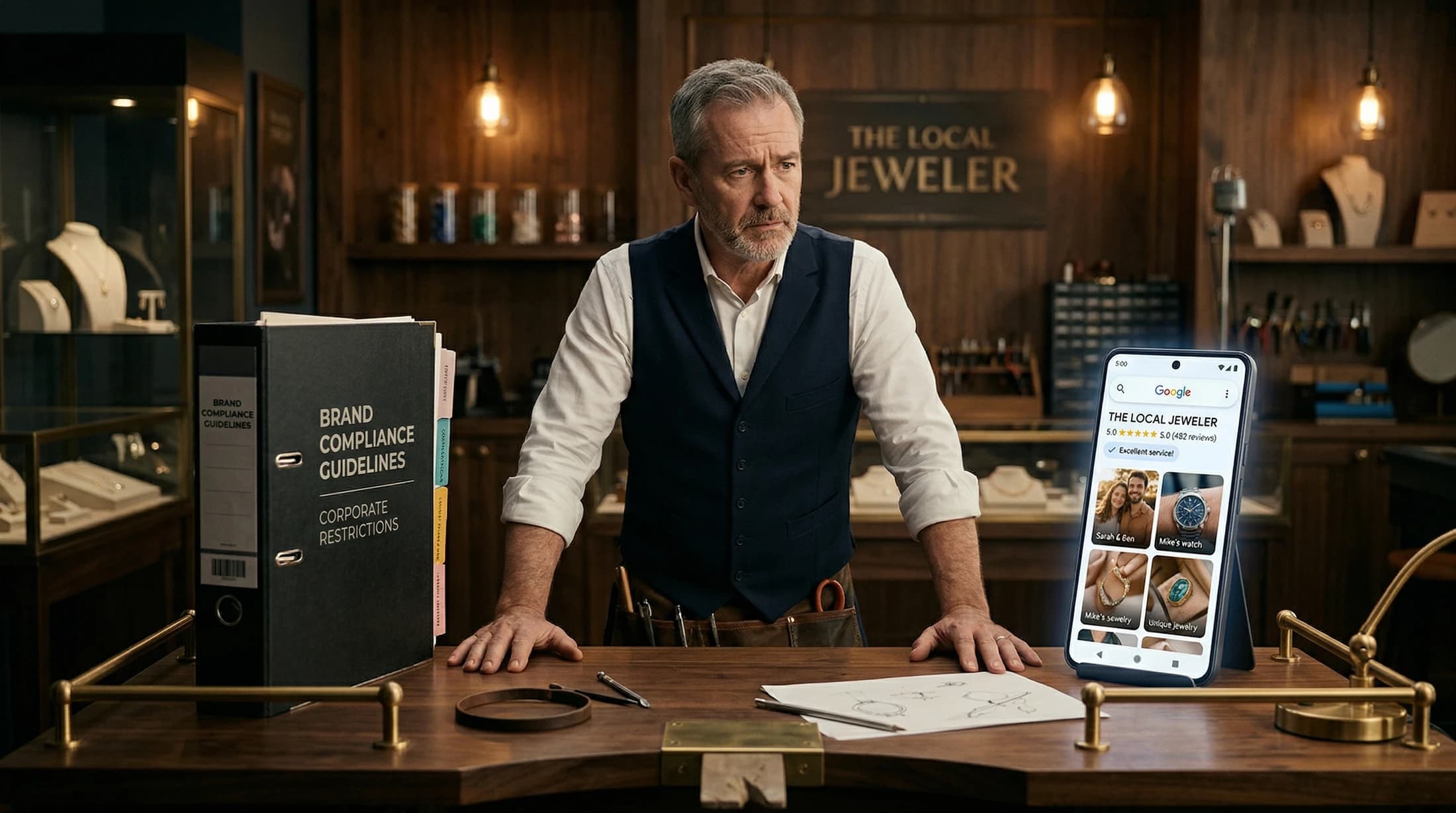
Certain brands require dealers to maintain a separate branded web presence, a dedicated domain or microsite for that brand's products. If you're running `smithjewelers.com` for your store AND maintaining a separate branded site for one of your watch brands, you now have two properties to manage, two domains to build authority on, and two places where a customer might land. Your marketing budget, your content effort, and your SEO equity are split across both.
The math is straightforward: every dollar and every hour you spend building someone else's domain is a dollar and an hour not spent building yours.
What Do You Actually Lose?
Your tracking and attribution
This is the most expensive loss. Most brand platforms and iframes limit what tracking you can install. If you can't put your own Meta Pixel, Google Ads conversion tracking, or server-side analytics on the pages where your products live, you can't measure what's working. You might be spending $5,000 a month on ads driving traffic to pages where you have zero visibility into what happens next.
Your differentiation
Luxury retail is built on the story of the store, the founder, the history, the expertise of the staff. A cookie-cutter website strips that away. If a buyer visits your site and the dealer across town and sees the same layout, the same product descriptions, and the same imagery, the only differentiator left is price. And in luxury, competing on price is a race to the bottom.
Your customer data
When a visitor browses products on a brand-controlled platform, who owns that data? Can you retarget them? Can you add them to your email list? Can you see which products they viewed? In many cases, the answer is no. The brand or the platform provider has more visibility into your traffic than you do.
What Does Ownership Actually Look Like?
Your own website on your own domain, built on a platform you control (Shopify, WordPress, or a headless CMS like Next.js), where:
- Every page builds YOUR domain authority. Blog posts, brand pages, service pages, review pages, all of it strengthens your URL, not someone else's.
- You control the conversion path. You decide what the CTA says, where the phone number goes, whether to use a Lead Bridge or a booking tool. You can test and iterate without asking permission.
- You own the pixel data. Every visitor is trackable. Every ad click is attributable. Every email capture belongs to you. (See our SEO Strategy for Jewelry & Watch Retailers for the technical details.)
- Your site survives brand changes. If you stop carrying a brand, your website doesn't disappear. Your blog posts still rank. Your reviews still count. Your domain authority stays intact.
According to Fortune Business Insights, 81.4% of luxury revenue still comes from in-store sales. Your website's only job is to generate the visit. To do that, it needs to be as distinctive as your showroom. A site that looks like every other dealer's does not accomplish that.
The Hybrid Reality
We're not saying to ignore the brand entirely. If a brand requires you to use their product data, their imagery, or their iframe, you work within those constraints. But your primary digital presence, the site you drive ad traffic to, the site you build blog content on, the site that captures emails and tracks conversions, should be yours.
Think of it this way:
- Your site is the hub. Your domain, your story, your team, your expertise, your local authority.
- Brand content is the spoke. It lives on your site in a format you control. If the brand provides an iframe, you surround it with your own original content (your descriptions, your photography, your expert opinion) so Google has something to index.
- Branded microsites are a supplement, not a replacement. If a brand requires a separate web presence, maintain it for compliance, but never let it be where you send your marketing dollars.
Your marketing effort should build equity on the property you own. If you're spending time and money making someone else's domain stronger, you're subsidizing their business at the expense of yours.
Not sure what you own vs. what the brand or your agency controls? We'll audit your setup and show you exactly where your effort is going. Let's take a look.
Research & Sources
- Think with Google: Local Search Statistics, 46% of all Google searches have local intent; 76% of local mobile searches result in a physical store visit within 24 hours.
- Bain & Company: Luxury Market Study 2024, 78% of luxury consumers research online before purchasing; 84% take action after engaging with interactive digital catalogs.
- BrightLocal: Local Consumer Review Survey 2026, AI tool usage for local recommendations surged from 6% to 45% in a single year.
*Part of the Luxury Retail Marketing Playbook.*

About the author
Hagop Imasdounian
Hagop Imasdounian is the founder of H&CO. Raised around his family’s jewelry businesses, he brings more than 15 years of digital marketing experience to helping jewelry and watch brands improve their websites, reach buyers and connect marketing with sales.