
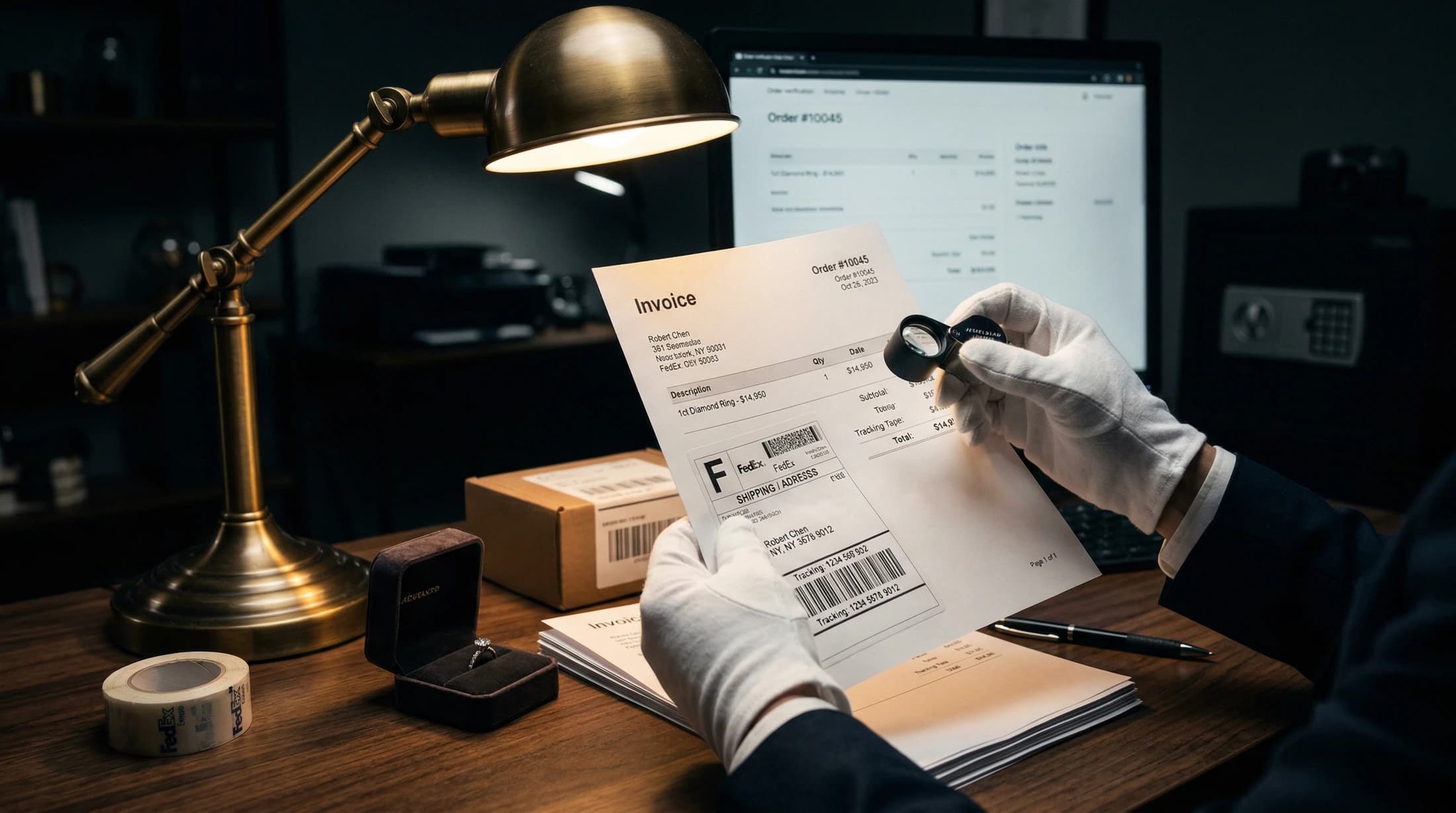
Most jewelry marketing advice focuses on how to get the click. At H&CO, we focus on what happens after the click, because if you're selling $30,000 engagement rings or $50,000 Patek Philippes online, a single "successful" marketing campaign that attracts a professional fraudster can wipe out your entire quarter's profit in one shipment.
Luxury jewelry is a unique target. Unlike consumer electronics or apparel, jewelry is small, high-value, virtually untraceable once it hits the secondary market, and holds its value remarkably well. While 81.4% of luxury sales still happen in physical stores, the shift to digital is accelerating. For the independent jeweler or authorized dealer, this is a double-edged sword: you have access to a global market, but you are also visible to global fraud syndicates who treat your checkout page like a high-stakes ATM (Euromonitor International, 2025).
If you want to scale your digital presence safely, you need to move beyond standard SSL certificates and basic "PCI compliance." You need a High-Ticket Fraud Shield.
What Makes Luxury Jewelry a Target for "Professional" Fraud?
We aren't talking about a kid using his parent's credit card. We are talking about professional fraud syndicates that use synthetic identities, sophisticated IP masking, and stolen credentials harvested from the dark web.
- Global Fraud 2025 ($B)48
- Projected 2030 ($B)131
- North America Share (%)42
- True Cost per $100 ($)207
The "so what" is simple: Revenue protection. Global eCommerce fraud is projected to hit $56 billion in 2025 and $131 billion by 2030, with North America accounting for a massive 42% of that global value.
In our 2026 Luxury Retail Marketing Playbook, we discuss how trust is the primary currency in this industry. If your site is perceived as "easy" by fraudsters, it's only a matter of time before you're targeted systematically. Recent data shows that Account Takeover (ATO) attempts are up 300% year-over-year in luxury sectors, as criminals target existing customer accounts to bypass initial trust filters.
The "Too Easy" Buyer: Warning Signs of a Professional Hit
Real luxury buyers are notoriously difficult. In H&CO client data they spend 20 days researching a high-end watch and 22 days a custom piece. A legitimate buyer will ask about the GIA certificate, request additional macro-video of the stone, check your return policy three times, and likely call the store to "feel out" the person on the other end.
A professional fraudster does the opposite. They are the "too easy" buyer.
- The Speed Demon: They want it shipped overnight, yesterday. They don't care about the price; they care about the transit time.
- The Mismatched Identity: The shipping address is a freight forwarder in Delaware, but the billing address is a residential home in Oregon. Or worse, the IP address is domestic, but the billing card is international.
- The "Test and Burn": You see three declined attempts with different cards followed by a "success." This is a fraudster cycling through a "fullz" (a complete set of stolen identity data) until one sticks.
- The Disposable Digital Footprint: An email address like `j.smith129384@gmail.com` created 48 hours ago is a massive red flag. Real $30k buyers use established professional or personal accounts they've had for years.
Building the Shield: A Multi-Layered Defense
You cannot rely on a single tool. You need a stack that filters out the noise without adding so much friction that your legitimate clients, who are already navigating a complex long purchase journey, abandon their carts.
1. Manual Review Thresholds
If you are an authorized dealer selling timepieces, one of those rules is: Every order over $5,000 gets a human eyes-on review.
Check the social footprint. Does the buyer have a LinkedIn? A professional bio? Does the "ship to" address look like a place where a $20,000 buyer lives? If you see a $15,000 order going to a $1,200-a-month apartment complex, pick up the phone.
2. The Phone Call Verification
This is the ultimate fraud-killer. A fraudster using a stolen identity will rarely answer a phone call or respond to a personalized text asking to "verify the shipment details for insurance purposes." A real buyer, however, appreciates the extra layer of security. If they are about to receive a $40,000 item, they *want* to know you are taking it seriously.
3. Advanced Tooling (Beyond the Basics)
Standard Shopify or WooCommerce fraud filters are insufficient for high-ticket items. You need enterprise-grade scoring like Signifyd, Kount, or Riskified. These platforms offer "Chargeback Protection," meaning they take the liability for the fraud if they approve the order. For a 1-2% fee, you can effectively insure your digital revenue.
4. AVS and CVV Strictness
Never, under any circumstances, ship a high-value item where the Address Verification Service (AVS) returns anything other than a "Full Match." If the zip code is off by one digit, the order stays in the warehouse.
Why Fraud Prevention is a Growth Strategy
The worry is that strict fraud prevention will "scare away" buyers. The data suggests the opposite.
When you clearly communicate your verification process on your "Shipping & Security" page, you are signaling Trust. In an era of AI-generated deepfake websites and fly-by-night "gray market" dealers, showing that you have a rigorous verification process actually increases your conversion rate for the most desirable clients.
This is a core part of your SEO strategy. Google's E-E-A-T (Experience, Expertise, Authoritativeness, and Trustworthiness) guidelines prioritize sites that demonstrate they are legitimate, secure businesses. A well-documented security protocol tells search engines and AI search bots that you are a low-risk, high-authority destination for luxury shoppers.
Your fraud prevention page also feeds directly into how AI search engines recommend retailers. When Perplexity or ChatGPT fields a query like "most trusted online jeweler for high-value purchases," sites with documented security protocols earn the citation.
Capturing the Revenue Gap
There is a first-time revenue gap, revenue that is often lost because of "false positives" in fraud detection or poorly tracked multi-touch journeys. Digital marketing revenue attribution is the discipline that makes this visible, and it starts with clean data on both sides of the transaction.
When your fraud shield is too "dumb," it blocks legitimate buyers who happen to be traveling or using a VPN. A sophisticated system allows those buyers through while catching the $30k thief. By refining this process, you reclaim the revenue that your "standard" security was accidentally blocking.
See our guide to Cyber Security for Jewelers for the full security stack every jewelry and watch retailer needs to protect both their revenue and their clients' data.
Selling high-ticket pieces online is about infrastructure. You are a target because your product is the ultimate liquid asset. If you don't have a system that spots a professional fraudster before that Fedex label is printed, you are running a charity for criminals with an ecommerce store attached.
Build the shield. Protect the revenue. Own the market.
"Selling high-ticket pieces online requires infrastructure that protects both you and your clients. We'll build the checkout and verification system that stops fraud without stopping sales. Let's talk."
Research & Sources
- Juniper Research: *eCommerce Fraud: Market Forecasts, Emerging Threats & Segment Analysis 2024-2030.* Projected global fraud value of $131B by 2030.
- LexisNexis: *The True Cost of Fraud Report.* Data on the full cost of fraud beyond the direct loss.
- Sift: *2024 Digital Trust & Safety Index.* Reports a 300% YoY increase in Account Takeover (ATO) attacks within the luxury and high-ticket sectors.
- Fortune Business Insights: *Luxury Goods Market Analysis.* Benchmark for the 81.4% in-store sales metric.
Hagop's Notes
Fraud is the "hidden tax" on success. I've seen jewelers lose $50k in a weekend because they were so excited about a "big win" that they ignored the fact that the IP was from a known proxy and the billing address didn't match. Don't be that guy. Marketing gets them there; security keeps the money in your bank account.
About the author
Hagop Imasdounian
Hagop Imasdounian is the founder of H&CO. Raised around his family’s jewelry businesses, he brings more than 15 years of digital marketing experience to helping jewelry and watch brands improve their websites, reach buyers and connect marketing with sales.