
What Is the Attribution Gap in Luxury Retail?
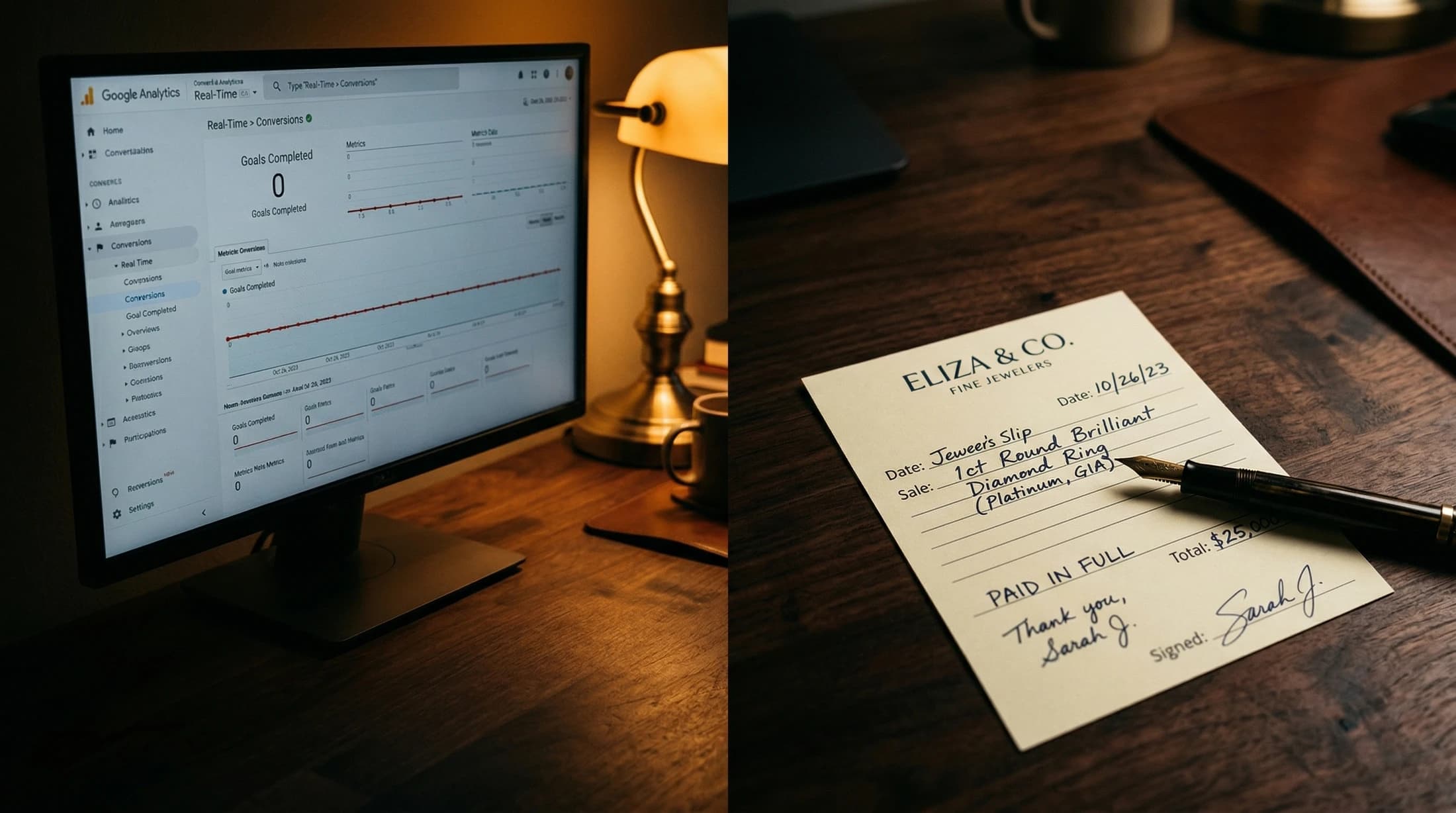
The attribution gap is the disconnect between when a customer first interacts with your marketing and when they actually buy. In luxury retail, that gap is wide enough to make your entire ad budget look like a waste, even when it's working. This complexity is driven by the fact that high-ticket luxury acquisitions now require a minimum of 8+ digital and physical touchpoints, with 78% of consumers conducting deep online research before ever making a move.
H&CO is a digital marketing agency for luxury jewelry and watch retailers. You look at your Google Ads or Meta dashboard and see a 2x or 3x Return on Ad Spend (ROAS). They feel like they are burning money. Their agency tells them to "be patient," but the numbers don't lie.
Except, in luxury retail, the numbers *do* lie.
In H&CO client data, the time between a customer's first website visit and their in-store purchase is 20 days for watches and 22 days for custom jewelry.
Even more significant: 70% of all luxury customers take longer than 14 days to move from research to purchase (H&CO client data).
If you are relying on standard browser-based pixels (like the basic Meta Pixel or Google Analytics), you are currently blind to the majority of your business. Here is why.
How Does Safari's Tracking Prevention Create a Blind Spot?
In a world obsessed with privacy, browsers like Safari (which accounts for over half of all mobile traffic in the US) have implemented Intelligent Tracking Prevention (ITP).
Safari has blocked all third-party cookies entirely since 2020. On top of that, ITP caps first-party script-writable storage (LocalStorage, document.cookie set via JavaScript, IndexedDB) to 7 days when there's been no user interaction with your site. If a tracking script writes a cookie and the user doesn't come back within a week, that identifier is gone. The practical effect for jewelry and watch retailers is devastating.
The Math of the Blind Spot:
- Day 1: A customer clicks your Instagram ad and browses $15,000 engagement rings.
- Day 8: The customer returns to your site to show their partner. Safari has already purged the script-written identifier.
- Day 20 (Average): The customer walks into your store and buys the ring.
To Meta and Google, that customer is a "New, Direct Visitor." The original ad click that started the entire journey is nowhere to be found. Because 70% of your customers take longer than 14 days to buy, standard tracking is systematically deleting the "proof" that your marketing works (H&CO client data).
How Much Revenue Disappears from Your Dashboard?
A large share of first-time purchase revenue is never captured by standard marketing dashboards.
These are the "Silent Buyers." They are the most profitable customers you have, people who did the work, did the research, and came in ready to spend five figures, yet your agency is likely telling you to turn off the very ads that brought them in because the "last-click" data looks poor.
Without server-side attribution and CRM integration, you are optimizing your budget based on the 30% of people who buy quickly (often lower-value fashion jewelry) rather than the 70% who take their time (high-value bridal and watches).
How Do You Bridge the 14-Day Gap?
To see the full 20-day (or longer) journey, you have to move your tracking off the user's browser and onto your own server. Standard analytics tools weren't designed for this. That's why we built H and Co Felix.
What Is H and Co Felix?
H and Co Felix is online-to-offline attribution software we built specifically to solve this problem for jewelry and watch retailers. It is infrastructure that integrates directly with your existing tech stack: your POS system, your CRM, your Google Ads account, your Meta Ads account, and your server-side tracking.
Here's what it does:
Extends your tracking window beyond Safari's limits. Server-side first-party cookies aren't subject to the same 7-day cap that ITP imposes on script-written storage. Felix extends your attribution window to 90 days, which covers the full buying cycle for watches and custom jewelry.
Matches in-store purchases back to the original ad click. When a customer buys in-store and gives their email at the point of sale, Felix matches that email against the ad interaction that first brought them to your website, even if that click was 20 or 30 days ago. The sale that looked "unattributed" in your dashboard now has a clear source.
Deduplicates revenue across Google and Meta. Without deduplication, both platforms claim credit for the same sale. If a customer clicked a Google Ad on Day 1 and a Meta Ad on Day 10, your ROAS numbers are inflated by 30-50%. Felix assigns the revenue once, to the right interaction, so your budget decisions are based on real numbers.
Integrates with your POS, not just your website. Most attribution tools stop at the website conversion (a form fill or a phone call). Felix goes further by connecting to your point-of-sale system so you can see the full path: ad click, website visit, phone call, store visit, register transaction. That's the chain that luxury retail runs on, and it's the chain that standard tools break.
Every H&CO engagement includes Felix as part of the infrastructure. It is how we prove your marketing is working.
What Changes When You Can See the Full Journey?
When you fix the blind spot, the conversation with your marketing partner changes completely. Instead of "how many clicks did we get this month," you're looking at "which campaigns produced the $45,000 sale on Saturday." Instead of cutting budget on ads that look like they're underperforming, you're doubling down on the channels that are actually driving five-figure transactions.
The revenue that was invisible becomes visible. The budget decisions that were based on guesswork become based on data. And the agency that was telling you to "be patient" can finally show you exactly what your patience produced.
If your average buyer takes 20 days to decide and your tracking only lasts 7 days, you're seeing a third of the truth. The other two-thirds is where the real revenue lives.
Learn more about how Felix works at hcoapp.com.
Research & Sources
- Bain & Company: Luxury Market Study 2024, 78% of luxury consumers research online before purchasing; 84% take action after engaging with interactive digital catalogs.
- Think with Google: Local Search Statistics, 46% of all Google searches have local intent; 76% of local mobile searches result in a physical store visit within 24 hours.
- BrightLocal: Local Consumer Review Survey 2026, AI tool usage for local recommendations surged from 6% to 45% in a single year.
*Related reading: Luxury Retail Marketing Playbook · Paid Advertising for Jewelry & Watch Retailers · Brand Compliance vs. Local SEO · The Iframe Trap*

About the author
Hagop Imasdounian
Hagop Imasdounian is the founder of H&CO. Raised around his family’s jewelry businesses, he brings more than 15 years of digital marketing experience to helping jewelry and watch brands improve their websites, reach buyers and connect marketing with sales.