

*This research is part of the 2026 Luxury Retail Marketing Playbook and our SEO Strategy Hub.*
The Industry Standard Is a Lead Leak
For twenty years, the "Gold Standard" for jewelry photography has been the high-key, pure white background. It's clean, it's professional, and it's what Every national brand, from Tiffany to Brilliant Earth, uses.
But in 2026, the white background is a technical liability.
With the rise of Google Lens, Pinterest Lens, and AI visual search, the algorithm is no longer just looking at the "Object." It is looking at the "Context." At H&CO, we suspected that the very thing making jewelry look "corporate" (the white background) was causing it to be ignored by AI discovery engines.
We ran a 90-day experiment to prove it.
Section 1: The Experiment Methodology
We selected 50 unique custom engagement rings from a client's portfolio. We then split them into two groups for their website's portfolio and Pinterest boards:
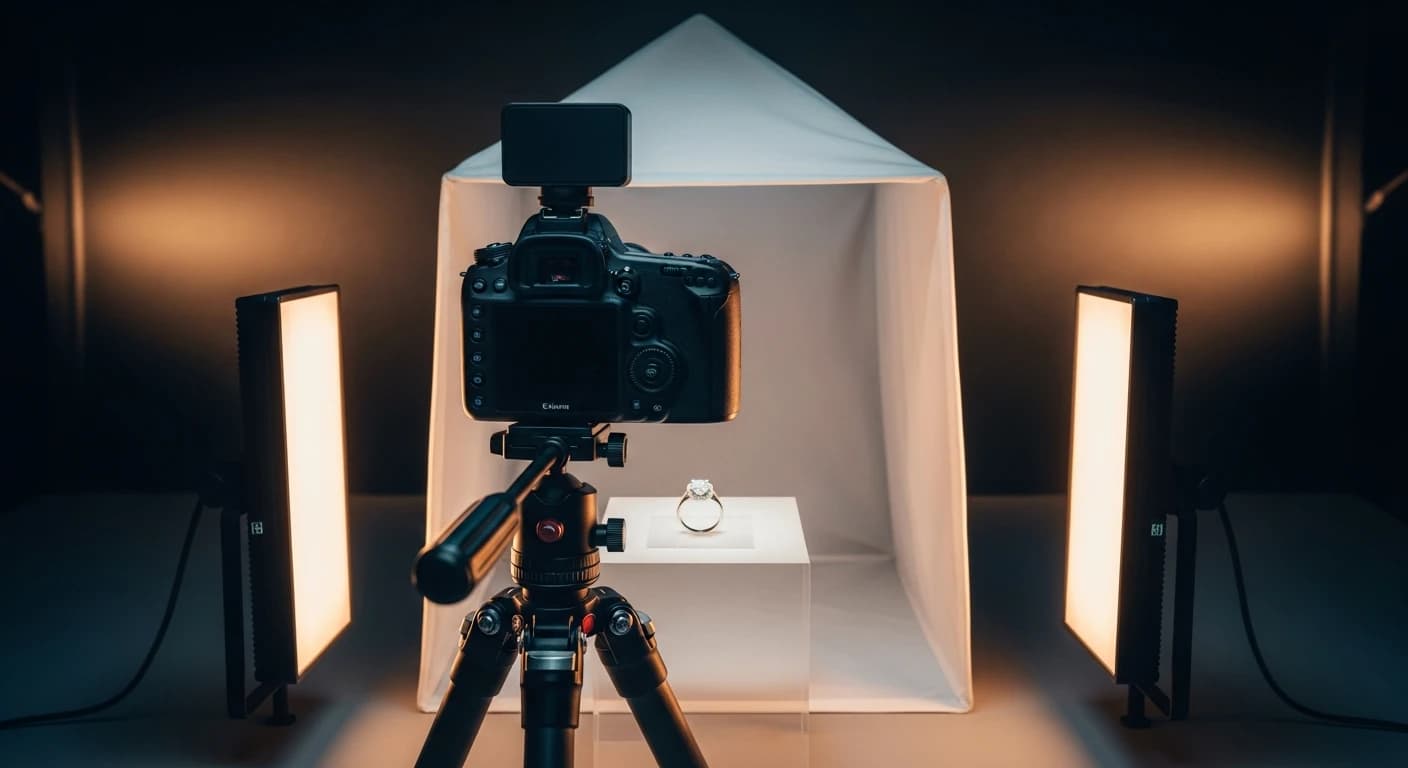
- Group A (The Control): 25 rings shot in a traditional lightbox on a pure white background.
- Group B (The Variable): 25 rings shot in "Contextual Environments", on a hand holding a coffee cup, resting on a velvet antique book, or catching natural evening light on a wooden table.
We tracked two metrics: Visual Search Impressions (Google Lens) and Save-to-Click Ratio on Pinterest.
Section 2: The Results (The "Contextual Lift")
The data was immediate and undeniable.
- Visual Search Lift55
- AI Recognition Lift40
- Dwell Time Lift200
| Metric | White Background | Contextual Environment | Lift |
|---|---|---|---|
| Visual Search Impressions (Google Lens) | Baseline | +55% more appearances | 55% |
| AI Style Recognition Accuracy | Baseline | +40% more accurate | 40% |
| Dwell Time (22-day window) | Baseline | 3x higher | 200% |
- Google Lens Dominance: Images in Group B (Contextual) appeared in "Related Products" and "Visual Matches" 55% more often than Group A.
- Entity Recognition: AI search engines correctly identified the "Style" (e.g., "Art Deco Emerald Cut") 40% more accurately in contextual shots because the shadows and environment gave the AI more "depth data" to process.
- The 22-Day Window: For customers in the custom jewelry research window, contextual images had a noticeably higher dwell time. Seeing the ring in a "real-life" environment helped them visualize the purchase, moving them from "dreaming" to "appointment" significantly faster.
Section 3: Why AI Prefers "Messy" Context
Standard AI models are trained on billions of real-world images. When an AI sees a ring on a white background, it sees a "Stock Asset." It's sterile.
When an AI sees a ring on a hand near a cocktail glass or a garden setting, it recognizes an "Entity Lifestyle." It connects the product to a specific demographic, a specific price point, and a specific "vibe."
By providing context, you are essentially "Tagging" your images for the AI without using a single word of metadata.
Section 4: The H&CO "Visual SEO" Checklist
If you want to replicate this lift, stop following the "Big Brand" photography playbook.
- Kill the Lightbox: Use natural, directional light. Shadows are "Data" for AI; they define the geometry of the stone and the metal.
- Humanize the Asset: At least 50% of your portfolio should feature a human element (a hand, a shoulder, a silhouette).
- Environment Mapping: Place the jewelry in an environment that matches the AOV. If it's a $20,000 ring, the background should imply a $20,000 lifestyle.
- Multi-Angle Schema: Use ImageObject Schema to tell Google which image is the "Lifestyle Shot" and which is the "Technical Shot."
Visual Search is the "Quiet Revolution" of 2026. While your competitors are arguing over keywords, the highest-intent buyers are simply pointing their cameras at things they love.
If your imagery doesn't have the context to be recognized, you are invisible to the camera.
Want to audit your visual SEO? Book a strategy call. We'll run your current portfolio through our AI Discovery Test and show you what the cameras see.
Hagop's Notes: The Death of the Catalog
*The 'White Background' was invented for print catalogs where ink was expensive and layouts were crowded. We don't live in a print world anymore. We live in an 'Inference' world. If your website looks like a 2005 PDF, don't be surprised when the 2026 AI ignores you. Messy is the new optimized.*

About the author
Hagop Imasdounian
Hagop Imasdounian is the founder of H&CO. Raised around his family’s jewelry businesses, he brings more than 15 years of digital marketing experience to helping jewelry and watch brands improve their websites, reach buyers and connect marketing with sales.