
You already know lab-grown changed your case. You feel it at the counter, in your margins, in the conversations with younger couples. What you may not have in front of you is the demand picture at the search level, broken out by what people actually type before they ever walk in or land on your site. That picture should be driving your inventory mix, your website, and your ad budget. The default is instinct instead.
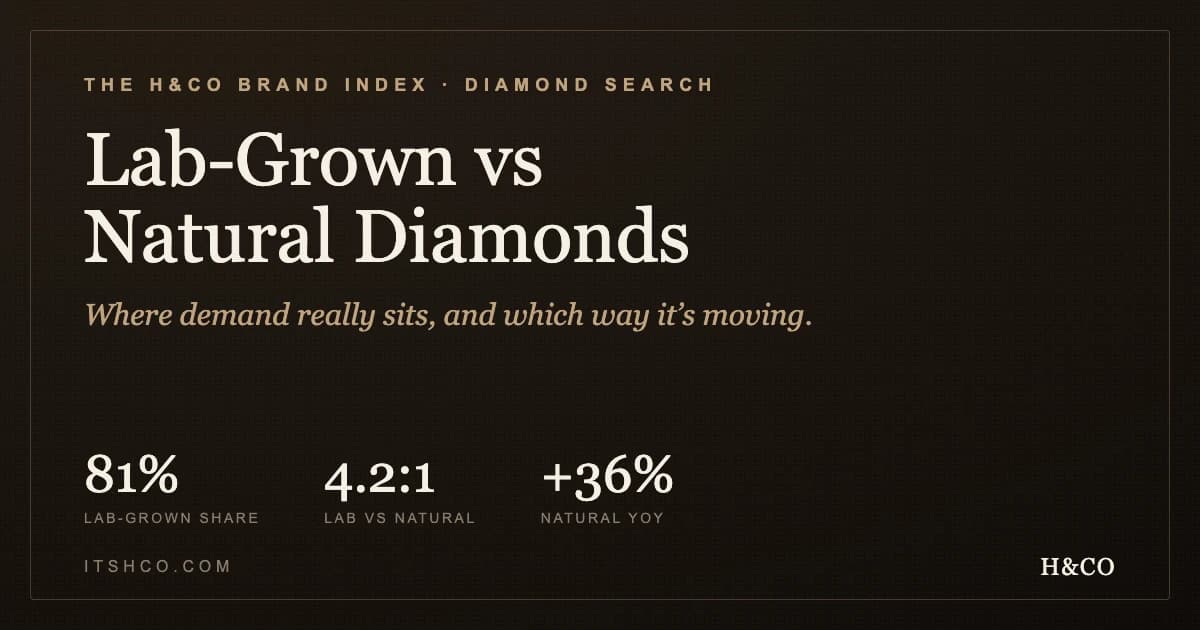
We pulled US branded search demand across roughly 18 diamond product-type queries per side, lab-grown and natural, through April 2026. The headline number is blunt. Lab-grown holds about 81% of total diamond search demand and outsearches natural roughly 4.2 to 1. Averaged out, lab-grown queries run near 404,000 a month against about 95,000 for natural. If your floor and your homepage still treat natural as the default and lab as the alternative, the search data says you have it backwards for most of what you sell.
But the single number hides the story that actually matters to you, which is where the demand sits by category.
- Lab-grown81%
- Natural19%
The split that should set your inventory mix
Demand is not uniform across the case. It splits along a line every jeweler will recognize: the everyday piece versus the milestone piece.
On the everyday end, lab-grown is close to total. Necklaces sit around 90% lab-grown search demand. Earrings are about 82%. These are the self-purchase and gifting categories, the pieces bought on shorter consideration and tighter budgets. The shopper has already decided lab-grown is fine here, and they decided it a while ago.
Then look at engagement. Lab-grown is only 64% of engagement ring demand, which is natural's single strongest category in the entire study. Wedding bands and solitaires hold more natural demand than the everyday pieces do as well. The pattern is clean. The everyday has gone lab-grown. The milestone purchase, the one with the most emotion and the most money attached, still leans natural more than anything else you carry.
That one contrast should change how you buy. A store that stocks lab-grown deep across studs, tennis bracelets, and pendants, then keeps a serious natural presence in the engagement case, is stocking to demand. A store that picks one side of the lab-versus-natural question and applies it to the whole case is fighting the market in half its categories.
- Necklaces90
- Bracelets88
- Earrings82
- Diamond rings77
- Wedding bands72
- Engagement rings64
Review the product-type comparison above →
These two slices highlight the difference between engagement rings and everyday jewelry. Review the product-type comparison above. Compare the categories you actually merchandise before you write your next buy.
Momentum changes the bet
A snapshot tells you where demand is. The trend tells you where it's going, and the trend complicates the easy read.
Natural diamond search is growing +36% year over year. Lab-grown is growing +10%. Lab's share of total demand has slipped from about 84% to 80% over the trailing year. Lab still owns the volume by a wide margin, no question. But natural is gaining momentum off a smaller base, and the share gap is narrowing rather than widening.
For a retailer, that kills two lazy conclusions at once. The first is that lab-grown has won and natural is a legacy line to wind down. The second is that the current split is permanent. Neither holds. The smart position is to merchandise to today's volume while keeping enough natural depth and natural-focused content to ride a category that's accelerating. Don't liquidate your natural story. The search trend says it's coming back into the conversation.
What this changes in your marketing
The demand split has direct consequences for the three things we work on with jewelry retailers every day.
Inventory and merchandising. Buy and display by category, not by a house bet. Lab-grown should anchor the everyday case where it owns 80 to 90% of demand. Natural deserves real presence in engagement, where the majority of considered shoppers still want it.
Website and SEO. Your collection pages and product copy should match where demand actually lives. If your site funnels everyone toward natural by default, you're misaligned with the searches that bring traffic. Lab-grown everyday pieces need their own optimized pages and their own content, because that's where the search volume is. Natural engagement content still earns its rankings, because that demand is real and growing.
Paid ads. Bid where intent and margin meet. Lab-grown everyday categories have the volume for efficient, high-frequency campaigns. Natural engagement is a higher-consideration, higher-ticket search with rising demand, which means it can carry a different bid strategy and a different creative angle. Pointing one undifferentiated budget at "diamonds" leaves both sides underserved.
The retailers who win the next two years won't be the ones who guessed right on lab versus natural. They'll be the ones who read the demand by category and built their store, their site, and their ad spend around it.
Review the data, then build your plan
The two slices above are the setup. The product-type comparison above breaks out lab-grown search share across six product types, so you can compare the categories you stock. The momentum section explains how the search trends differ.
Once you've seen your categories, the harder question is what to do about it. That's the work we do. We connect this kind of demand data to inventory, site structure, and ad spend for independent jewelry and watch retailers, then tie it to revenue you can actually see, online sales and store visits both.
If you want a read on where your store sits against this demand and where your budget is leaking, book a call with a strategist. Bring your categories. We'll show you where the market is moving and what to do before your next buy.

About the author
Hagop Imasdounian
Hagop Imasdounian is the founder of H&CO. Raised around his family’s jewelry businesses, he brings more than 15 years of digital marketing experience to helping jewelry and watch brands improve their websites, reach buyers and connect marketing with sales.