
The modern bridal jewelry shopper doesn't walk into a store with a checkbook; they walk in with a Pinterest board and 22 days of digital exhaustion. H&CO client data shows a 22-day research window for custom jewelry before a lead even considers booking a consultation. During those three weeks, they are looking for a guide as much as for a ring. If your website is just a static gallery, you aren't guiding; you're just another tab in their browser. A clean first interaction is critical, as 32% of luxury consumers will abandon a brand after just one negative experience. The quiz ensures that first touch is helpful, not frustrating.
At H&CO, we see independent jewelers across the US and Canada making the same mistake: they treat their website as a catalog rather than a conversion engine. To bridge that research gap, you need a mechanism that captures intent early. Enter the Style DNA Quiz.
Why Are Quizzes the Best Lead Magnet for Jewelers?
A downloadable PDF guide, the "5 Things to Know Before Buying a Diamond", is dead. It converts at a dismal 1-3%. Why? Because it asks the client to do more work (Subpage.co, 2026).
- PDF Guide2
- Quiz (Low)10
- Quiz (High)30
An interactive quiz, however, converts at 10-30%. The psychology is simple: a quiz gives the client something they crave (a personalized recommendation and a sense of "finding" their style) in exchange for something you need (their email address and their specific aesthetic preferences). It's not a transaction; it's the start of a relationship.
When you implement an interactive quiz, you're moving away from "hope-based marketing" and toward data-driven acquisition. You stop wondering what your traffic wants and start knowing exactly what they're looking for before you ever hop on a Zoom call.
The 22-Day Black Hole: Bridging the Consideration Gap
During that research window, your potential client is being bombarded by Meta ads from Blue Nile, Brilliant Earth, and every local competitor. If you don't capture their information on day one or two, you are relying on their memory to bring them back on day 21.
A Style DNA quiz is a "micro-conversion." It allows the shopper to engage with your brand without the high-friction commitment of a "Book a Consultation" button. Once they take the quiz, they are on your list. You can now use digital marketing revenue attribution to track exactly how that initial quiz engagement leads to a $20,000 custom commission three months later.
What Kind of Quiz Works for a Custom Jeweler?
The quiz must reflect your brand's specific expertise. Don't go broad; go deep into your niche.
- "What's Your Engagement Ring Style?", 8-10 visual questions about aesthetic preferences, lifestyle, and personality that recommend a ring style (vintage, modern, nature-inspired, minimalist).
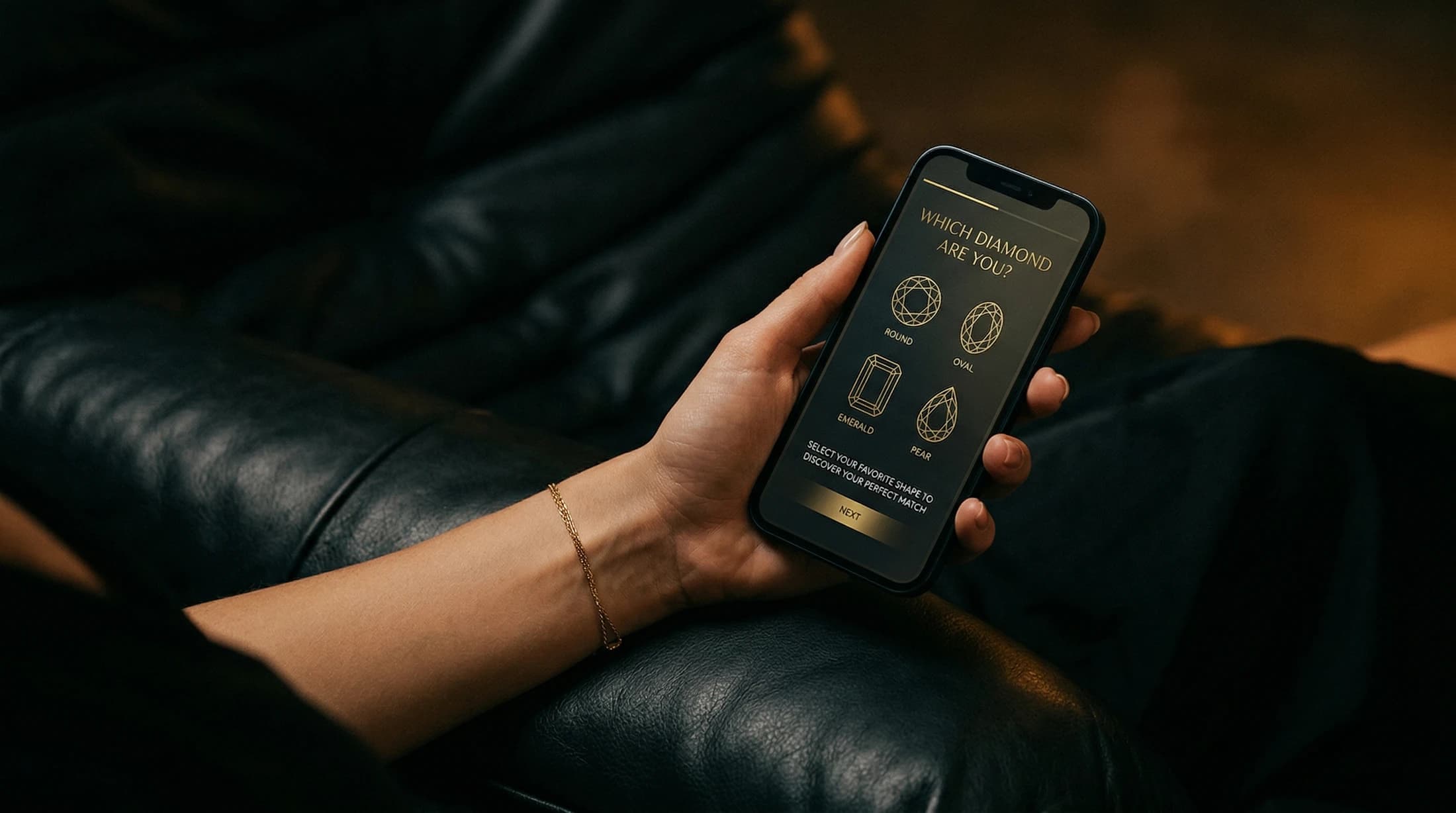
- "Which Diamond Shape Matches Your Hand?", A utility-based quiz that helps the buyer decide between an oval, emerald, or pear cut based on their finger shape and style preferences.
- "The Custom Design Readiness Quiz", Helps the buyer decide if they actually want a full custom design or if a semi-custom mounting is a better fit for their timeline and budget.
The output must be specific. Don't just say "You like modern rings." Say, "You are a Modern Architecturalist," show three portfolio pieces that match, and offer a specific "Designer's Insight" on why that style fits their quiz answers.
Zero-Party Data: The Gold Mine You're Ignoring
Beyond the email address, a quiz captures "Zero-Party Data", data that the customer intentionally and proactively shares with you. This is far more profitable than the "First-Party Data" (like site behavior) that you get from your SEO strategy.
A well-constructed quiz tells you:
- Aesthetic DNA: Do they hate halos? Are they obsessed with yellow gold?
- Budget Signals: Questions about "what matters most" (size vs. quality vs. uniqueness) provide a budget range without the awkwardness of a direct "how much can you spend" question.
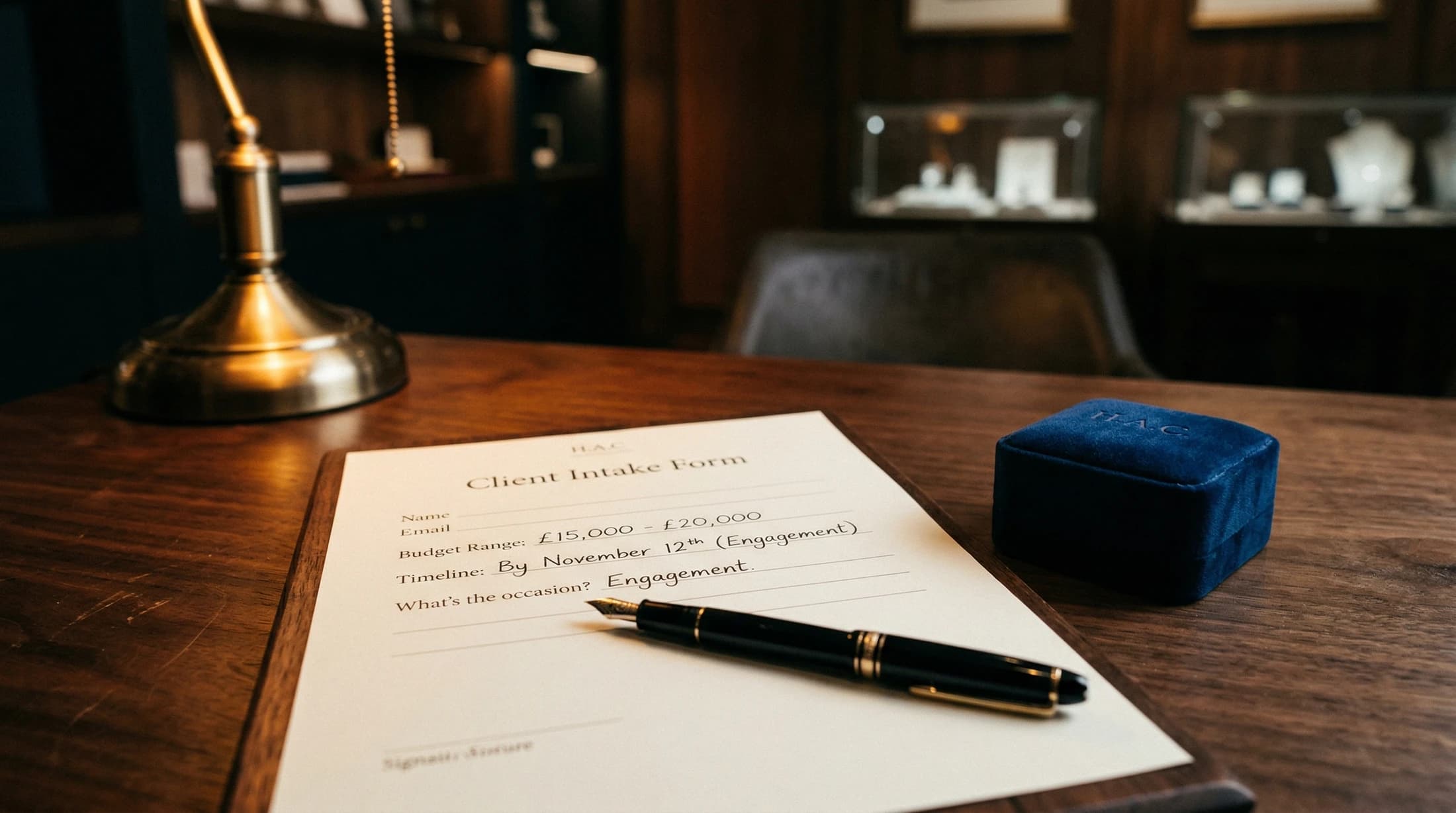
- Timeline Intent: Asking "When is the big moment?" tells your sales team whether this is a "hot lead" for this month or a "nurture lead" for next year.
- The Partner Factor: Are they shopping together, or is this a surprise? Your follow-up tone should change based on this answer.
Technical Execution: How to Build It
The Tools
- Typeform: Best for high-end aesthetic brands. It feels premium and integrates with almost everything.
- Interact: Built specifically for lead-gen quizzes. It has jewelry templates that you can customize.
- Outgrow: Best for advanced logic. If you want to calculate a "rough estimate" based on their stone choice, this is the tool.
The Structure
- 8-10 Visual Questions: Use images, not text. Show different setting heights, metal finishes, and stone shapes.
- The Value Proposition: Before the results, explain *why* they need to enter their email. "We'll send you a personalized style report and our 'Hidden Gem' guide for [Style Name] lovers."
- The Results Page: This is your sales pitch. It needs to include their style name, a brief psychological profile of that style, 3-4 high-res photos of your work, and a direct link to book a discovery call.
- The Automated Nurture: The quiz is useless without the follow-up. Set up a 5-email sequence that triggers the moment they finish.
ROI: The Math of Interactivity
Let's look at the numbers. If you spend $500/month on Meta ads pointing to a "Contact Us" page, you might get 5-10 leads. If you point that same $500 to a Style DNA Quiz, you could easily generate 50-100 leads.
Even if the "Contact Us" leads are higher intent, the volume of the quiz leads allows you to build a massive email list of people who are *actively* in their research window. Over a year, that is 1,200 potential clients who know your brand, have seen your work, and have told you exactly what they want to buy.
A quiz is the highest-converting page on your website that you haven't built yet. It turns "window shoppers" into "profiled leads." In an industry built on personal relationships, why wouldn't you want to know your customer's style DNA before you even say hello?
"We don't just build quizzes; we build pipelines. Let's create a lead magnet that actually works for your brand. Talk to H&CO."
Research & Sources
- NRF 2026 Forecast: *Total U.S. retail sales growth.* Prediction of $5.6 trillion and 4.4% expansion.
- PwC Consumer Intelligence Series: *Experience is Everything.* Documentation of the 32% luxury consumer abandonment rate after one bad interaction.
Hagop's Notes
*Quizzes are the ultimate bridge between "just looking" and "let's talk." If you're a custom jeweler, your biggest competition isn't other jewelers. It's the customer's own indecision. A quiz solves that indecision while putting you in the driver's seat of the conversation.*
About the author
Hagop Imasdounian
Hagop Imasdounian is the founder of H&CO. Raised around his family’s jewelry businesses, he brings more than 15 years of digital marketing experience to helping jewelry and watch brands improve their websites, reach buyers and connect marketing with sales.