
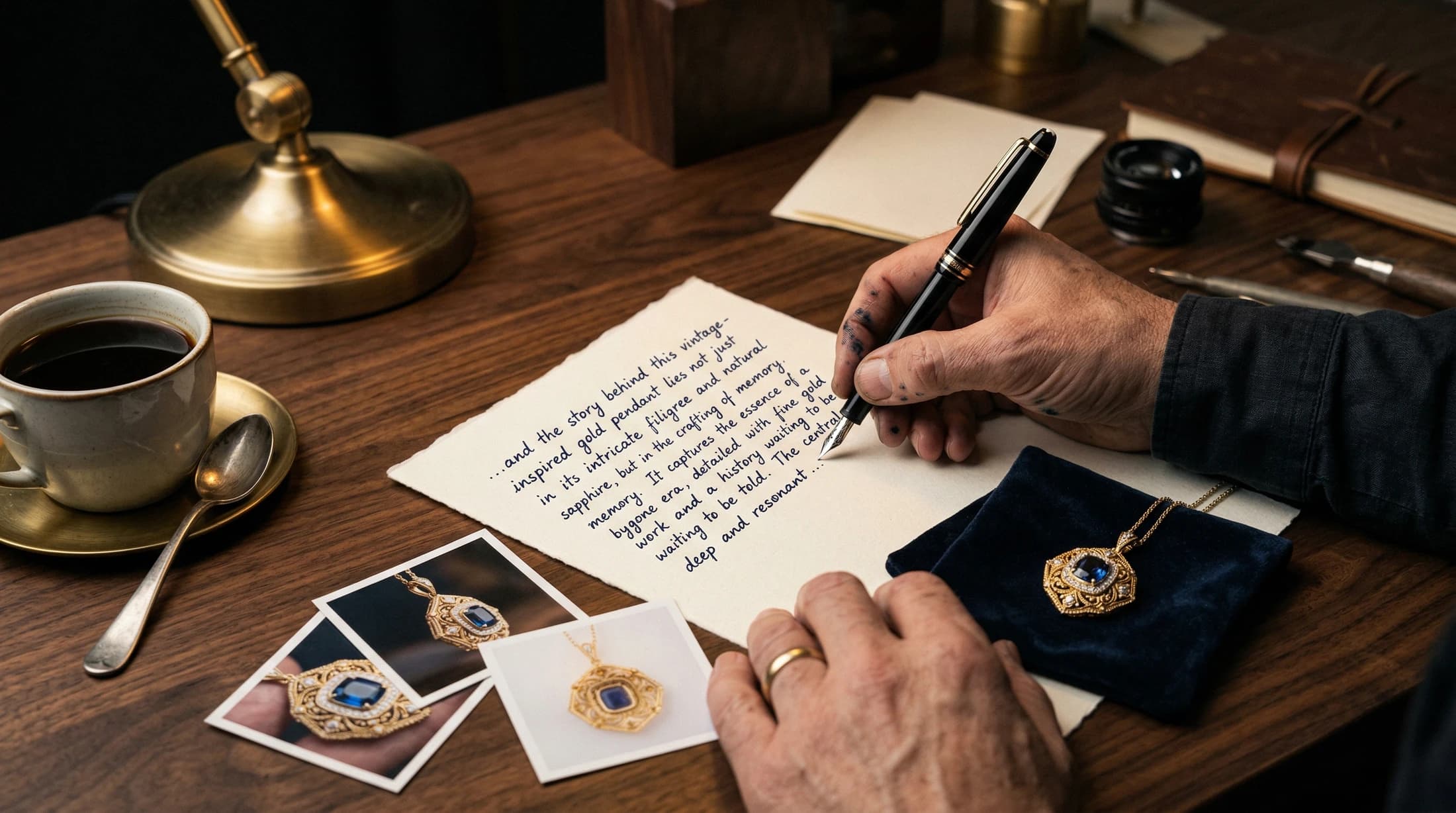
Most jewelry websites are ghost towns of technical specifications. They list the metal, the stone, the clarity, and the price, and then they wonder why their conversion rate is hovering at 0.5% (Skailama, 2026).
The hard truth? Your client isn't buying a "18K yellow gold solitaire with a 2.5ct oval diamond." They are buying the way she'll look when she sees it for the first time. They are buying the story they'll tell their grandkids. They are buying a legacy.
At H&CO, we see a massive opportunity for jewelers who move beyond the spec sheet. By injecting narrative into your product descriptions, you don't just increase sales. You increase your brand's SEO authority.
Why Do Spec Sheets Fail the Buyer?
A spec sheet is for an appraiser. A story is for a human. When a lead is in their research window, they are looking at dozens of rings that all look roughly the same on a screen. If your description is identical to your competitor's, "2ct Round Brilliant, Platinum Setting", then you have officially commoditized your craft.
When you commoditize, the only lever you have left is price. And in custom jewelry, competing on price is a race to the bottom. Storytelling allows you to compete on meaning, where there is no competition.
The Semantic Shift: How AI Search Changes Copywriting
In H&CO client data, high-quality, narrative-driven content earns a 45% AI citation lift.
AI search engines (like Perplexity or ChatGPT) don't just look for keywords; they look for *semantic meaning* and *contextual authority*. When you describe *why* you chose a cathedral setting for a specific stone, or *how* a certain band width balances a finger shape, you are providing the "reasoning" that AI search engines crave. This positions you as the expert, not just a vendor.
How to Write a Product Description That Actually Converts
To bridge that research gap, your copy must be both emotional and tactical. Here is the H&CO framework for a high-converting description:
1. The Intentional Lead
Start with the "why." Why was this piece created? What was the inspiration?
- Weak: "Custom oval ring in rose gold."
- Strong: "He wanted a ring that felt like an heirloom from day one. We chose a muted rose gold and a slightly thicker band to give this oval diamond a sense of permanence and history."
2. Sensory Language (The Digital Touch)
Since your client can't feel the piece through their iPhone, your words must do the work of their hands. Use sensory adjectives that describe weight, light, and texture.
- Visual: "The facets catch the morning light and throw it across the room."
- Tactile: "The inside of the band is comfort-fit, polished until it feels like silk against the skin."
- Structural: "This setting sits low enough to be worn every day, even for the woman who never takes her hands off her work."
3. Name Your Design Choices
Custom jewelers make hundreds of micro-decisions. Don't hide them. Naming your choices builds perceived value.
- "We chose a 1.8mm taper to make the center stone appear to float."
- "The hidden halo is our secret, a touch of brilliance that only the wearer sees from the side profile."
4. The Specs (The "Technical Footer")
Don't ignore the technicals. Put them at the bottom in a clean, bulleted list. This satisfies the "rational" brain and provides the data needed for digital marketing revenue attribution.
- Metal: 18K Yellow Gold
- Center Stone: 2.5ct Oval Diamond (GIA, F, VS1)
- Setting: Cathedral with hidden halo
Turning "Ready-to-Ship" into "One-of-a-Kind"
Even if you're selling a repeatable collection, you should still write as if it were a commission. Why did you design this specific piece? Who were you thinking of?
- "I designed the 'Solace' band for the woman who hates traditional jewelry but wants something for a milestone. It's bold, it's heavy, and it's unapologetic."
This single sentence transforms a generic product into a brand statement. It gives the buyer a "tribe" to belong to.
The SEO Bonus: Long-Tail Magic
Storytelling naturally incorporates the long-tail keywords that "spec-only" pages miss. When you write about "how to choose an oval diamond for a thin band" or "the benefits of a low-profile cathedral setting," you are capturing the high-intent search queries that drive your most qualified traffic.
You aren't just "writing copy"; you are building an SEO asset that works for you 24/7.
The Before and After
The "Standard" Description:
"14K white gold engagement ring with 1.5ct round diamond and 0.5ctw side stones. Size 6 available."
The H&CO Description:
"This ring is for the woman who wants her engagement to be a celebration. We paired a brilliant 1.5ct center stone with a 'tapered baguette' side-stone arrangement that draws the eye inward, making the center diamond feel even more substantial. The 14K white gold is polished to a mirror finish, ensuring that every angle of this piece catches the light. Whether she's at a gala or a grocery store, this ring is meant to be noticed."
Which one justifies a $12,000 price tag?
"Your jewelry is art. Don't describe it like it's hardware. We'll help you find the voice that turns your website into a storytelling machine. Let's talk."
Hagop's Notes
*If I see one more product description that says 'beautiful ring for a beautiful woman,' I'm going to lose it. Be specific. Be provocative. Tell me why this ring is better than the 5,000 others I just saw on Instagram. If you can't tell me why it's special, why should I buy it?*
Research & Sources
- NielsenIQ: *Consumer Sustainability Report.* Research on the 78% ethical sourcing priority and 24% higher loyalty for recycled metals.
- Statista: *Jewelry E-commerce Performance Benchmarks.* Data on the 1.19% industry average conversion rate.
- McKinsey & Company: *The Future of Luxury Copywriting.* Insights on semantic search and emotional brand positioning.
About the author
Hagop Imasdounian
Hagop Imasdounian is the founder of H&CO. Raised around his family’s jewelry businesses, he brings more than 15 years of digital marketing experience to helping jewelry and watch brands improve their websites, reach buyers and connect marketing with sales.